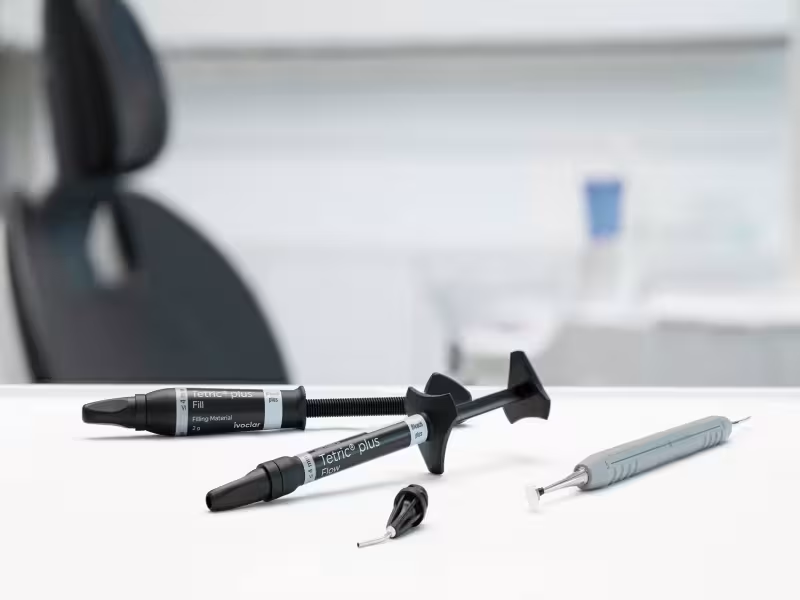
SHERIDAN, WYOMING -- June 7, 2026 -- Ivoclar has published clinical practice guidance for dental professionals working with the Tetric plus composite system, focusing on combined workflows involving Tetric plus Flow and Tetric plus Fill in anterior restorations. The guidance positions Tetric plus Flow as a single-material replacement for both Tetric EvoFlow and Tetric PowerFlow, built around its thixotropic properties — controlled, precise application alongside strong flow when required. Three tips address contouring support, surface imperfection repair and volume or transition adjustment in Class IV, Class V and direct veneer procedures. OptraSculpt Pad and OptraGloss are recommended as supporting instruments throughout.
Tetric plus Flow Consolidates Two Previous Products in One Thixotropic Formulation
Tetric plus Flow is the flowable component of the Tetric plus composite system, combining the application areas of Tetric EvoFlow and Tetric PowerFlow in a single material. Its thixotropic behaviour allows controlled, precise placement while delivering strong flow when clinical conditions require it. Using the correct cannula is specified as essential for easy placement. The formulation serves both as a primary restorative material in appropriate cases and as a complement to Tetric plus Fill across anterior and Class V workflows.
Tetric plus Flow Replaces Modelling Liquid for Contouring on Labial Surfaces
Dental professionals routinely use modelling liquid to prevent instruments from sticking to composite surfaces during contouring. Ivoclar's guidance identifies Tetric plus Flow as a functional replacement for this role. Applied as a small drop to the OptraSculpt Pad — which already carries non-stick properties — Tetric plus Flow assists in shaping and smoothing the labial surfaces of anterior teeth restored with Tetric plus Fill. The outcome is a smooth, aesthetic finish with precise transitions on the labial surface.
Flow Material Corrects Minor Surface Imperfections on Class IV Restorations and Direct Veneers
Surface imperfections can emerge after polishing on Class IV restorations or direct veneers on anterior teeth. Ivoclar's guidance sets out a targeted repair sequence: lightly roughen the affected area, clean the surface, apply etching and an adhesive, then use Tetric plus Flow in the matching shade directly on the imperfection. After re-polishing with OptraGloss, the repaired surface is described as nearly indistinguishable from the original Tetric plus Fill restoration. This result is possible because Tetric plus Flow exhibits very similar surface characteristics to Tetric plus Fill once cured.
Volume and Transition Adjustments in Class V, Diastema and Veneer Cases Call for Direct Application
Uneven transition lines and insufficient labio-palatal volume are common challenges in Class V defect restorations, diastema closures and anterior veneer layering with Tetric plus. Ivoclar's guidance recommends applying Tetric plus Flow directly in these situations to achieve the desired contours and volume. Both the OptraSculpt Pad and a composite brush are recommended for precise contouring. The approach applies across the full range of anterior cases where fine adjustment to volume distribution or surface transitions is needed after initial placement of Tetric plus Fill.
Combined Material Workflow Spans Modelling Through Final Polish in Anterior Restorations
Across the three scenarios, Tetric plus Flow functions as a versatile auxiliary tool throughout the Tetric plus workflow, rather than a material reserved for isolated tasks. Whether acting as a modelling aid on the OptraSculpt Pad, providing targeted post-polish repair or enabling fine volume and transition corrections, it addresses a continuous range of clinical situations encountered in anterior restoration practice. The comparable surface characteristics between the two materials after curing support consistent visual outcomes across all three application contexts.
Dental professionals can find further technical information and product details on the Tetric plus composite system at Ivoclar.