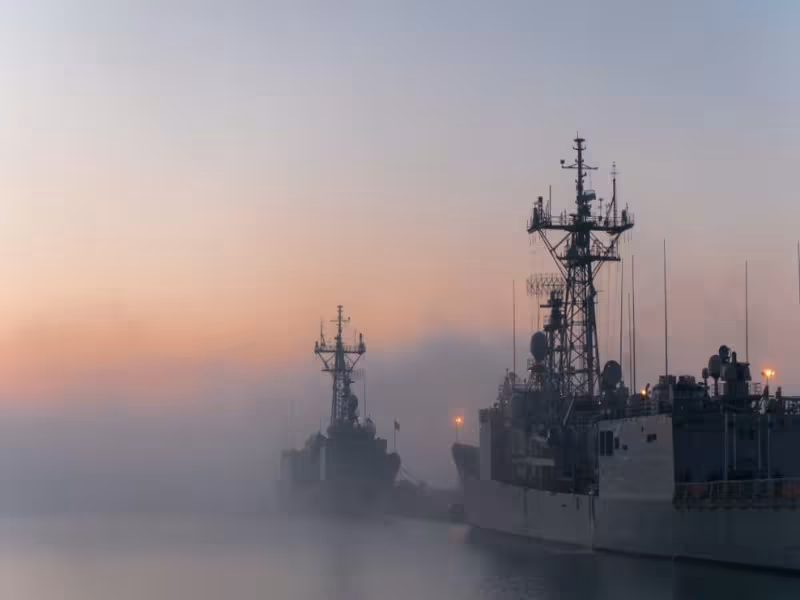
IRAN -- November 27, 2026 -- Iran's revenue from crude oil and condensate exports could fall to zero by mid-December, for the first time in the country's history, according to energy-intelligence firm Kpler. Hardline commentators and outlets close to the Islamic Revolutionary Guards Corps (IRGC) are now urging a declared tanker convoy to run the US naval blockade.
Kpler previously estimated the blockade costs Tehran between $200 million and $250 million a day in lost oil revenue. Acting Navy Secretary Hung Cao confirmed at a Senate hearing this week an independent estimate of about $32.5 million a day for the US. By our calculation, Iran's estimated daily loss is roughly six to eight times Washington's estimated daily cost.
Kpler data shows Iranian oil on the water fell from 88.8 million barrels to zero
Iranian oil at sea outside the blockade zone peaked at 88.8 million barrels on July 14, when the blockade was reimposed. By mid-October it had fallen to zero, as the last cargoes were discharged in China.
Another 43 million barrels remain stranded inside the blockade area. That is equivalent to about 48% of the July peak, and it is the stock Tehran can still try to deliver to buyers.
Kpler has identified about 20 tankers near Kharg Island, Iran's main export terminal. Most have loaded but stay stationary, apparently waiting for the blockade to lift. Only one tanker has been seen moving, according to Kpler senior commodity analyst Homayoun Falakshahi.
Fars column proposes a convoy and threatens Gulf neighbors' oil facilities
On November 19, the IRGC-affiliated Fars news agency published a column calling for a convoy of oil tankers. It warned that an attack on an Iranian tanker could prompt retaliation against oil facilities in Qatar, Saudi Arabia and the United Arab Emirates.
The same day, TankerTrackers.com posted on X that Iran appeared to be preparing to ship oil again. IRGC spokesman Hossein Mohebbi told a gathering in Tehran that Iran would not allow the continued blockade. Lawmaker Ebrahim Azizi, who chairs parliament's national security and foreign policy committee, said Iran cannot be blockaded. Commentator Ruhollah Jomei wrote of a decision to dispatch a tanker to China, the biggest buyer of Iranian oil.
Iranian forces already attempted attacks on US targets in Bahrain and Kuwait this week. No Iranian official body has announced a convoy plan.
Kpler's analyst says it is too early to call the moves a breakout
Falakshahi told RFE/RL's Radio Farda it is too early to say Iran has taken serious action to break the blockade. He said he would watch over the next few days whether more tankers move.
On November 17, Kpler detected an Iranian tanker transferring crude to a vessel typically used to carry Russian fuel oil. Falakshahi said a technical problem could explain the transfer. He noted Iran usually conducts ship-to-ship transfers near Malaysia or off Oman, not near Kharg Island.
Hamidreza Azizi of the International Crisis Group said that if the reports are true, Iran is seeking to actively challenge the blockade. He argued that a tanker getting through would damage the blockade's credibility. A US stop or strike, he said, would give Tehran a trigger for retaliation.
The blockade has run about 195 days and ties up over 30% of US warships
The US first blockaded Iranian ports on April 13, after talks in Islamabad collapsed. It lifted the blockade on June 18 under a memorandum of understanding signed the previous day, then reimposed it on July 14. Iranian ports have been blockaded about 195 days in total, including the last 129 without a break. By our calculation, the first blockade ran 66 days.
Bloomberg, which produced the daily cost figure cited by Senator Elizabeth Warren, has reported that the operation ties up more than 30% of the US Navy's warships. The Pentagon put the overall cost of the Iran war at $48.3 billion as of November 13, excluding damage to US bases in the region.