Medical Devices & Technology

Philips Wins FDA Clearance for Reusable SpO₂ Sensor Built to Hold Accuracy Across Skin Tones

Image
Philips Wins FDA Clearance for Reusable SpO₂ Sensor Built to Hold Accuracy Across Skin Tones

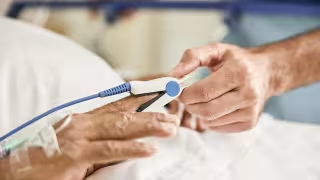
SHERIDAN, WYOMING -- July 22, 2026 -- Royal Philips has received FDA 510(k) clearance for its next-generation reusable SpO₂ clip sensor, a pulse oximetry device built around internal optical refinements that improve signal quality. In desaturation testing, the sensor posted an accuracy result nearly twice as tight as the level recommended by ISO and recognized by the FDA. It also held accuracy within half a percentage point between light and dark skin pigmentation groups tested. The clearance extends Philips' broader pulse oximetry portfolio and follows a validation program built specifically around performance across diverse patient populations.
Philips Adds Alturion to Ultrasound Line, Targets High-Volume Clinical Workflows

Image
Philips Adds Alturion to Ultrasound Line, Targets High-Volume Clinical Workflows

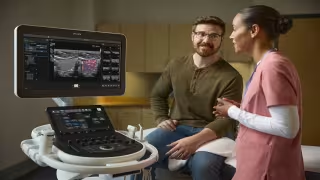
SHERIDAN, WYOMING -- July 22, 2026 -- Royal Philips has launched Alturion, a new ultrasound system built for departments that run high patient volumes across varied exam types. The system pairs AI-powered workflow tools with imaging hardware designed to hold up across shift changes and multiple users. Alturion has received FDA 510(k) clearance and CE mark certification, making it available now in the U.S. and Europe. Philips positions the launch as an expansion of its ultrasound portfolio rather than a standalone product, built to share transducers and interface design with existing systems already in clinical use.

Philips VeriSight Pro 3D ICE Brings Real-Time Imaging Inside the Heart to Advance Minimally Invasive Structural Procedures

Image
Philips VeriSight Pro 3D ICE Brings Real-Time Imaging Inside the Heart to Advance Minimally Invasive Structural Procedures

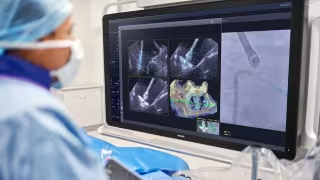
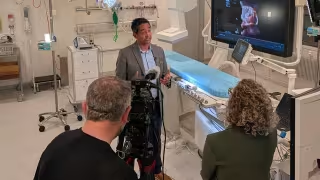
SHERIDAN, WYOMING -- June 9, 2026 -- Philips has put its VeriSight Pro 3D intracardiac echocardiography (ICE) technology in front of a wider audience through a feature on the BBC's technology program Tech Now, filmed during a live structural heart procedure in Copenhagen. The technology places a miniature ultrasound probe on the tip of a catheter, threading it through a vein into the heart to deliver real-time three-dimensional images of anatomy, valves, and treatment devices. For interventional teams, it offers an alternative to passing a larger probe down the patient's esophagus under general anaesthesia. The result is a more precise and less invasive route to treating structural heart disease.

AdvaMed urges House action after Senate approves SBIR and STTR reauthorization

WASHINGTON, 4 March 2026: AdvaMed said the U.S. Senate has approved legislation to reauthorize the federal Small Business Innovation Research and Small Business Technology Transfer programs, and the association called on the House of Representatives to move quickly on passage. The medtech trade group said the vote matters because authorization for the two programs lapsed on 30 September 2025, leaving early-stage medical technology companies without the certainty they need as they pursue product research and development.

What the Senate action changes

SHERIDAN, WYOMING - March 31, 2026 - Early-stage medtech companies could regain a key non-dilutive funding route in 2026 after the Senate passed legislation to reauthorize the federal Small Business Innovation Research and Small Business Technology Transfer programs, reducing uncertainty that has persisted since the programs' authorization lapsed on September 30, 2025. AdvaMed said the Senate action restores momentum for grants that support early research and development at startups and small manufacturers, and it urged the House of Representatives to move quickly on passage. The association framed the programs as an important bridge for companies that struggle to finance next-generation device development before products reach patients or later-stage commercial milestones.

Advita Ortho Wins 2025 Innovation Award for Newton Balancing Technology in Total Knee Replacement

Image
Advita Ortho Wins 2025 Innovation Award for Newton Balancing Technology in Total Knee Replacement

SHERIDAN, WYOMING - December 16, 2025 - Advita Ortho has been recognized with an Innovation award in the 2025 Medical Device Network Excellence Awards for its Newton® Balancing Technology, highlighting the growing clinical and commercial demand for more data-driven, reproducible approaches to soft-tissue management in total knee replacement surgery.

Award recognition spotlights soft-tissue balancing as a key outcomes lever
While implant design and alignment remain central to knee arthroplasty performance, soft-tissue balancing is increasingly viewed as a differentiator in patient satisfaction and functional outcomes. Advita Ortho is positioning Newton as a method to bring greater consistency to what has often been a highly surgeon-dependent step-an area the company notes has historically contributed to dissatisfaction in a meaningful share of procedures.

Implantica's RefluxStop® Gains Momentum as Florence's Careggi University Hospital Joins European Rollout

Image
Implantica’s RefluxStop® Gains Momentum as Florence’s Careggi University Hospital Joins European Rollout

SHERIDAN, WYOMING - December 10, 2025 - Implantica is strengthening its European market expansion for RefluxStop®, announcing that Florence's renowned Careggi University Hospital has performed its first procedure with the implantable device for gastroesophageal reflux disease (GERD), adding another high-profile reference center to the therapy's growing footprint.

Careggi University Hospital Becomes a Flagship Center for GERD Innovation

The first RefluxStop® implantation at Careggi University Hospital was carried out by Dr. Paolo Prosperi, Chief of Emergency Surgery, assisted by Dr. Alessio Giordano. As part of the University of Florence, Careggi is one of Italy's most respected academic medical centers and a key reference institution for advanced surgical technologies.

Philips' DeviceGuide brings real-time AI navigation into structural heart valve repair

Image
Philips’ DeviceGuide brings real-time AI navigation into structural heart valve repair

SHERIDAN, WYOMING - November 25, 2025 - Royal Philips is introducing DeviceGuide, an AI-powered device tracking solution that brings real-time, 3D navigation support into one of interventional cardiology's most demanding procedures: minimally invasive repair of leaking heart valves. Built on the company's EchoNavigator platform and previewed at London Valves 2025, DeviceGuide is designed to translate complex imaging into intuitive visual guidance, helping structural heart teams perform mitral valve repair with greater clarity, confidence and reproducibility.

AI-guided navigation inside the procedure room

Prototyping and On-Demand Manufacturing Gain Strategic Importance in Next-Generation Medical Device Development

Image
Prototyping and On-Demand Manufacturing Gain Strategic Importance in Next-Generation Medical Device Development

SHERIDAN, WYOMING - November 14, 2025 - Rapid prototyping and digital on-demand manufacturing are becoming indispensable pillars in the medical device industry as manufacturers race to accelerate development cycles, reduce costs, and bring high-performance devices to market faster. With rising demand for personalized medical solutions and increasingly complex regulatory expectations, companies are turning to advanced prototyping partners to validate designs earlier, improve manufacturability, and support real-world clinical readiness.

Bolded H5 subheadings start below

Innovation Driving Faster Medical Device Development

Wearable Cyborg HAL Demonstrates Direct Stimulation of Brain Plasticity in Groundbreaking Tsukuba Study

Image
Wearable Cyborg HAL Demonstrates Direct Stimulation of Brain Plasticity in Groundbreaking Tsukuba Study

SHERIDAN, WYOMING - November 13, 2025 - Researchers at the University of Tsukuba have presented the first-ever brain-imaging evidence that a wearable cyborg can directly activate neuroplasticity through intentional movement. The study, centered on the Hybrid Assistive Limb (HAL), shows that users' voluntary intention to move triggers significant activity in the brain's higher motor areas-advancing the understanding of how robotics can support neural recovery and rehabilitation.

Proving Human-Machine Synergy Through Brain Imaging