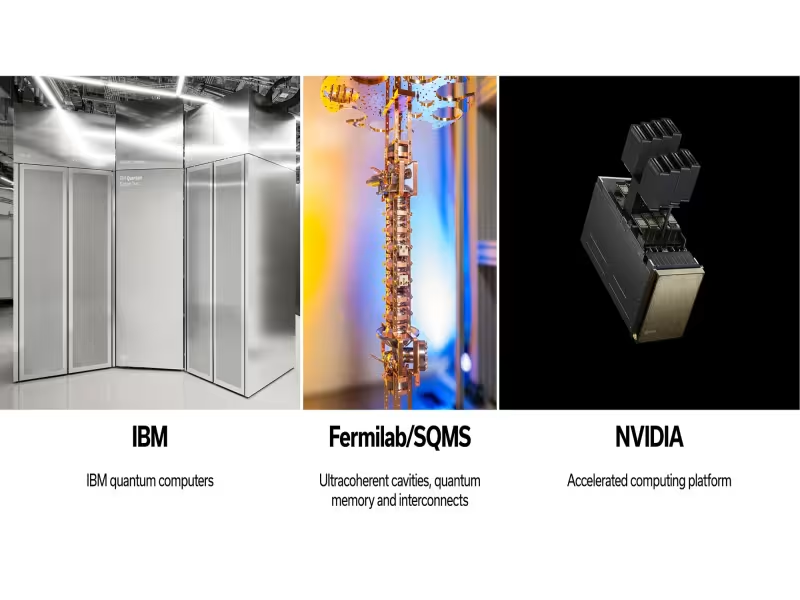
YORKTOWN HEIGHTS, N.Y. -- November 24, 2026 -- IBM plans to build a modular quantum-classical computing co-design platform with NVIDIA and Fermi National Accelerator Laboratory (Fermilab) that co-locates NVIDIA DGX B200 systems with IBM quantum computers, the company announced on Nov. 16. The announcement also covered a Slurm integration for managing quantum processors and a simulation that IBM, RIKEN and NVIDIA say is 79 times more accurate than earlier runs of the same experiment.
IBM, NVIDIA and Fermilab plan a platform pairing DGX B200 systems with quantum processors
The platform is to include machines powered by IBM Quantum Nighthawk, which IBM calls the most powerful quantum processor it has built. IBM specifies circuits of up to 7,500 two-qubit operations on 120 qubits, at up to 100,000 samples per second. Fermilab's Superconducting Quantum Materials and Systems (SQMS) Center will host work on how multiple quantum processors can run together while classical compute scales alongside them.
Fermilab and IBM will also research what is needed to run calculations in high-energy and nuclear physics that they describe as beyond classical systems alone. The examples are lattice gauge theories, neutrino interactions and nuclear simulations. Fermilab CTO Anna Grassellino calls the effort a step toward a future U.S. Department of Energy quantum computing user facility. The release gives no launch date, budget or hardware count for the platform.
QRMI lets Slurm allocate and account for quantum processors like CPUs and GPUs
IBM, NVIDIA and Pasqal worked with the open-source community on the Quantum Resource Management Interface (QRMI). It is an open-source, vendor-agnostic layer that connects to Slurm's Hierarchical Resources (HRES) scheduling. Until now, Slurm had no native concept of a quantum processor, and sites attached QPUs through plugins outside the scheduler's core resource model.
The change matters because a QPU can be shared across multiple nodes, while a GPU works within a single node. With HRES, administrators can manage that shared resource and set limits for each part of the system. Slurm can then allocate, reserve and account for QPU time under the same policies used for CPUs and GPUs. According to the company, an HPC center can run a quantum-classical workflow as a normal Slurm job, with no separate queue, login or operating model. Because QRMI is vendor-agnostic, the same approach can cover processors from other providers.
IBM, RIKEN and NVIDIA report a 79-fold accuracy gain on an iron-sulfur cluster
The researchers simulated Fe4S4, an iron-sulfur cluster found in the proteins of living cells. Its interacting electrons make it hard to simulate. They extended earlier IBM-RIKEN work on sample-based quantum diagonalization (SQD) by starting from an intentionally imperfect but more realistic guess of the molecule's state. According to the paper, this steers the quantum computer toward the electron configurations that matter most.
The runs used circuits of up to 4,000 two-qubit operations on 72 qubits and collected 5 million samples. Against Nighthawk's stated ceiling, that is about 53% of the 7,500 operations and 60% of the 120 qubits, by our calculation. At Nighthawk's stated peak of 100,000 samples per second, 5 million samples equal 50 seconds of sampling. The workflow combined quantum computers with NVIDIA GPUs, including those in RIKEN's JHPC-quantum GPU supercomputer ROQUO.
The results came within 4.3 millihartree of density-matrix renormalization group (DMRG), a classical method known for high accuracy. RIKEN's Seiji Yunoki says the result approaches DMRG accuracy for a strongly correlated iron-sulfur cluster.
Japan's New Energy and Industrial Technology Development Organization (NEDO) supports the research through its quantum-supercomputer hybrid platform project. Earlier in 2026, a separate IBM collaboration with Cleveland Clinic was named a finalist for the 2026 ACM Gordon Bell Prize.