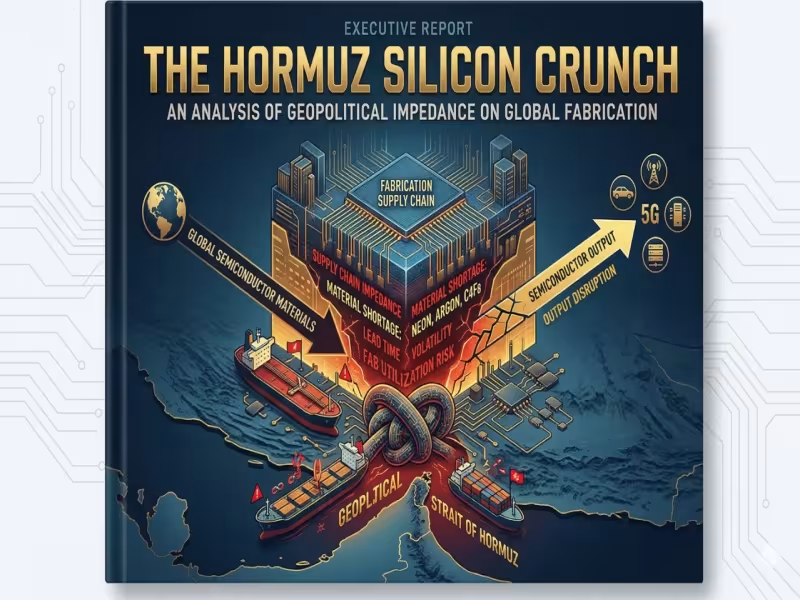
Middle East – October 24, 2026 -- Spot helium prices have doubled after Iranian strikes hit Qatar's Ras Laffan Industrial City, exposing semiconductor fabs to a materials shortage that extends well beyond oil.
Qatar produced roughly one-third of the world's helium as a byproduct of LNG processing. QatarEnergy has declared force majeure, and repairs are estimated at three to five years.
Stranded cryogenic containers put a 35-to-48-day clock on Asian fabs
Roughly 200 specialised cryogenic containers are stranded near the Strait of Hormuz. They keep helium liquid for only 35 to 48 days before it warms and escapes. The last scheduled shipments to Asian fabs are arriving now.
Helium cools wafers during ion implantation, carries reactive gases in chemical vapour deposition and enables vacuum leak detection. Any fab running EUV lithography depends on it, and no viable substitute exists at the required purity and scale. Per-wafer helium consumption is rising as geometries shrink and EUV adoption grows.
South Korea sourced 64.7% of its helium from Qatar in 2025
Samsung and SK Hynix are directly exposed. SK Hynix says it has diversified and secured inventory, but industry analysts estimate the buffer lasts weeks, not months. South Korea's Ministry of Trade has opened an investigation into supply and demand for 14 semiconductor materials with high Middle Eastern dependence.
Taiwan's foundries also rely on Qatari helium. TSMC reports no near-term impact. Its CoWoS advanced packaging capacity was already sold out through mid-2026 before the crisis.
Western Digital has sold out its helium-sealed hard drives through 2026, with prices up 46% since September 2025.
Israel and Jordan supply two-thirds of bromine used in photoresist
Bromine is used in photoresist chemistry for circuit pattern formation, and a break in that chain stops lithography lines. Israel and Jordan together supply roughly two-thirds of global production. South Korea sources 90% of its bromine imports from Israel.
Gulf sulphur exports also move through the Strait. Sulphuric acid derived from sulphur is used to leach and refine critical metals for chips and batteries, and its prices were already climbing before February.
The Middle East accounts for roughly 9% of global aluminium smelting capacity. European and Japanese manufacturers are drawing down inventories. Automotive makers report that qualifying a new aluminium supplier takes up to 18 months, and the same timeline applies to semiconductor packaging materials.
Twenty percent of global LNG trade moves through Hormuz, leaving Taiwan and South Korea's grids exposed. About 6.5 million tonnes of monoethylene glycol shipped from the Gulf in 2025, and shortages are already reaching electronics packaging materials.
Helium alternatives remain years from production scale
The United States is the largest helium exporter but cannot cover a 30% global supply loss, and the Federal Helium Reserve has been wound down since 2023. Pulsar Helium in Minnesota, Helium One in Tanzania and projects in Saskatchewan and South Africa are early-stage.
Russia's Amur Gas Processing Plant was designed to supply up to 25% of global demand. It still runs well below capacity, and sanctions limit its commercial viability. Algeria's output is modest.
Linde, Air Liquide and Iwatani, the major helium distributors, are reworking logistics, contract structures and equipment deployment. Unwinding those emergency arrangements could take months even if Hormuz reopens.
Rerouting around the Cape of Good Hope adds about 3,500 nautical miles, roughly $1 million in fuel per voyage and 10 to 14 days of transit. For helium with a 35-to-48-day shelf life, that delay erodes a large share of the cargo's usable window.
Hydrogen and neon are being explored for select applications but cannot replace helium in EUV cooling or mass spectrometry leak detection. Before Russia's invasion of Ukraine, roughly half of semiconductor-grade neon came from two Ukrainian companies. Closed-loop helium recovery exists but cannot yet close the gap at high-volume scale.
Material qualification, not sourcing, limits how fast fabs can switch
Every new gas, chemical or substrate must be qualified before it touches a production wafer. Trace impurities measured in parts per billion can shift etch rates, alter film stress or introduce defects that surface weeks later in reliability testing.
Standard qualification relies on end-of-line electrical testing, which can take weeks or months. The faster route is an inline data plan that validates film thickness, particle counts, etch uniformity, deposition rates and defect density at each critical process step.