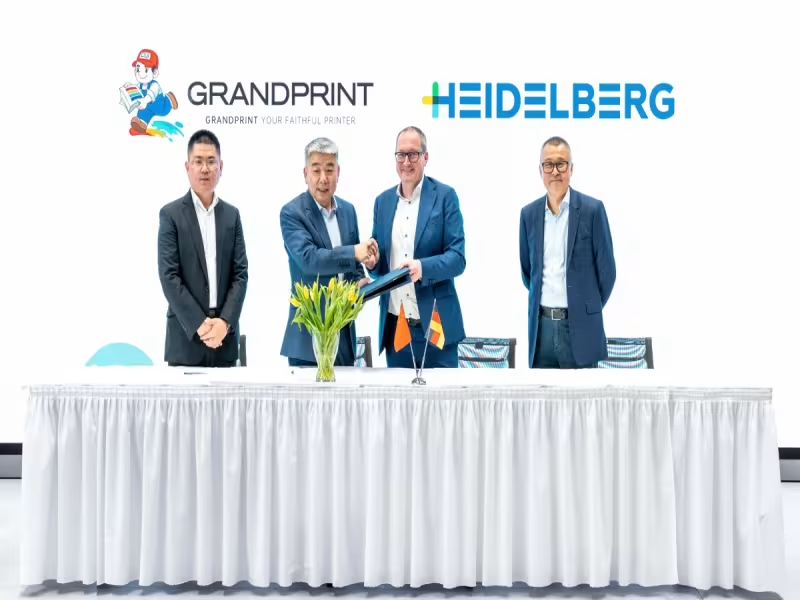
SHERIDAN, WYOMING - March 17, 2026 - Grandprint (Shengda) has expanded its web-to-print operations by purchasing six additional Speedmaster CX 92 presses from Heidelberger Druckmaschinen AG (HEIDELBERG). The move continues what HEIDELBERG describes as a sustained investment cycle by the printer in digital and hybrid technologies from HEIDELBERG and Gallus. For commercial leaders and production managers, the purchase signals added conventional press capacity aligned with hybrid workflows, aimed at meeting demand patterns tied to packaging and label work in China. It also indicates continued capital deployment into equipment that can support web-to-print-driven order volumes and turnaround expectations.
What was announced and what equipment is involved
HEIDELBERG reported that Grandprint (Shengda) has purchased six more Speedmaster CX 92 presses. The company framed the transaction as part of Grandprint's expansion of its web-to-print business and as a continuation of prior investments in digital and hybrid technologies. In the same announcement, HEIDELBERG linked the investment cycle to technologies from both HEIDELBERG and Gallus, positioning the overall program as hybrid-oriented.
While the press release excerpt does not provide configuration details, installation timing, plant locations, or financial terms, it clearly identifies the equipment model and the number of units purchased. For buyers evaluating comparable expansions, the key data points are the scale of the order-six presses-and the stated intent to support web-to-print production growth. In B2B terms, that typically connects to higher throughput requirements and the need to run a broader mix of jobs efficiently, especially when orders originate digitally.
Operational relevance for web-to-print and hybrid production
The stated goal-expanding web-to-print-matters operationally because web-to-print models commonly drive more frequent job changes and a need to respond quickly to demand. Adding multiple presses can be interpreted as a capacity and resilience play within production planning, supporting higher volumes or more parallel scheduling. HEIDELBERG also tied the purchase to hybrid technology investments, suggesting Grandprint is aligning conventional press capacity with digital and hybrid workflows rather than treating them as separate production silos.
The announcement also references Grandprint's "sustained investment cycle" in digital and hybrid technologies. For operations teams, that implies the Speedmaster additions are not a one-off procurement, but a continuation of a broader technology roadmap that includes HEIDELBERG and Gallus. However, the excerpt does not specify which digital systems, hybrid configurations, or Gallus products are part of that roadmap, so the scope beyond the CX 92 purchase cannot be quantified from the provided material.
Market context: packaging and label demand in China
HEIDELBERG explicitly connected the investment to a "growing packaging and label printing market in China." That linkage is the primary market rationale offered in the source and frames the business case as demand-led rather than purely technology-led. For packaging and label converters and commercial printers serving brands, incremental capacity investments often aim to protect service levels under growth conditions, particularly when lead times, SKU proliferation, and product variation increase operational complexity.
From a sector perspective, the combination of web-to-print expansion and a hybrid-technology narrative underscores how packaging and label production continues to absorb workflow concepts that originated in commercial print ordering and automation. The source does not detail Grandprint's customer base, product mix, or end-use segments, but it does make clear that the company is positioning its production investments to address packaging and label opportunities in China, using HEIDELBERG's Speedmaster CX 92 platform as part of that strategy.