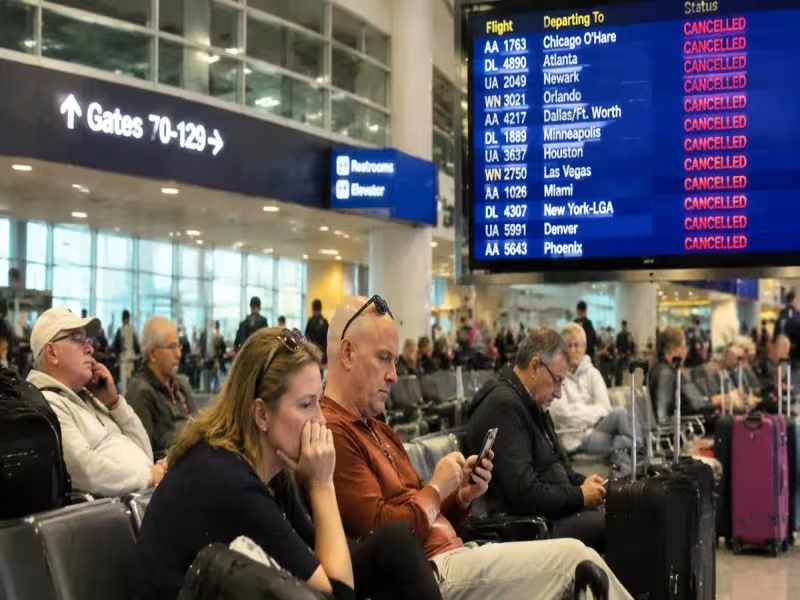
UNITED STATES -- November 24, 2026 -- A nationwide communications failure at the Federal Aviation Administration (FAA), which began on Friday, 13 November, still disrupted more than 5,200 US flights on Sunday, 15 November, its third day. The total included over 1,600 cancellations and about 3,600 delays. The figures are FlightAware data reported by Reuters and the Egyptian Gazette and are a developing snapshot, not a final total.
Saturday, 14 November, was heavier, with more than 6,400 cancellations and over 8,000 delays. A full-day count and an intraday snapshot are not like for like. Even so, Saturday's cancellations alone were about four times the Sunday snapshot figure (6,400 against 1,600), by our calculation.
The FAA restored its air traffic control network on Friday evening and lifted the nationwide ground stop. Sunday's disruption therefore reflects displaced aircraft and crews rather than the original failure. Airlines are repositioning aircraft, reorganising crews and clearing passenger backlogs ahead of the Thanksgiving travel season, according to the source material.
JetBlue cancelled about 27% of Sunday services, against 3% to 5% at Southwest, United and Delta
American Airlines cancelled around 13% of scheduled services. JetBlue's rate works out to roughly five to nine times those of the three carriers at 3% to 5%, by our calculation.
Cancellations made up about 31% of all affected flights on Sunday (1,600 of 5,200), by our calculation. The remainder were delays. Carriers with extensive connecting networks are exposed to knock-on effects because an aircraft delayed at one airport may be scheduled for several later services. Crew working-hour limits can slow recovery further.
Passengers whose flights are cancelled and who decline alternatives are generally entitled to a refund under US Department of Transportation rules. The same applies to a significant schedule change, defined as an arrival delay of at least three hours on domestic itineraries or six hours on international ones. Refunds must be issued automatically to the original payment method, within seven business days for credit cards and 20 calendar days for other methods.
FAA traces the instability to data overload that reached 17 of 22 route control centres
The failure began at about 3.30 pm Eastern Time on Friday, 13 November. The FAA imposed a nationwide ground stop as a precaution because inconsistent information was affecting the communications and radar feeds that controllers use. The instability spread across 17 of the country's 22 Air Route Traffic Control Centres, about 77% by our calculation, and later reached several Terminal Radar Approach Control facilities.
The FAA's 15 November investigation update said data activity had reached approximately 1,000 connection attempts every four to five seconds. That equals 200 to 250 attempts per second, by our calculation, on a legacy telecommunications network. Federal officials said about 3,500 aircraft landed safely and every passenger reached their destination safely. The agency said some radio frequencies and radar feeds stayed operational throughout.
The inquiry centres on maintenance by L3Harris, the FAA's telecommunications network service provider. Officials named two potential locations for the abnormal data activity: a radar facility in Amarillo, Texas, and a radio communications facility in El Dorado, Arkansas. The contractor was replacing ageing infrastructure at the Arkansas site, including installing a new router, when the network became unstable.
The FAA and L3Harris are still examining the equipment and the installation process to establish the precise cause. The agency disabled the broadcasting function on approximately 60 similar routers as a precaution. Officials said they have no indication of a cyberattack or deliberate external interference.
Transportation Secretary Duffy says the $12.5 billion approved in 2025 is only an initial investment
Congress approved approximately $12.5 billion in 2025 for aviation technology improvements, including communications equipment and radar systems. According to the Department of Transportation's 15 November briefing, the money is already allocated to specific projects: replacing telecommunications lines, upgrading radio systems and installing electronic flight technology.
Duffy said further investment is needed in network architecture and in the software used to manage aircraft movements. The department did not put a figure on the additional investment. It said the routers linked to the incident are undergoing diagnostics with engineers at L3Harris facilities, and that further funding decisions remain subject to federal budget and congressional processes.