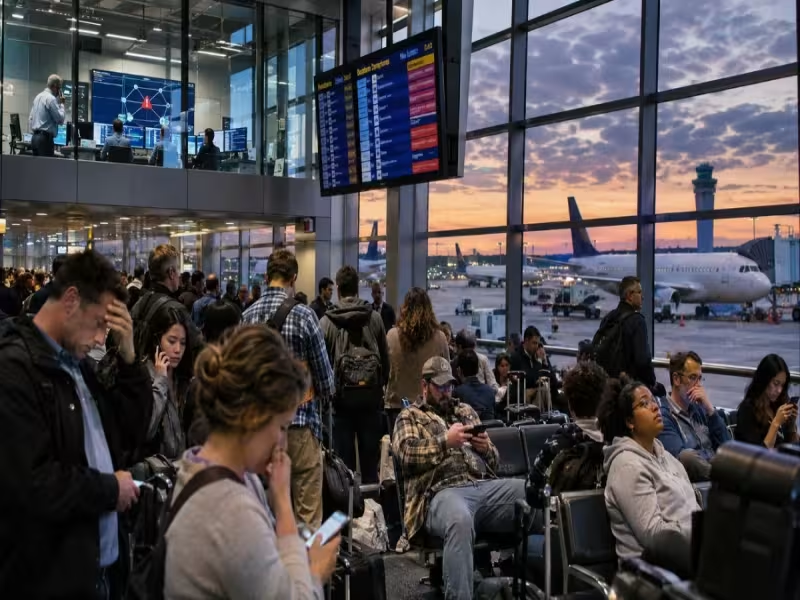
UNITED STATES -- November 22, 2026 -- The Federal Aviation Administration (FAA) ordered a nationwide ground stop on 13 November 2026 that lasted about 4 hours 20 minutes, after a router in a fibre-optic upgrade by contractor L3Harris generated more than 1,000 connection attempts every four to five seconds, according to the US Department of Transportation. More than 3,500 aircraft were airborne when the problem developed.
Router sent at least 200 to 250 connection attempts a second during a copper-to-fibre swap
L3Harris, an FAA telecommunications contractor, was replacing a copper connection at a remote FAA site with fibre-optic infrastructure. The work moved the link from legacy time-division multiplexing to internet protocol-based communications. The router's output works out to at least 200 to 250 attempts per second (1,000 divided by five and by four seconds).
The traffic destabilised communications and radar data used by controllers at multiple air traffic control centres and terminal radar approach control facilities (TRACONs). Not every radio or radar service failed at once. The failures were intermittent, and the FAA judged the resulting uncertainty too great for normal departures.
Airborne count fell from more than 3,500 to under 400 as 8,000 operations resumed
Aircraft already in the air continued to landings while departures were held. A later government update put the airborne count at fewer than 400, a drop of more than 88% from the 3,500 reported at the outset.
The Department of Transportation reported the reopening at about 20:15 Eastern Time on 13 November, which is early 14 November in Coordinated Universal Time. Subtracting the 4 hours 20 minutes, the stop began at about 15:55 Eastern by our calculation. The FAA then ran a phased recovery, and more than 8,000 flight operations resumed that evening. That figure counts resumed operations, not cancellations, and the department has not published a final cancellation total.
Airlines had aircraft out of position, and some services needed replacement crews because pilots and cabin crew work under hour limits. Several airports applied airline-specific restrictions. International arrivals were handled individually. Passengers connecting through US hubs between Europe, Asia, Latin America and the Caribbean faced missed onward flights.
Officials rule out a cyberattack but have not named the fault
The Department of Transportation says it has found no evidence of a cyberattack. It has identified two possible explanations, defective equipment or an installation error, and has not established which applies.
The government incident summary also lists 69% for copper communications replaced with fibre and US$12.5bn in congressional aviation modernisation funding.