FRANKFURT -- November 26, 2026 -- Two EU rules will cost a German beauty and household care manufacturer with €1 billion in annual revenue about €51.7 million over five years in the most likely scenario, according to a Roland Berger study for industry association IKW. A mid-sized company with €20 million in revenue would pay about €4.1 million.
Against five years of revenue, that is about 1.0% for the large model company (€51.7 million of €5 billion) and about 4.1% for the mid-sized one (€4.1 million of €100 million), by our calculation. The mid-sized firm therefore carries roughly four times the burden per revenue euro, matching the multiple IKW cites. More than 90% of the costs are recurring, not one-off.
Wastewater levy accounts for most of the large-company bill
The study covers the EU Urban Wastewater Treatment Directive (KARL) for cosmetics makers and the Digital Product Passport (DPP) for detergent and cleaning product makers. The model assumes a mixed product range.
- Large company: €40.1 million for KARL and €11.6 million for the DPP
- Mid-sized company: €2.2 million for KARL and €1.9 million for the DPP
KARL accounts for about 78% of the large company's total (€40.1 million of €51.7 million) but about 54% of the mid-sized company's (€2.2 million of €4.1 million), by our calculation.
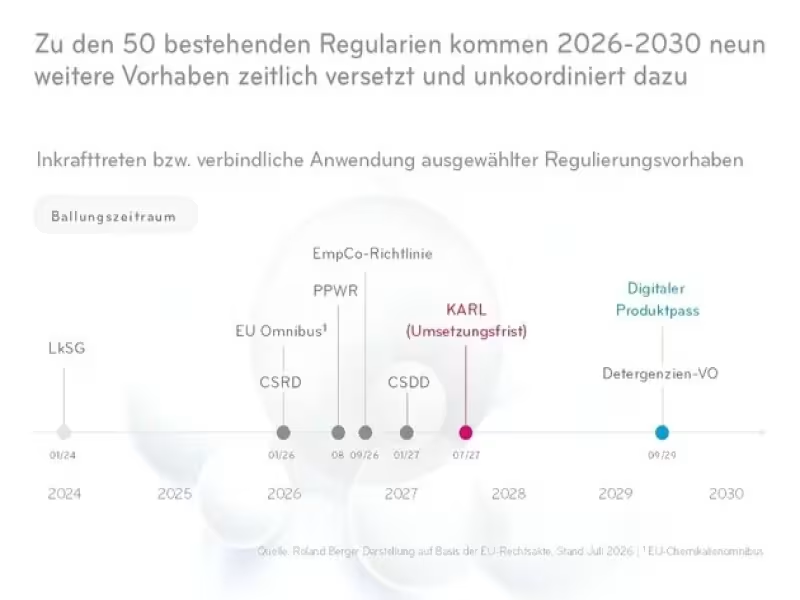
KARL requires pharmaceutical and cosmetics producers to bear at least 80% of the cost of building and running a fourth treatment stage at larger sewage plants. Member states must transpose it by July 31, 2027. The DPP follows from Regulation (EU) 2026/405 and applies from September 23, 2029.
The ranges are wide because neither rule is final. For a large company, the cosmetics share of the KARL levy drives costs between €2.6 million and €40.1 million. The mandatory scope of the DPP, including authority access to data, puts its cost between €9.7 million and €19.7 million.
Industry grew in 2025 while the economy stalled
The sector's 2025 revenue reached €35.6 billion, up 2.9%, with domestic sales of €23.9 billion, up 5.5%. German GDP rose 0.2% against an expected 0.4%. The sector supports about 533,000 jobs in Germany, around 178,000 of them in production and distribution.
Momentum is slowing in the survey. Of 70 IKW member companies polled in June 2026, 23% expect revenue growth in 2026 and 37% expect declines. In the same survey, 93% describe regulation as a very strong or fairly strong burden. The survey is not representative of the whole industry.
IKW says manufacturers face more than 50 relevant rules today and nine more by 2030. It calls for a binding impact assessment with an SME test before each new rule, better coordination of timelines, and national transposition that exceeds the EU minimum only where necessary.
The study states the model is not a forecast for individual companies. Actual costs depend on final legal design, the allocation key and implementation. It does not disclose how many companies the two model firms represent.