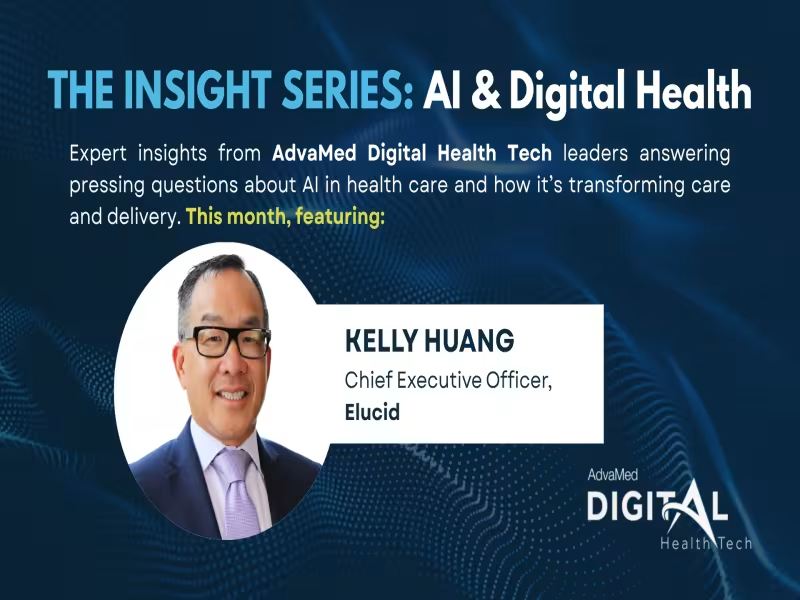
United States – October 17, 2026 -- Nearly half of all heart attacks occur in patients classified as low risk under traditional factors such as age, cholesterol and family history, Elucid CEO Kelly Huang said in AdvaMed's "Insight Series: AI & Digital Health," arguing that AI must change clinical decisions rather than accelerate existing ones.
Elucid extracts plaque biology and blood-flow data from a single CT scan
Elucid's Plaque-IQ software analyzes an existing coronary CT angiogram to quantify plaque type and amount in coronary and carotid vessels. Its BioIntegrated FFR-CT predicts fractional flow reserve values along each vessel, using invasive FFR as ground truth. Plaque algorithms are validated against histology.
Huang said two patients can show identical plaque volume and similar stenosis yet carry different risk: one has lipid-rich, unstable plaque, the other calcified, stable plaque.
Huang outlines "CCTA 3.0" integrating anatomy, biology and physiology
She described CCTA 1.0 as anatomy alone and CCTA 2.0 as AI-derived plaque or FFR-CT estimates delivered as separate tools. CCTA 3.0 would integrate all three layers lesion by lesion from one noninvasive scan.
Workflow gains have not moved outcomes, Huang says
Most digital health tools optimized workflow around a clinical decision without changing the decision itself, she said. Population-level risk stratification still misses patients, and "we can't out-efficiency a diagnostic blind spot."
Four criteria for health systems evaluating AI tools
Huang pointed buyers to validation against real ground truth, reproducibility, regulatory clearance backed by peer-reviewed or real-world evidence of changed clinical management, and transparency. She said physicians who can inspect segmentation and plaque composition are more likely to use a tool at the point of care.
She also cited a common governance blind spot: a scheduling algorithm and a diagnostic algorithm trained on histopathology carry different risk and should not be governed the same way.