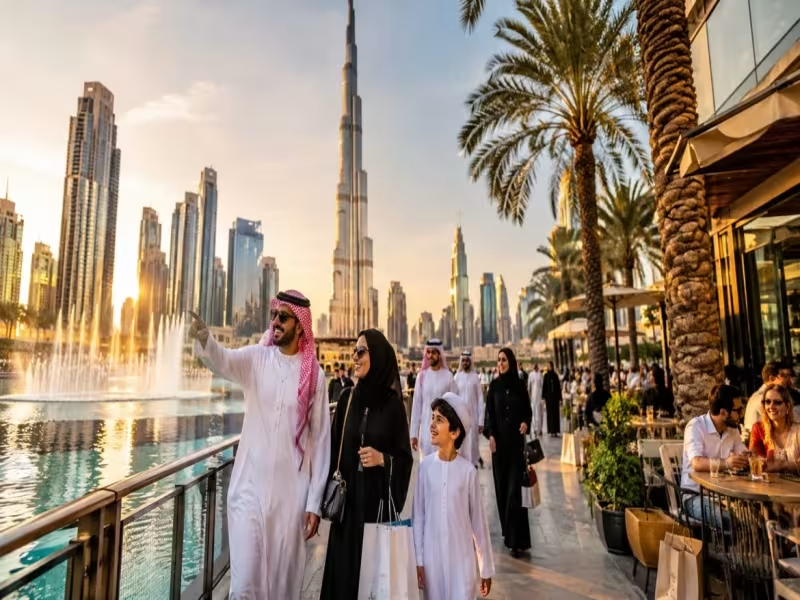
DUBAI -- November 19, 2026 -- Dubai tourism has recovered to 66% hotel occupancy in August 2026, up from a 36% trough in March, but the emirate is still far from its record year. International overnight arrivals for January to August totalled 6.97 million, about 36% of the 19.59 million recorded in all of 2025.
Regional military escalation and Gulf airspace restrictions from late February 2026 cut long-haul transit traffic, which historically makes up roughly half of Dubai's aviation volume. The figures come from a November 14 market analysis that cites the Dubai Department of Economy and Tourism (DET) and aviation regulators. Dubai Airports lowered its 2026 passenger forecast from nearly 100 million to about 70 million, a cut of about 30%. First-half traffic fell 31.3% to 31.5 million passengers.
Dubai hotel occupancy has regained 89% of its August 2025 level
In 2025, Dubai hotels averaged 80.7% occupancy across 154,264 rooms in 827 establishments. The average daily rate was AED 579 and revenue per available room was AED 467. Occupancy fell to 36% in March 2026, with some properties below 20% in April. It reached 66% in August, which DET data put at 89% of the August 2025 level.
August arrivals were about 869,000, the highest monthly volume since February. January had brought 2.00 million visitors before the disruption. The other seven months of January to August therefore totalled 4.97 million, an average of about 710,000 a month by our calculation, so August ran about 22% above that average. The 2025 monthly average was about 1.63 million, which makes August roughly 53% of it. The analysis gives no 2027 forecast for Dubai visitor numbers or occupancy.
Gulf and Middle Eastern neighbours supplied 27% of Dubai's 2025 visitors
According to DET source-market benchmarks, GCC states accounted for 16% of Dubai's international visitors in 2025, about 3.13 million. The wider Middle East and North Africa outside the GCC added 11%, about 2.17 million. Together that is about 5.3 million visitors, or 27% of arrivals.
Federal UAE data show roughly 1.9 million Saudi visitors a year across the emirates before the 2026 disruption, with Dubai receiving more than 1.45 million. Oman historically sent between 1.3 million and 1.57 million visitors a year to Dubai, a range that brackets the Saudi figure. Its land border let Omani travellers reach Al Ain, Dubai, Sharjah and Ras Al Khaimah by road during the aviation disruption. India sends over 2.2 million visitors a year to Dubai, the largest single country. DET data show South Asia gained market share alongside the GCC from January to August 2026.
World Bank forecasts return Qatar only to its 2025 output level by end-2027
The World Bank's October 2026 forecasts show Qatar's GDP contracting 20.9% in 2026 and growing 26.7% in 2027. Kuwait is forecast to contract 14.6% and then grow 22.0%. Compounded, Qatar would end 2027 at about 100% of its 2025 level (0.791 x 1.267), and Kuwait about 4% above it (0.854 x 1.22), by our calculation and if both forecasts hold. The analysis says this rebound will feed outbound travel to Dubai and Abu Dhabi.
The World Bank projects UAE growth of 9.5% in 2027 within a GCC expansion of 10.3%. Oxford Economics and ICAEW forecast regional growth of 6.6% to 8.1%, with inflation easing from 2.6% in 2026 to 2.1% in 2027.
Airlines, visa changes and new rooms are scheduled ahead of 2027
By September 2026, Emirates had restored 93% of its pre-conflict capacity and carried over 8.6 million passengers in July and August. Etihad Airways raised available seat kilometres 15% to 17% year on year, with an August load factor of 92%. Dubai Airports projects direct connections to 240 cities by mid-2027.
In early November 2026, Dubai introduced 48-hour processing for 30- and 60-day tourist visas. It also widened visa-on-arrival eligibility for passport holders with valid residence permits from the EU, UK, US, Canada and Australia. The AED 750,000 minimum property valuation was removed for sole owners seeking two-year property residency visas. The six-nation GCC Unified Tourist Visa had not launched as of November 2026. GCC tourism ministers and passport directors-general confirmed technical integration in September 2026, and a phased rollout is expected during 2027.
Cavendish Maxwell tracks more than 23,000 new UAE hotel rooms in development through 2030, including 11,180 in Dubai. That equals about 7% of Dubai's 2025 inventory of 154,264 rooms. Ras Al Khaimah, which targets 3.5 million annual visitors, is scheduled to open Wynn Al Marjan Island in March 2027, which the analysis calls the region's first integrated gaming resort.