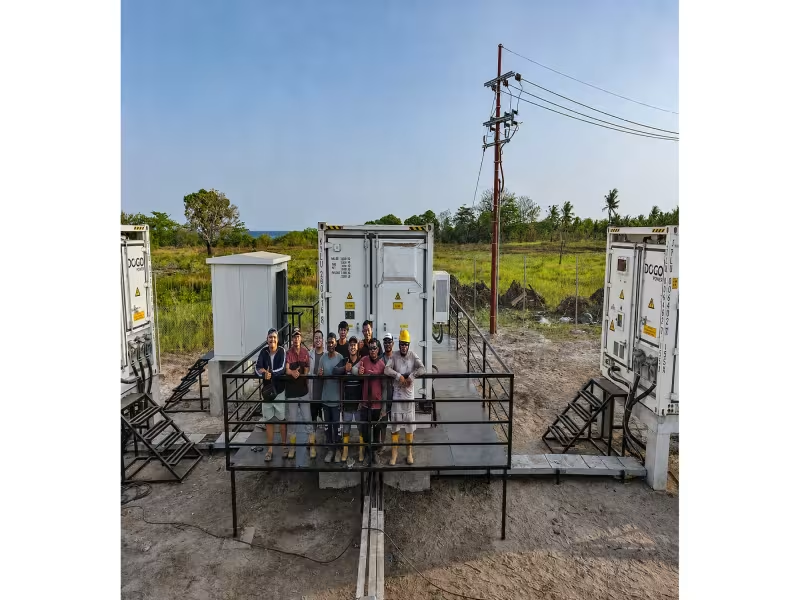
JAKARTA -- November 24, 2026 -- DoGo Power has put a grid-forming energy storage system (ESS) into operation on Pagerungan Kecil Island (P Island), Indonesia, raising daily power supply from 3-6 hours to more than 20 hours, the company said on November 16, 2026. By our calculation, that is roughly three to seven times the previous supply window.
The project pairs 1MW of solar PV with a 2MW/4MWh ESS and DoGo's energy management system (EMS). It serves a community of more than 2,000 fishing households with no subsea cable link to the mainland grid. At 4MWh of storage, the system can run at its full 2MW rating for two hours. DoGo says the storage system regulates voltage and frequency on its own, without external grid support.
Diesel at 35 cents per kWh consumed up to 40% of household income on the island
P Island previously relied on diesel generators. According to DoGo, only about a quarter of residents had power, limited to 3-6 hours a day and mostly in daylight, with frequent unplanned outages. Diesel power cost roughly 35 US cents per kWh and took 25% to 40% of many families' incomes, the company says.
Project data cited by DoGo shows electricity costs for the island's households have fallen by roughly 81%. The company does not say whether that figure compares tariffs or total household spending.
Public services, including clinics, schools, telecom networks and water systems, and local fishery processing and cold storage now have uninterrupted power, according to the company. "We waited decades for reliable electricity," village chief Halilurahman said.
DoGo built a 10-foot container under 22 tonnes to fit the island's hoisting limits
The island has no deep-water port. Storage units, lifting gear and trucks came from neighboring islands and were unloaded from temporary pontoons at low tide. DoGo designed a 10-foot storage container weighing under 22 tonnes to stay within the island's hoisting capacity. The company supplied the storage system and EMS and led the solution design.
The system's stated 7,300 equivalent utilization hours a year equal 20 hours a day over 365 days, consistent with the 20-hour daily supply claim. DoGo projects more than 26 million kWh of power over the system's lifecycle and CO2 savings of more than 22,000 tonnes. That works out to about 0.85 kg of CO2 avoided per kWh. Both figures are company projections, and DoGo did not disclose the project cost.
Indonesia's village PV program would multiply the P Island configuration 80,000 times
The Indonesian government has previously announced a national village-level PV program. It plans 1MW of PV and 4MWh of ESS in each of 80,000 villages. That matches the P Island project's PV and storage-energy capacity. Applied to 80,000 villages, the plan equals about 80 GW of solar and 320 GWh of storage, by our calculation.
DoGo describes the P Island installation as a replicable blueprint for island microgrids across Southeast Asia and says it has built delivery expertise for similar deployments.