Oracle

Quantinuum Q3 Revenue Jumps 233% to $9.1M, Lifts 2026 Outlook
Image
Quantinuum Q3 Revenue Jumps 233% to $9.1M, Lifts 2026 Outlook

Broomfield – November 05, 2026 -- Quantinuum Inc. (Nasdaq: QNT) raised its full-year 2026 revenue outlook to $31 million to $34 million, up from $28 million to $32 million, after third-quarter revenue rose 233% year-over-year to $9.1 million from $2.7 million.

Losses widen as margins improve

GAAP gross margin reached 33.3%, compared with negative 43.5% a year earlier. Adjusted gross margin was 74.6%, up 853 basis points year-over-year.

Losses grew alongside revenue. Adjusted EBITDA loss was $80 million, against $45 million in the prior-year period. GAAP net loss was $118 million, against $52 million, or $0.46 per Class A share. Adjusted net loss per share was $0.29. Cash and cash equivalents stood at $1.94 billion on September 30, 2026.

CEO Rajeeb Hazra said the momentum gives the company "more confidence than ever" in its opportunity.
Chubu Electric Power Grid Deploys 10 Million Smart Meters With Oracle

Image
Chubu Electric Power Grid Deploys 10 Million Smart Meters With Oracle

Nagoya – November 04, 2026 -- Chubu Electric Power Grid Co., Inc. has deployed 10 million smart meters under its Advanced Metering Infrastructure (AMI) program with Oracle, following an upgrade to the latest version of Oracle Utilities Meter Data Management (MDM).

The upgrade adds scalability, interval-readiness and operational resilience across the utility's commercial and residential meters. It also prepares the grid operator for initiatives tied to distributed energy resources and electrification.

Oracle Targets $225B FY30 Revenue, Caps New Capital Raises at $20B

Image
Oracle Targets $225B FY30 Revenue, Caps New Capital Raises at $20B

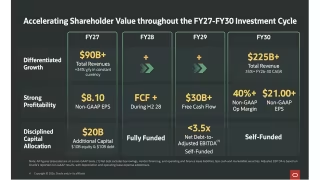
AUSTIN – October 29, 2026 -- Oracle set a fiscal 2030 target of $225 billion or more in total revenue, a compound annual growth rate above 35% from FY26, and committed to limiting new capital market funding to $20 billion through FY30. Co-CEOs Clay Magouryk and Mike Sicilia and CFO Hilary Maxson presented the updated medium-term guidance at the company's Investor Day in Las Vegas.

Oracle targets 40% non-GAAP operating margin and $21 EPS in FY30

Beyond the revenue goal, Oracle guided to a non-GAAP operating margin of 40% or higher and non-GAAP earnings per share of $21 or more in FY30. The company said each of its three business models, cloud infrastructure, database and applications, is expected to generate strong profitability and free cash flow.

Oracle: AI Now Writes 70% of Its Code, Adds Google TPUs to OCI

Image
Oracle: AI Now Writes 70% of Its Code, Adds Google TPUs to OCI

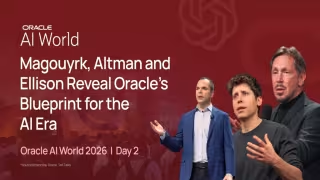
Las Vegas – October 29, 2026 -- More than 70% of Oracle's code is now written by AI, CEO Clay Magouyrk told attendees on Day 2 of Oracle AI World 2026, as the company paired the disclosure with security, chip and application announcements.

Oracle cuts support resolution from 3.5 hours to 16 minutes

Magouyrk presented internal results before announcing any product. Support requests that once took 3.5 hours now resolve in 16 minutes. Product ideas that previously took nine months to reach customers now take six weeks. Vulnerabilities are found and fixed ten times faster than six months ago.

Oracle AI Database Migration Turns Into an Architecture Decision

Image
Oracle AI Database Migration Turns Into an Architecture Decision

Global – October 29, 2026 -- Oracle AI Database can now run across five environments: OCI, AWS, Microsoft Azure, Google Cloud, and supported on-premises setups. It can also run on Oracle-managed infrastructure inside the customer data center. Migration is therefore an architecture decision before it is a data-movement exercise, according to guidance from Oracle services provider AppsTek.

AI Agent Counts Mislead as Workflows Handle Routine Enterprise Tasks

Image
AI Agent Counts Mislead as Workflows Handle Routine Enterprise Tasks

Global – October 29, 2026 -- An enterprise running 9,000 AI agents can still miss measurable business outcomes if those agents handle tasks that structured workflows could run more efficiently, according to AppsTek Corp, which builds enterprise AI on Oracle platforms.

Workflows run predictable rules while agents handle uncertainty

A workflow executes a predefined sequence of business logic, while an AI agent decides parts of that sequence as work progresses. Workflows move invoices, validate records, route approvals and trigger integrations. Agents interpret context, select tools and retrieve knowledge once uncertainty enters a process. Choosing the highest level of autonomy every time usually raises cost without raising value, AppsTek argues.

Oracle Acceleron Adds NVMe Options With Up to 3x Performance

Image
Oracle Acceleron Adds NVMe Options With Up to 3x Performance

Las Vegas – October 29, 2026 -- Oracle said new NVMe block-storage attachment options across Oracle Acceleron bare metal and VM shapes improve performance by up to 3x, as it expanded its Oracle Cloud Infrastructure (OCI) networking suite for AI workloads at Oracle AI World.

Oracle extends NVMe block storage and RDMA connectivity to more AI workloads

The NVMe options target AI, database and other data-intensive workloads. Separately, Oracle Acceleron High-Performance Fabric adds RDMA connectivity on OCI front-end compute, aimed at inference, storage and HPC deployments.

Oracle Collective Communications Library reroutes traffic across the backend Multiplanar Network when links fail

The library spreads collective traffic across OCI's backend Multiplanar Network and steers it toward healthier paths. Oracle says workloads recover instantaneously when links, ports or NICs fail.

Oracle Extends Fusion Claw to 25 of 75 Agentic Apps

Image
Oracle Extends Fusion Claw to 25 of 75 Agentic Apps

Las Vegas – October 29, 2026 -- Oracle says 25 of its 75 packaged agentic applications for Fusion are now Claw-enabled. Claw is a governed runtime that executes analyst-grade work in finance, supply chain and workforce planning and commits results to Fusion within business-set limits. Oracle announced the expansion at Oracle AI World in Las Vegas on October 26, 2026, and says all of it is available in the current Fusion release.

Oracle extends Claw across ERP, HCM, SCM and CX applications

Oracle first introduced Claw on September 29, 2026. The runtime takes over when an agentic application needs deep analysis across millions of records. Its scope covers reconciliation, analysis, planning, simulation and optimization, and runs can last hours.

Snowflake and Oracle Plan Native First-Party Snowflake on OCI

Image
Snowflake and Oracle Plan Native First-Party Snowflake on OCI

Global – October 28, 2026 -- Snowflake and Oracle plan to offer Snowflake's AI Data Cloud as a native, first-party service on Oracle Cloud Infrastructure (OCI), with customers buying and being billed directly through Oracle. The companies describe the offering as planned, not committed, and no launch date has been given.

Snowflake on OCI would bring AI, analytics, data engineering, transactions, applications and collaboration workloads closer to enterprise data held in Oracle databases, Oracle applications and OCI services.

Oracle would sell and bill Snowflake directly through OCI

Customers would contract with Oracle, be billed through OCI and could pay with Oracle Universal Credits. Accounts would be provisioned through the OCI control plane. Customers would then manage warehouses, databases, data pipelines and access controls with standard Snowflake tools.

Oracle Adds AI-Built Ontologies and Agent Governance to AI Platform

Image
Oracle Adds AI-Built Ontologies and Agent Governance to AI Platform

LAS VEGAS – October 28, 2026 -- Oracle will roll out AI-generated business ontologies, a semantic reasoning engine and an AI agent registry within the next 12 months as part of its AI Data Platform, and has launched a services offering to move enterprise AI projects into production. The company announced the moves at Oracle AI World.

AI Discovery agent drafts ontologies from schemas and documents

Oracle's AI Discovery agent generates business ontologies by analyzing database schemas, semantic models, application and API documentation, and business knowledge held in unstructured documents. Domain experts review and refine the output before approving it as the shared foundation for all AI solutions. The platform also monitors how agents use the ontologies and recommends updates for expert approval.