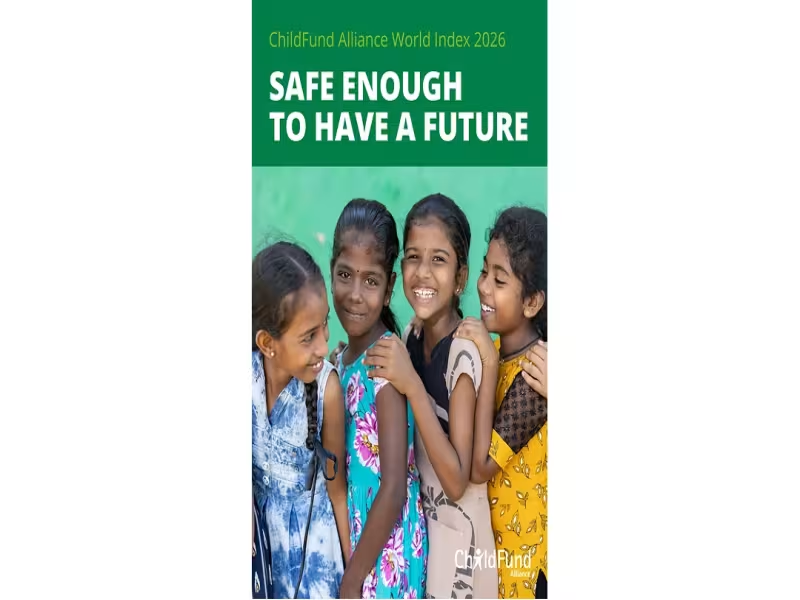
MILAN -- November 24, 2026 -- The ChildFund Alliance World Index 2026 finds that more than one in three children feel unsafe sometimes or often, based on research with more than 3,000 children in 27 countries. The report also ranks 134 countries on how they implement children's formal rights, using 30 indicators.
The child research therefore covers 27 of the 134 ranked countries, or about 20%. The ranking measures formal rights. The survey measures lived experience. The release does not name the highest- or lowest-ranked countries.
Children name home as the safest place, and accidents make places feel unsafe
The research has two parts: a survey of 2,344 children aged 8 to 18 in 27 countries, and Safety Mapping sessions with 834 children in 21 countries. In the mapping sessions, children marked safe and unsafe places in their communities.
Home is the most frequently cited safe space at 74%, followed by family or caregivers (54%) and school (45%). Home is cited 29 percentage points more often than school. Roads and routes to school are among the most commonly identified unsafe spaces.
Accidents and injuries (52%), harm from other people (32%) and traffic (30%) are the main factors that make places feel unsafe. By our calculation, accidents are cited about 1.6 times as often as harm from others. Children's biggest worries are illness affecting themselves or loved ones (45%), conflict and violence (36%), and climate and environmental threats (35%).
Family supplies 80% of children's support while formal services are rarely mentioned
Parents and family are the main source of support at 80%, followed by teachers at 46%, a gap of 34 percentage points. Helplines and social workers are rarely mentioned. Children often associate safety with the presence of a trusted adult.
Having an adult to talk to does not guarantee help. More than one in five children who find it easy to talk to a trusted adult do not believe they could access help in a crisis. ChildFund Alliance reads this as a gap between having someone to turn to and having a protection system that responds.
"A child's right to safety must mean more than laws and policies," said Tamar Manuelyan Atinc, Chair of the ChildFund Alliance Board of Directors.
Girls with disabilities report the most distress, yet 67% of children believe they can shape their future
Girls with disabilities or functional difficulties consistently report greater distress, less access to trusted adults and a narrower sense of control over their future. The report also links girls' confidence in shaping their future to the rights and opportunities available to women in their communities.
On the future, 67% of children say they can shape it, 17% say "maybe" and 10% say "no." Those three answers add up to 94%, and the release does not account for the other 6%. Children answering yes outnumber those answering no by 6.7 to 1. ChildFund Alliance says safety is fundamental to maintaining that sense of agency.
The report was launched in Manila ahead of the Second Global Ministerial Conference on Ending Violence Against Children. ChildFund Alliance is also releasing child-friendly versions of the findings in several languages, with activities for schools, communities and peer groups.