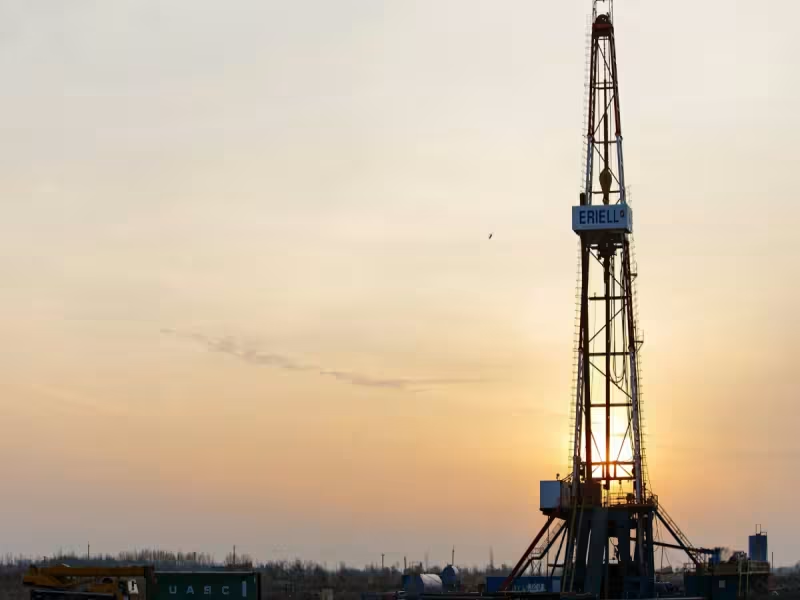
IRAQ -- November 24, 2026 -- Chevron and Iraq's Oil Ministry have agreed contract terms for the West Qurna 2 oilfield, and a formal signing is expected before December 31, according to OilPrice.com. That is roughly two months ahead of the February 2027 expiry of Chevron's one-year, USD200 million exclusivity window.
The terms were confirmed after a meeting between Oil Minister Basim Mohammed Khudair Al-Abadi and Chevron vice president of business development Joe Cook.
Deputy prime minister ordered negotiators to speed up West Qurna 2 and split off Nassiriya
A senior source close to the Oil Ministry told OilPrice.com that Deputy Prime Minister for Energy Affairs Mohsen al-Mandalawi told negotiators to "get on with it" during a November visit by a Chevron delegation. He wanted obstacles removed and the deal wrapped up, preferably in November, the source said.
Al-Mandalawi also told negotiators to stop tying West Qurna 2 to the pace of talks on the Nassiriya oilfield. Nassiriya negotiations now proceed separately and more slowly.
In mid-September the Oil Ministry signed a technical consultancy contract that lets Chevron advise the state-run Basra Oil Company (BOC). BOC has operated West Qurna 2 since Lukoil effectively pulled out in November 2025.
Iraq's 800,000 bpd working peak is double the field's earlier output
West Qurna 2 lies 65 kilometres northwest of Basra and holds roughly 14 billion barrels in place. Under Lukoil it produced around 400,000 barrels per day (bpd), about 9% of Iraq's output at that time.
The Oil Ministry source put the current working figure for peak production at 800,000 bpd. By our calculation that is twice the 400,000 bpd level and 67% of the 1.2 million bpd peak in Lukoil's contract. That contract peak had itself been cut from 1.8 million bpd, a reduction of one-third. The 800,000 bpd figure equals about 19% of Iraq's October 2026 national output of 4.22 million bpd.
OilPrice.com reports that Lukoil reached 650,000 bpd in August and September 2017, and that the Oil Ministry believes output nearer 1.2 million bpd is achievable. The report's author judges it very likely that Chevron can reach at least 635,000 bpd quickly.
Lukoil was paid USD1.15 per barrel recovered, the lowest rate paid to any international oil company in Iraq at that point, according to OilPrice.com. GazpromNeft received USD5.50 per barrel at the Badra field, about 4.8 times as much. Lukoil had spent at least USD8 billion on the field and was owed around USD6 billion, equal to 75% of that spend. The report does not disclose the per-barrel fee Chevron would receive.
USD60 billion in lost export revenue drives Baghdad's urgency
Foreign Minister Fuad Hussein said in mid-October 2026 that Iraq had lost approximately USD60 billion in oil export revenue because of the Strait of Hormuz closure alone. Iraq's budget deficit rose 346% in the first nine months of 2026, while oil revenues fell 50.8% year on year.
Historically, over 90% of Iraq's annual budget came from oil, and around 95% of that oil passed through the strait.
Output has recovered. Crude production rose to 4.22 million bpd in October, of which 3.95 million bpd, about 94%, came from the federal-government-run south. Exports rose 9.5% month on month to between 3.35 million and 3.5 million bpd, or 79% to 83% of production by our calculation.
Full storage forced Iraq to shut many wells, according to the source. That risks permanent damage through loss of reservoir pressure, water infiltration and corrosion.
Prime minister ordered ministries to prioritise American companies
In late June 2026, Prime Minister Ali al-Zaidi instructed the oil, electricity and communications ministries to give top priority to American companies, following an earlier cabinet order that month. During al-Zaidi's five-day U.S. visit, the two countries signed 48 agreements valued at over USD60 billion. Companies named include Chevron, ExxonMobil, Halliburton, KBR, GE Vernova and Starlink.
OilPrice.com reports that Baghdad sees a Chevron presence as an added deterrent against attacks by Iran and its proxy groups. It also expects more U.S. firms to follow and needs U.S. waivers, financial access and support for alternative export routes.