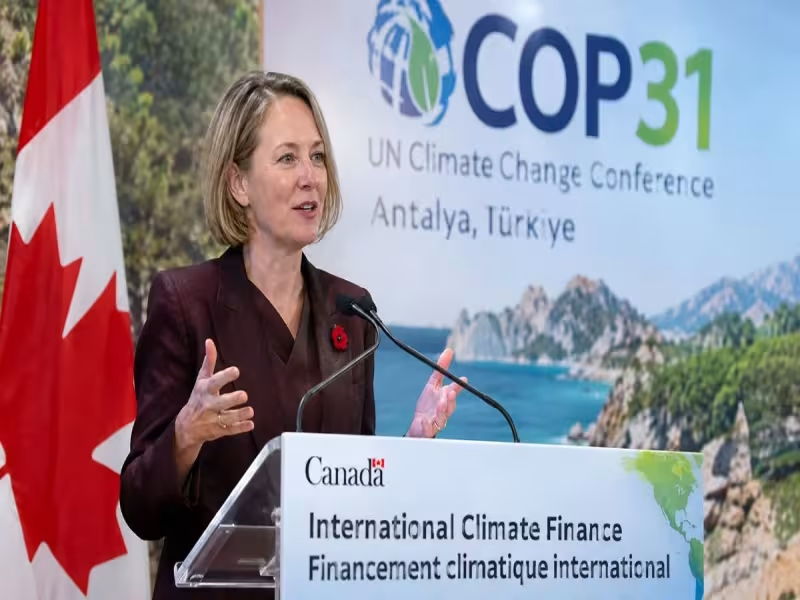
ANTALYA -- November 21, 2026 -- Canada has committed C$116 million in climate finance to 12 international projects, announced at COP31 in Antalya, Türkiye, on 13 November 2026. The package equals about 0.9% of Canada's C$13 billion goal for climate support to developing countries through 2031, by our calculation. The government describes it as an initial allocation within that goal.
Seven announced allocations add up to C$80 million of the package
The announcement gives amounts for seven initiatives:
- C$15 million for the World Bank's Energy Sector Management Assistance Program, the largest single allocation
- C$14 million for the Ocean Risk and Resilience Action Alliance
- C$12 million for the National Adaptation Plan Global Network
- C$12 million for an initiative to strengthen climate adaptation capacity
- C$11 million for the Climate Finance Access Network
- Up to C$10 million over five years for the Climate Risk and Early Warning Systems initiative
- C$6 million for the Southeast Asia Energy Transition Partnership
These seven come to C$80 million, about 69% of the C$116 million total. Spread across all 12 projects, the package averages about C$9.7 million per project. The largest allocation is about 13% of the total.
The government says the amounts are funding ceilings, not money already distributed. The allocations run for three to five years and are planned to begin in either 2026-27 or 2027-28.
Seven of the 12 projects include adaptation and resilience as a primary or significant secondary objective
That is about 58% of the portfolio by project count. The 12 projects address climate adaptation, emissions reduction and institutional capacity.
The Ocean Risk and Resilience Action Alliance connects more than 140 members, including governments and financial institutions, and works on financing for marine protection. The Climate Finance Access Network helps Small Island Developing States obtain climate funding and develop projects.
The early-warning initiative covers forecasting, risk communication and preparedness in climate-vulnerable developing countries. Its ceiling of C$10 million over five years works out to C$2 million a year. The Southeast Asia partnership supports cleaner electricity systems, electrification and a reduced reliance on coal.
The package targets environmental resilience, not tourism facilities
The government has not designated the funding for hotels, airports or tourism facilities. Any effect on visitor economies would come indirectly, through disaster preparedness, ocean protection and more reliable energy in communities that also host travellers. No country-by-country allocation has been published for the 12 projects, so no Caribbean, Pacific or Southeast Asian destination can be shown to have secured funding.
Canada has provided more than C$14.3 billion in climate finance since 2015
According to the Canadian government, that earlier support is expected to reduce or avoid nearly 658 megatonnes of greenhouse gas emissions by 2050. It is also expected to help more than 40 million people in developing countries adapt to climate impacts. The government presents these as projected outcomes of its wider climate finance efforts, not results of the new C$116 million.
The C$13 billion goal covers five years through 2031. The strategy combines public contributions, development finance and efforts to mobilise private investment.