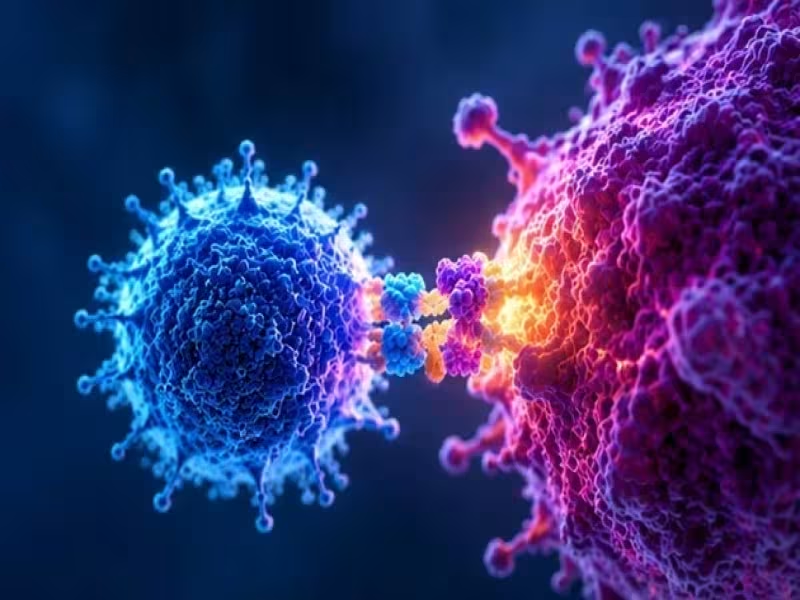
Emmendingen – November 13, 2026 -- BioCopy GmbH says its lead antibody candidate VR-6 binds about 90% fewer unintended structures than a reference molecule from published literature. The result comes from a preprint on its ValidaTe platform, released at the end of July 2026. The company's results section cites 38 versus 4 sequence-similar peptide fragments, which works out to a reduction of about 89.5% by FairsOnline's calculation. The data are laboratory results; VR-6 has not been given to humans.
VR-6 destroyed tumor cells in lab tests without attacking healthy comparison cells
BioCopy counted only fragments that the antibody binds with a strength below one micromole per liter, the company's threshold for potential danger sources in healthy tissue. It compared VR-6 and a second in-house candidate against a published antibody aimed at the same target. According to the company, the gap was confirmed experimentally, not only predicted by software. In cell assays VR-6 destroyed tumor cells while leaving healthy comparison cells intact, and the company says its effect against tumor cells was unchanged.
BioCopy has also developed a second safeguard, which it calls WiFi ("Widened Fingerprint"). It joins two antibodies that recognize the same tumor target but have different off-target profiles. The company says full binding strength should arise only where both attach, which it expects on tumor cells. It describes the resulting theoretical risk reduction as "orders of magnitude", a claim the release does not quantify.
HighSCORE chip screens up to 5,000 peptide-HLA combinations in about three hours
ValidaTe combines computer prediction, a high-throughput measurement and cell assays in five safety stages. All five run before first use in humans, according to the company. The measurement step, HighSCORE, places up to 5,000 peptide-HLA combinations on a stamp-sized chip. That is roughly 1,700 combinations per hour, by FairsOnline's calculation. The company says conventional methods need months for comparable data volumes. The results feed learning models that predict risks for fragments not physically tested.
The target peptides are short, typically eight to eleven building blocks, so similar sequences also occur in healthy tissue. BioCopy says this off-target toxicity has ended clinical trials of related drug classes abruptly, in individual cases fatally for participants. It adds that standard cell-culture and animal tests only partly reproduce the human HLA system, so such risks often appear only in humans, after investments of tens to hundreds of millions.
BioCopy runs five preclinical programs against solid tumors, led by MAGE-A4 in lung cancer
The company is developing five T-cell engagers: non-small-cell lung cancer, ovarian cancer, bladder cancer, hepatocellular carcinoma and triple-negative breast cancer. The MAGE-A4 program in lung cancer is the most advanced and is in the preclinical phase. The company says more than 73% of cancer-relevant proteins sit inside the cell, so fewer than 27% are reachable by conventional antibodies, by FairsOnline's calculation. BioCopy's TCR-mimetic antibodies read peptide fragments that cells display on their surface through HLA, which brings internal targets into reach.
BioCopy works only in oncology. Projects in other fields, such as autoimmune disease, are under review and are not programs, the company says. It did not dis