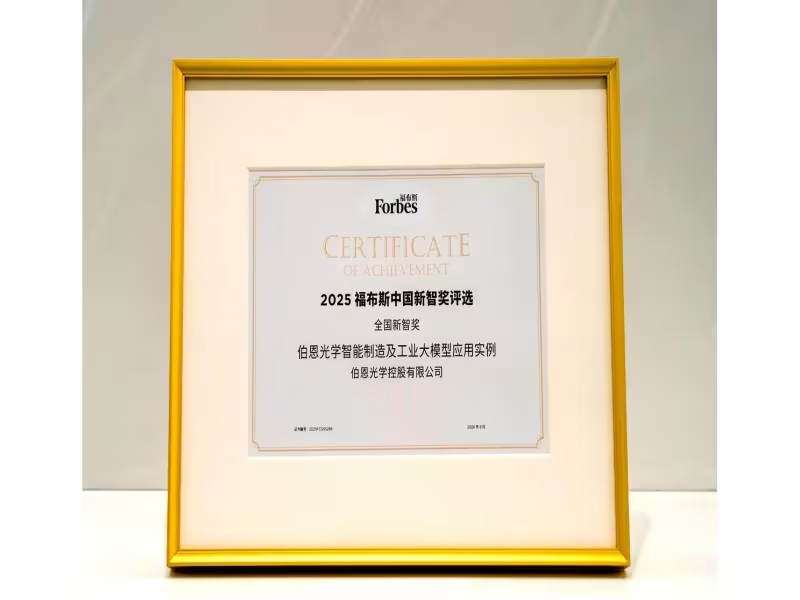
HONG KONG — November 13, 2026 -- Forbes has named Biel Crystal, a maker of exterior structural components for smart devices, to its "2025 Forbes China Novel Intelligent Economy Selection," citing the company's work in smart manufacturing and industrial large models. Biel Crystal operates nine manufacturing bases worldwide with more than 100,000 employees and annual capacity above 2.5 billion units, which works out to more than 278 million units per base and at least 25,000 units per employee.
The performance figures below are the company's own. The release does not say Forbes verified them.
Biel Crystal reports at least 10% efficiency gain from AI in production
The company says it has combined machine learning with industrial simulation to adjust coating machine parameters automatically and to compensate CNC machine tools automatically. It reports that overall efficiency improved by at least 10%. It says the industrial AI models now cover R&D and design, manufacturing, finished-product inspection, operations management and maintenance services.
R&D simulation cuts physical prototypes by more than 60%, company says
Biel Crystal uses structural, fluid/thermal, motion and electromagnetic simulations together in product design. According to the company, this identifies and resolves more than 80% of potential problems at the R&D stage. It reports R&D cycles shortened by 30% to 50% and physical prototypes reduced by more than 60%.
The release gives no absolute cycle length or prototype count, so the size of the saving in time or cost cannot be calculated.
In-house optical inspection lowers missed detections to 0.05%
The company's self-developed automated optical inspection (AOI) technology combines multimodal inspection, few-shot learning and millisecond-level real-time feedback. Biel Crystal says it has cut the missed-detection rate to 0.05%, equivalent to one missed defect per 2,000 items by our calculation. It also reports a 50% reduction in manual re-inspection workload. The company did not disclose the missed-detection rate before AOI was introduced.
Biel Crystal says it did not use general-purpose large models. It built an architecture for industrial scenarios, with requirements for real-time performance, determinism and reliability designed in from the start. The company says this keeps the models "usable, stable and precise" on production lines.