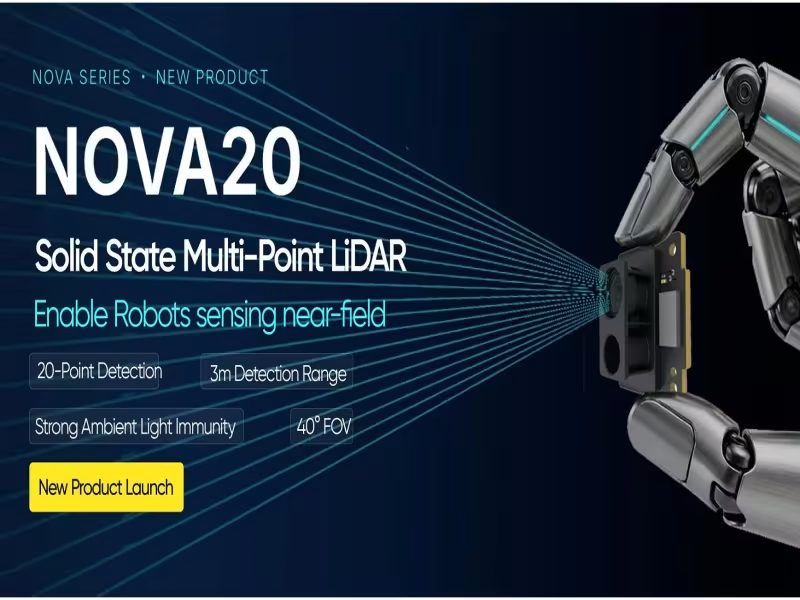
Beijing – October 12, 2026 -- Benewake has launched the NOVA20, a solid-state multi-point LiDAR that weighs less than 5g and draws less than 1W, built to cover the one-meter zone around robots where existing sensor stacks leave gaps.
NOVA20 delivers 20-point sensing across a 40° field of view
The sensor covers a detection range of 0.05-1m, rated at 1m against 10% reflectivity targets under 100 klux ambient light. It has no mechanical moving components. It outputs physical distance data directly and generates no 2D images, which Benewake says reduces image data collection and host-level vision processing requirements.
The compact form factor allows mounting on the chassis, body, wrist, waist, knee and ankle of a robotic platform.
Benewake targets three blind spots in current robot perception
Benewake identifies three limitations in existing architectures:
- 360° spinning LiDARs handle long-range mapping and global localization but can have limited coverage within tens of centimeters of the robot.
- Head- or torso-mounted cameras can be occluded by the robot's own chassis or articulating limbs, can be affected by challenging lighting, and require compute-intensive processing.
- Ultrasonic and single-point infrared sensors offer few measurement points, making it hard to resolve low-profile obstacles or sharp drop-offs.
NOVA20 is positioned as an independent near-field layer that complements, rather than replaces, existing LiDAR and vision systems.
Three use cases span AMRs, humanoids and delivery robots
For lateral edge-following and narrow passages, the sensor provides multi-point side distance measurements for AMRs, commercial cleaning robots and robotic mowers. This supports wall-following and lowers the risk of side collisions.
For ground edge recognition, it detects negative obstacles, staircase edges and sudden elevation drops on bipedal humanoids, quadrupeds and wheeled platforms, to reduce step-off accidents.
For human-robot proximity, it supplies near-field distance data to delivery robots, patrol robots and collaborative platforms, supporting deterministic speed reduction before physical contact.