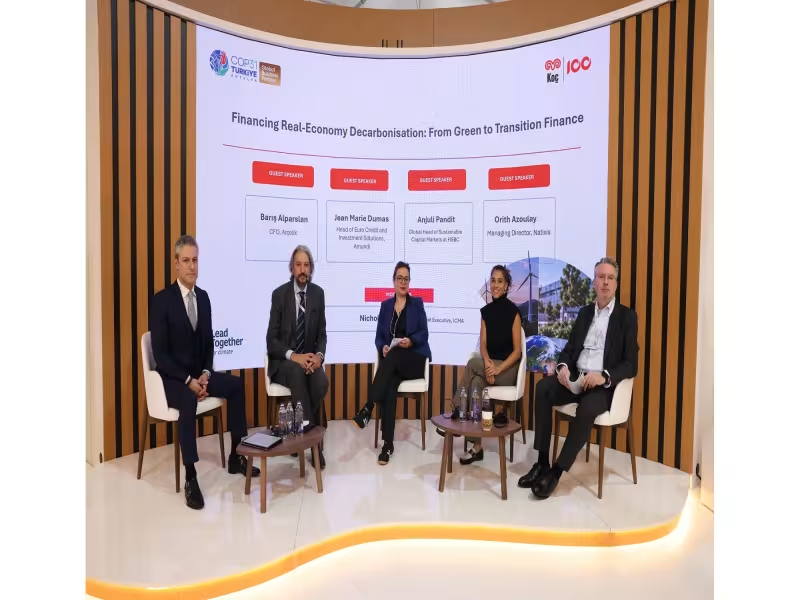
ANTALYA -- November 19, 2026 -- Beko, which makes home appliances in both Türkiye and the EU, told COP31 panels that any extension of the EU's Carbon Border Adjustment Mechanism (CBAM) to downstream products should be assessed product by product. The European Commission has proposed extending CBAM to around 180 downstream products with high steel or aluminium content, including domestic appliances, from 1 January 2028. The proposal has not yet been adopted.
The proposed start date falls two years after CBAM entered its definitive phase at the start of 2026. Beko says this gives home appliance makers a direct stake in the debate.
Beko asks the EU to recognise carbon prices paid in Türkiye
Fatih Özkadı, Beko's Chief Sustainability, Quality, and Customer Care Officer, said costs add up when carbon pricing, CBAM and industrial measures are not aligned, and that this reduces what manufacturers can invest in decarbonisation. He said manufacturers buy steel and aluminium and make finished products in several countries.
For manufacturers working across Türkiye and the EU, Özkadı asked that carbon prices effectively paid in Türkiye be recognised and that reporting be kept practical. He also called for any downstream extension to take account of the combined effects of climate, trade and industrial policies.
Beko's €200 million IFC loan equals about 1.9% of its 2025 turnover
Chief Financial Officer Barış Alparslan pointed to the sustainability-linked loan Beko signed in December 2025. It is the company's first, a five-year facility of €200 million from the International Finance Corporation (IFC). Its KPIs are tied to cutting greenhouse gas emissions and raising women's representation in the workforce.
Beko reports consolidated turnover of €10.7 billion for 2025. The facility therefore equals about 1.9% of that figure (€200 million against €10.7 billion), by our calculation. Beko did not disclose the numerical targets behind the KPIs or its own CBAM cost exposure.
"Industrial decarbonisation is a capital question as much as a technical one," Alparslan said. He said manufacturers need long-term finance, appropriate risk-sharing structures and a cost of capital that reflects how long it takes to transform factories and supply chains.
Three Beko plants already belong to the WEF Global Lighthouse Network
Beko's refrigerator and dishwasher plants in Türkiye and its washing machine plant in Romania are part of the World Economic Forum's Global Lighthouse Network. The Romanian site also holds the Sustainability Lighthouse designation. Beko cites these plants as evidence that Turkish and European industry are integrated, and says Turkish manufacturers invest, produce and create jobs within the EU.
The company operates subsidiaries in more than 55 countries and has a workforce of around 45,000.
Four sessions in three days put Beko executives next to WTO, IFC and EBRD officials
Özkadı spoke on 10 November in the Green Zone alongside Mustafa Tuzcu, Türkiye's Deputy Minister of Trade, and Peter Spiller, a McKinsey & Company partner in Frankfurt am Main. On 11 November he moderated a session at the Türkiye Pavilion with Aik Hoe Lim, Director of the Trade and Environment Division at the World Trade Organization, and Fatma Canan Nilüfer Dora of Türkiye's Ministry of Trade.
On 13 November, Alparslan spoke on two panels at the Koç Holding Pavilion. One included executives from Amundi, HSBC and Natixis. The other included Wagner Almeida, IFC Regional Director of Industry for the Middle East and Central Asia, and Jacqui Powell, Managing Director, Corporate Sector, at the EBRD.
COP31 is the first COP since publication of the Baku to Belém Roadmap to 1.3T, which sets out how climate finance for developing countries can rise to USD 1.3 trillion a year by 2035.