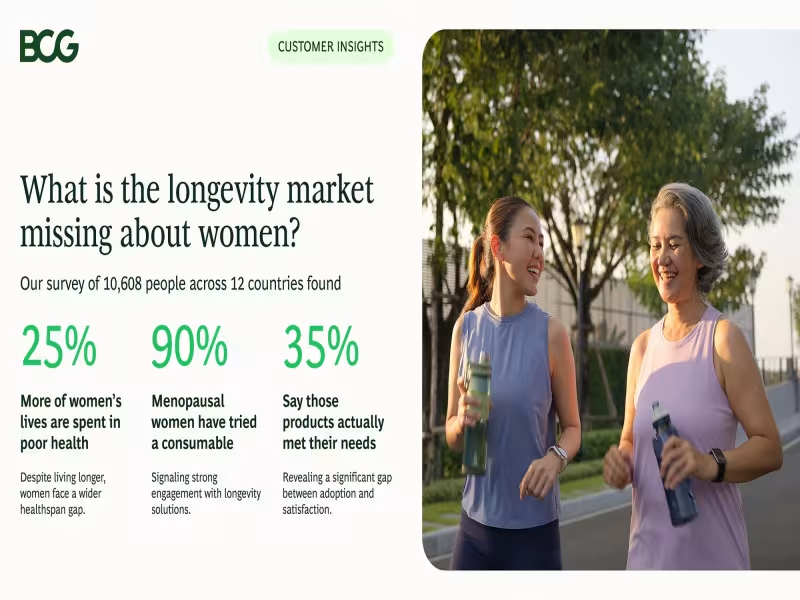
Boston – September 22, 2026 -- Women in perimenopause or menopause represent an estimated $350 billion in unmet demand within the global longevity market, according to a new Boston Consulting Group (BCG) study covering roughly 1 billion women worldwide already spending on longevity products and services.
Women outspend every other demographic on longevity but remain equally dissatisfied
The BCG report, titled "The $350 Billion Longevity Mismatch in Women's Health," surveyed 10,608 people across 12 countries for the St. Moritz Longevity Forum. Women in perimenopause or menopause spend a median $84 a month on longevity interventions, compared with $68 for other women and $73 for men. Roughly a third of these women said they would spend $108 a month if a product or service delivered visible results.
Adoption rates run 15 to 22 percentage points higher, yet satisfaction stays flat near 50%
Women in this life stage have tried an average of 3.3 more longevity interventions than other women and 2.9 more than men, spanning consumables, services and specialized treatments. Despite this higher engagement, satisfaction levels across all groups surveyed hover around 50%, showing no measurable improvement for the highest-spending cohort.
Interest in long-term health begins a decade before menopause, at age 36 to 38
Hormonal shifts and fertility challenges occurring at age 36 to 38 raise women's interest in long-term health by 8 percentage points, nearly double the 5-point effect tied to menopause itself. Men show no comparable rise in interest until roughly ten years later, according to the survey data.
"Companies wait for menopause before they start talking to women about long-term health, but the real window opens about a decade earlier," said Parul Bajaj, BCG managing director and partner, and report coauthor. She said treating mid-30s hormonal shifts as short-term symptoms rather than a turning point remains a major blind spot in how the market serves women.
Only 63% of women consult doctors for hormone-related conditions, versus 78% for cardiovascular issues
The survey found that among women who do seek care for conditions such as PCOS, endometriosis or menopause, only 72% felt taken seriously by providers, compared with 85% of those treated for heart-related symptoms. Trish Stroman, BCG managing director and senior partner, said closing the gap requires more research, better provider training, and giving women greater influence over which longevity solutions receive development funding.
Mark Abraham, global leader of BCG's Marketing, Sales & Pricing practice, said companies that address the mismatch between spending and satisfaction can capture a share of the $350 billion opportunity while resetting standards for how the longevity market serves women.