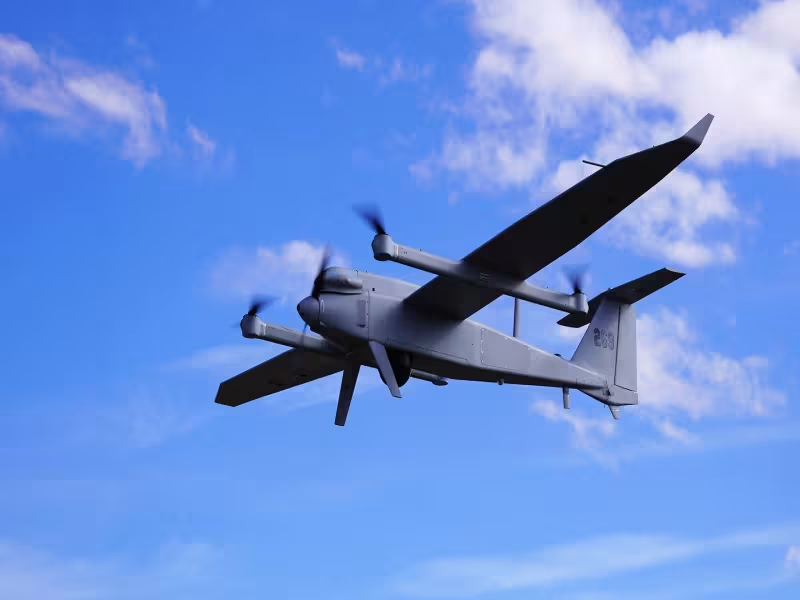
PERTH -- November 19, 2026 -- AV and NIOA Australia signed an agreement at LAND FORCES 2026 in Perth that sets a framework for developing a path toward Australian co-production and localization of AV's one-way attack systems. It is a framework, not a production order, and the companies did not disclose a contract value, volumes or a timeline.
AV also says it can now pursue Direct Commercial Sales (DCS) for one-way attack systems in Australia. According to Sean Colvin, AV's Director of Business Development for Asia Pacific, this adds a further route between an operational requirement and a fielded capability. Colvin writes that he met Australian customers in Perth about expanding their one-way attack capabilities.
AV and ARKEUS put an Australian hyperspectral sensor on the JUMP 20
AV and Australian defense technology company ARKEUS have integrated ARKEUS's Warden payload onto AV's JUMP 20 aircraft. Warden is an Australian-developed hyperspectral sensing technology. Colvin describes the pairing as the first uncrewed platform to carry ARKEUS's real-time, wide-area Hyperspectral Optical Radar capability.
The arrangement means ARKEUS did not have to build a new aircraft around its sensor. Colvin says the JUMP 20 supplies the endurance, altitude, payload capacity and runway-independent access needed to keep Warden on station for extended periods.
Taken together, the two deals run in opposite directions. Warden takes Australian technology onto an allied platform. The NIOA agreement aims to bring an allied product into Australian industry.
Colvin ties both deals to the Australian Army's archipelagic warfare planning
Colvin writes that the Australian Army is preparing for what its leadership describes as "archipelagic warfare". He lists littoral maneuver, surveillance, reconnaissance, long-range strike, autonomous systems and resilient logistics among its priorities. In that setting, he argues, sovereignty should be judged by how much control Australia has over acquiring, adapting, sustaining and scaling a capability, not only by where it was built. He calls this "operational sovereignty".
Colvin says customers in the region often know the operational problem before they know the final technical solution. He describes AV's P550 as a "truck" whose value lies in the power, interfaces and payload capacity that let it carry different equipment as missions change.
He also argues that AUKUS should extend beyond the SSN-AUKUS submarine program, which is expanding the nuclear-powered attack submarine fleet, into a broader defense-industrial and technology ecosystem.