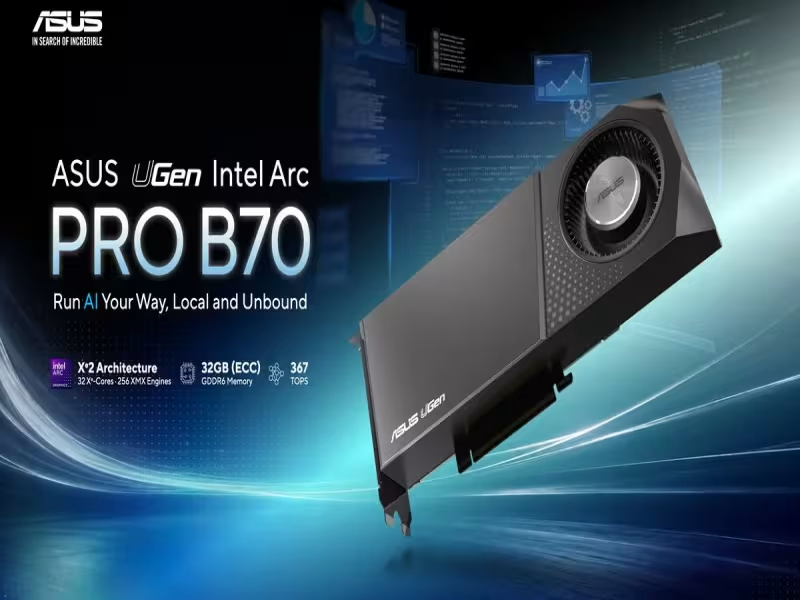
TAIPEI -- November 24, 2026 -- ASUS announced the UGen Intel Arc Pro B70 32GB on October 23, 2026, an AI accelerator card with 32GB of ECC GDDR6 memory, double the 16GB on the mainstream cards that ASUS says cap the size of models users can run. Four cards combine to 128GB of VRAM and, by our calculation, draw 1,240 watts at the rated 310W per card.
ASUS scales the B70 from 32GB to 128GB across four cards
A single card carries 32GB. ASUS offers 64GB in a dual-card configuration and 128GB in a quad-card configuration. At 310W per card, the power draw works out to about 620W for two cards and 1,240W for four, counting the cards only and not the host system. That is roughly 9.7W per gigabyte of VRAM in every configuration.
ASUS says one card supports most models under 27 billion parameters and a context window of up to 128K tokens with Llama 3.1 8B. The company says dual-card setups ran 80B-class models at 43.4 tokens per second.
ASUS builds the 32GB target around a claimed 90% slowdown from memory offload
ASUS says that when VRAM runs out, data spills into host memory and inference performance can fall by up to 90%. At that rate, throughput would drop to a tenth of the in-memory level. The company says long-context reasoning inflates KV-cache use and that multi-agent setups multiply VRAM needs by running several models at once.
Intel and open-source tooling carry the software stack
ASUS lists support for Intel LLM Scaler, vLLM XPU, llama.cpp (SYCL and Vulkan), Ollama, Intel OpenVINO and oneAPI, PyTorch XPU, and ComfyUI. Verified models include Llama 3.1/3.2 (8B to 70B), Qwen 3.x, DeepSeek-R1 Distill (7B to 70B), Mistral and Mixtral, OpenAI gpt-oss (20B and 120B), Whisper-large-v3 and InternVL3.5.
ASUS says LLM Scaler's built-in INT4/FP8 online quantization removes the need for external CUDA-based quantization tools. It also says known ecosystem limitations do not affect near-term commercial deployment.
ASUS targets three buyer groups. Independent developers get a single card. Small businesses and creative studios get 64GB dual-card systems that keep sensitive data in-house. Enterprise departmental AI teams get multi-card 128GB systems, which ASUS says cost far less over time than cloud APIs and meet data-compliance rules in law, medicine, government and finance. ASUS calls the card economical but did not disclose a price or a ship date.
ASUS describes the B70 as the building block of an "agent computer," a system it says is designed to run AI agents locally.