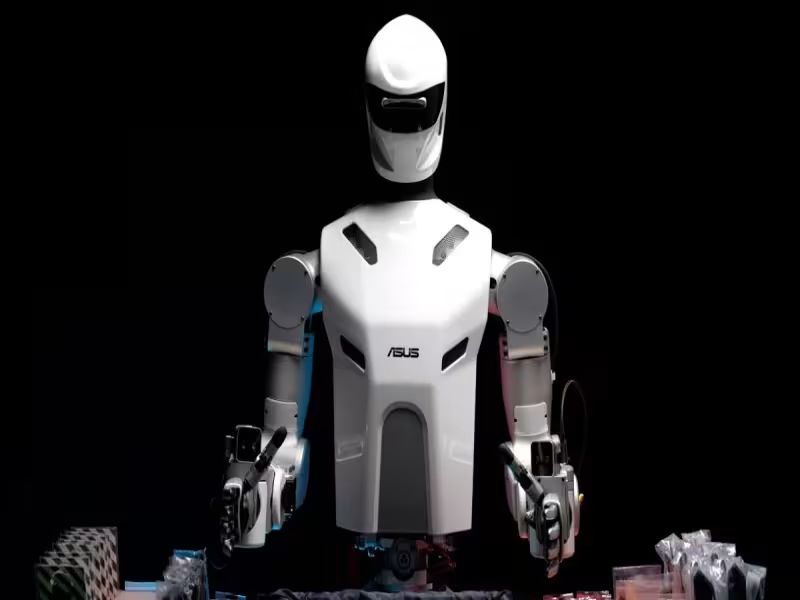
TAIWAN -- November 24, 2026 -- ASUS has set its Gallop humanoid robot a target of 99.5% success within 20 seconds at its first workstation, packing motherboard accessories at an ASUS group electronics manufacturing plant. The company says this is the same standard it holds a human worker to. By our calculation, it allows about one failed or overrunning board in every 200, or roughly one per hour at continuous 20-second cycles.
Packing station combines 15 small parts, many in thin clear bags
The station takes about 20 seconds per board, which works out to about 1.3 seconds per part and up to 180 boards an hour. ASUS chose it because small, thin, soft parts defeat simple grippers. It also wants Gallop to take over most of the job, not work beside a person who has to stay for the whole task. ASUS did not disclose Gallop's current success rate against the 99.5% target.
Gallop today works from a fixed base with two arms, and a wheeled version is next. A single NVIDIA Jetson AGX Thor computer inside the robot runs the software. ASUS designs the robot body and the hand, which includes a sense of touch, and buys motors and other standard components from partners.
The software has four layers: a planner that breaks the job into steps, a second AI that supervises each step and re-plans after errors, a skills layer for reaching, grasping and placing, and a control layer that stops the arms if anything goes wrong. Fixed interfaces between the layers let ASUS swap in a newer AI model without rebuilding the robot. The company says new models arrive every few months.
Gallop learns from ASUS workers' head-camera footage and VR-guided practice
ASUS says it does not build its own large AI model and starts from open models instead. Experienced workers wear head cameras, with their consent, so Gallop can learn how the job is done. Simulation then generates variations of each example. An operator in a VR headset and gloves guides the robot through the task on the same parts and cameras as the real station. Once deployed, what the robot records feeds back into training.
ASUS says its advantage is the right data, from a real station with real parts and quality rules, not more data. It also says the robot targets repetitive, physically demanding stations that are hardest to staff, and that the workers who teach it move into setting up, supervising and improving the robots.
ASUS plans customer pilots in 2027 and market availability in the second half of 2028
The Gallop program started in early 2026. Over the coming year, ASUS plans to put its own dexterous hand into the robot, add wheels and show Gallop to customers at Computex 2027. Electronics manufacturing comes first. ASUS says hospitals and service sites could follow over time.