TAIWAN -- November 24, 2026 -- ASUS reported third-quarter operating profit of NT$22.0 billion, up 161%, on revenue of NT$258.8 billion, up 36%. The operating margin widened to 8.5% from 4.4% a year earlier. By our calculation, the figures imply year-earlier revenue of about NT$190.3 billion and operating profit of about NT$8.4 billion.
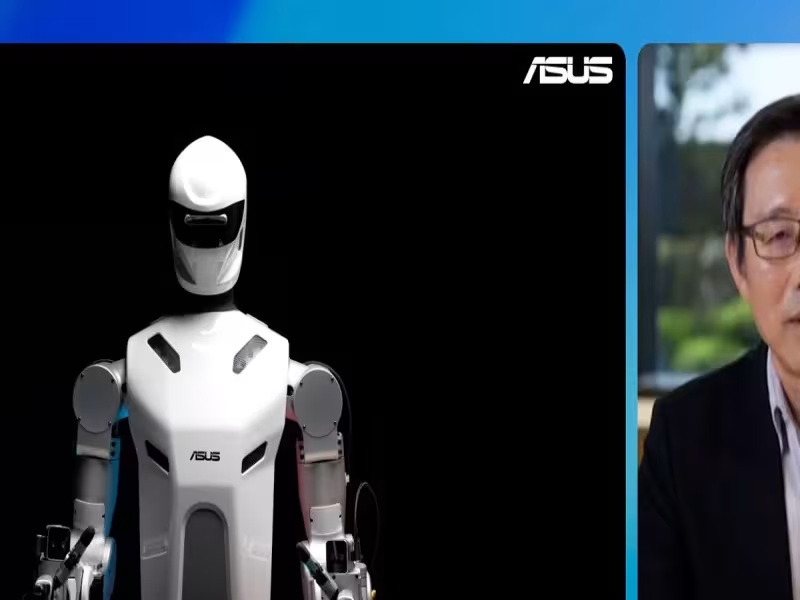
ASUS said in a first-person post on its CNBC interview of November 13 that it is also building a humanoid robot, Gallop. Net profit more than doubled to NT$21.6 billion, equal to about 98% of operating profit.
ASUS expects fourth-quarter server revenue to grow about 280% year on year
Server revenue doubled in the third quarter. A 280% increase would put fourth-quarter server revenue at 3.8 times the year-earlier level, by our calculation. ASUS left its full-year outlook unchanged. It did not disclose absolute server revenue, so the size of that growth target cannot be judged.
The extra NT$68.5 billion of quarterly revenue produced about NT$13.6 billion of extra operating profit, an incremental margin of roughly 20%, more than double the reported margin. ASUS says demand for AI compute still exceeds supply and that its buyers now include neoclouds, governments and enterprises, not only the largest cloud providers. It cites the ASUS AI POD, built on NVIDIA Vera Rubin NVL72 with liquid cooling.
AI PCs make up close to 60% of ASUS PC shipments as memory costs rise
PC revenue grew 25%, which ASUS says is ahead of the industry. High-value products made up more than 65% of PC revenue. AI PC revenue doubled year on year, and commercial PC shipments rose more than 30% as businesses replaced older fleets. Industry research puts AI PCs at more than half of shipments, so ASUS sits only slightly above that level.
Memory now accounts for almost a quarter of the cost of building a PC, according to ASUS, and some customers are delaying purchases. ASUS says it is holding more buffer inventory with its DRAM and storage suppliers and pricing by segment, focusing on gaming, creator and commercial AI PCs. Its RTX Spark systems ship with 128 GB of memory. ASUS says the first batch sold out and that it holds the No. 1 share in RTX Spark.
The company says its hybrid AI PCs cut token costs by up to 70% by splitting work between the device and the cloud. It will unveil the full ASUS Agentic AI Ecosystem at CES 2027 in January.
ASUS says it can keep sensitive AI workloads on customer premises
ASUS argues that companies reluctant to send sensitive data off-site can run AI in-house, because it supplies hardware from servers to desktop PCs. Edge AI systems revenue grew more than 50% year on year, led by workstations and compact systems such as the Ascent GX10. In September, ASUS renamed its AIoT group the Physical AI Solutions Business Group, which now covers AI solutions, autonomous platforms and humanoid robotics. Albert Chang co-leads the group.
ASUS plans Gallop humanoid robot customer pilots in the second half of 2027
Gallop is being tested on production lines in ASUS's own factories. Its first task is packing 15 motherboard accessories, many in soft plastic bags. It uses dexterous hands and cameras, and it learns from ASUS workers on the same parts and to the same quality rules. The robot runs on NVIDIA's Jetson Thor platform. ASUS says new AI models can be added without rebuilding the robot.
ASUS describes the program as early-stage. It positions Gallop for low-volume, high-mix production, where it says traditional automation is hard to justify. Electronics manufacturing comes first, with hospitals and service sites later. Customer pilots are planned for the second half of 2027, and ASUS is targeting the second half of 2028 for market availability, one year later.