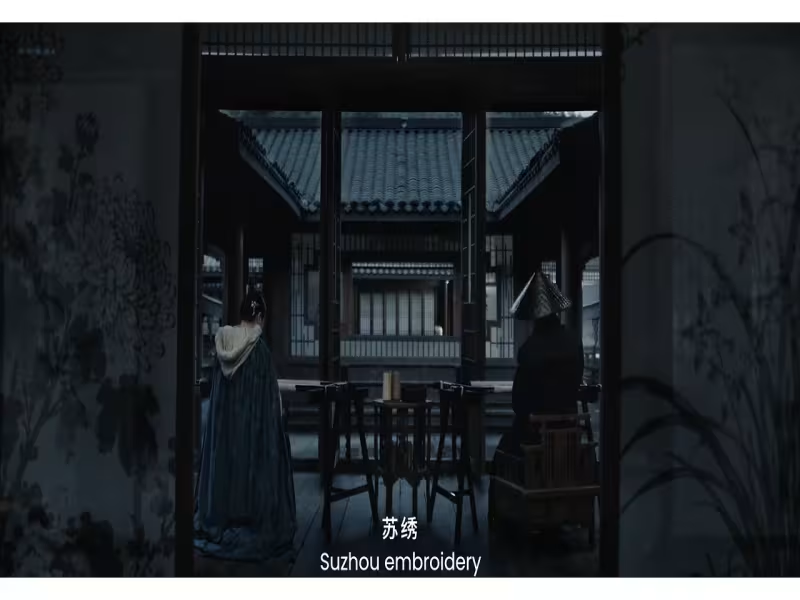
Suzhou – – September 30, 2026 -- Chinese robotics firm AGILINK has shipped more than 15,000 dexterous robotic hands since spinning out from AGIBOT in January 2026, a scale-up that coincides with a demonstration of its OmniHand 3 Ultra performing traditional Suzhou embroidery.
Master craftswoman trains robotic hand on silk-thread techniques
Fu Xianghong, a Suzhou embroidery master, taught the OmniHand 3 Ultra foundational stitching skills including separating silk threads, threading a needle, stretching fabric on an embroidery hoop and stitching. Silk thread bends, slips and changes shape with slight contact variation, requiring one finger to isolate strands while others maintain tension, and opposing fingertips to twist thread without losing grip.
Hand combines 21 active degrees of freedom with fingertip-level tactile sensing
The OmniHand 3 Ultra uses a fully direct-drive architecture paired with vision-based tactile sensors across fingertips, finger pads and palm. The sensors detect contact-surface changes in real time, generating feedback needed to manipulate thin, deformable materials such as silk. Qiao Tianjie, Vice President of AGIBOT and CEO of AGILINK, said the silk-thread task provides a measurable benchmark for fingertip dexterity and points to machines taking on more delicate manual work.
OmniHand series wins 14 medals at World Humanoid Robot Games
In August, AGILINK's OmniHand series competed in all eight dexterous-hand events at the World Humanoid Robot Games, taking seven gold, four silver and three bronze medals.
Company reaches unicorn status within five months of spin-out
AGILINK reached a valuation exceeding US$1 billion in its fourth funding round in June, five months after launch, with backing from investors including Hillhouse Ventures and Mirae Asset. The company positions dexterous manipulation of flexible and delicate materials for applications spanning cable handling, flexible-material assembly and precision-component manipulation.
Fu said the hand adds capacity for delicate handwork that has traditionally required skilled human craftspeople.