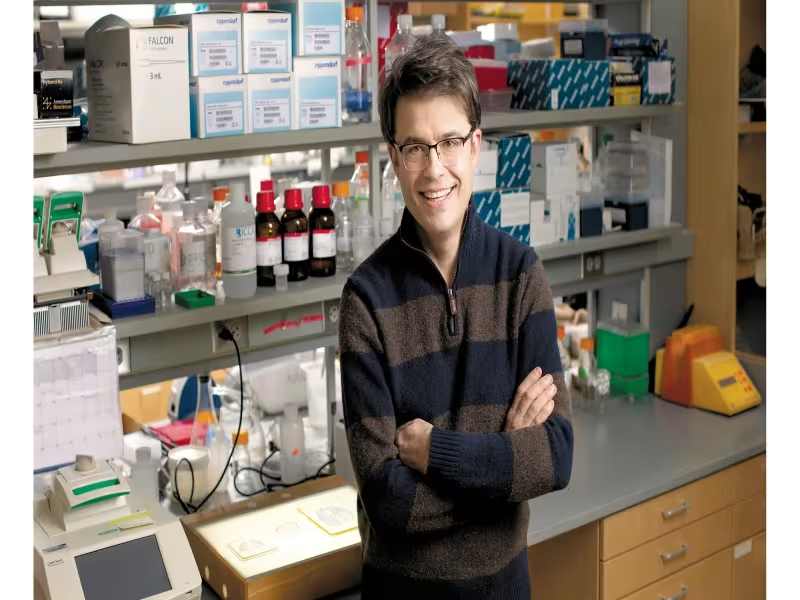
NEW HAVEN, Conn. -- Aug. 31, 2026 -- Yale School of Medicine has secured a nearly $25 million grant from the Aligning Research to Impact Autism (ARIA) initiative to build the first high-resolution map of the developing human brain and pinpoint where autism diverges from typical neural development.
The award, part of ARIA's Human Developmental Neurobiology Research Hub, funds two Yale-led projects within a four-project collaboration that also involves Harvard University. Combined, the initiative targets a gap researchers say has stalled autism drug and diagnostic development for decades: no detailed reference map exists for how the human brain wires itself in the first years of life.
CDC data show 1 in 31 US children now diagnosed with autism
The Centers for Disease Control and Prevention puts current US pediatric autism prevalence at 1 in 31 children, while the World Health Organization estimates a global rate of roughly 1 in 100. Rising diagnosis rates have intensified pressure on research funders and pharmaceutical developers to identify biomarkers earlier, before behavioral symptoms become entrenched.
Yale and Harvard scientists to co-lead four linked research projects
Nenad Sestan, MD, PhD, the Harvey and Kate Cushing Professor of Neuroscience at Yale, and Paola Arlotta, PhD, the Golub Family Professor of Stem Cell and Regenerative Biology at Harvard, will co-lead the effort. Yale's portion covers a structural wiring map of the developing brain and a cellular-molecular model isolating the earliest points of divergence linked to autism. The Harvard-based components add patient-derived brain organoids to link genetics with clinical features, plus generative AI models designed to predict interventions and rank therapeutic targets.
Sestan said existing neuroscience has produced more detailed maps of the planet than of the developing brain. He noted that most synaptic circuits and neurons form within the first years of life, meaning adult brain models cannot be scaled down to represent infant or toddler neurobiology.
Limited tissue access has blocked large-scale developmental brain studies
Brain maturation unfolds over nearly two decades, and researcher access to developing human tissue remains scarce, a constraint that has kept most autism biomarker research anchored to adult or juvenile models rather than the infant period when divergence first appears. Yale's grant is structured to integrate experimental biology, imaging, computational modeling, and clinical partnerships into a single reference dataset that other labs and companies could eventually license or build upon.
Nancy J. Brown, MD, Dean of Yale School of Medicine, said the funding is expected to generate knowledge extending beyond Yale, guiding earlier detection, clearer biomarkers, and more precise interventions for patients and families.
Commercial diagnostics and biotech firms stand to gain reference data
A validated developmental brain map carries direct implications for diagnostics companies and biopharmaceutical firms pursuing autism-related drug targets, since current clinical trials largely rely on behavioral criteria rather than molecular staging. If Yale and Harvard succeed in defining a cellular-molecular signature for early divergence, it could shorten trial timelines for companies developing early-intervention therapeutics by giving them a measurable biological endpoint instead of relying solely on developmental assessments administered years after symptom onset.
The grant adds to Yale's existing ARIA-supported portfolio, expanding the school's position in a funding landscape where autism research dollars increasingly favor mechanistic, data-generating infrastructure over incremental clinical studies.