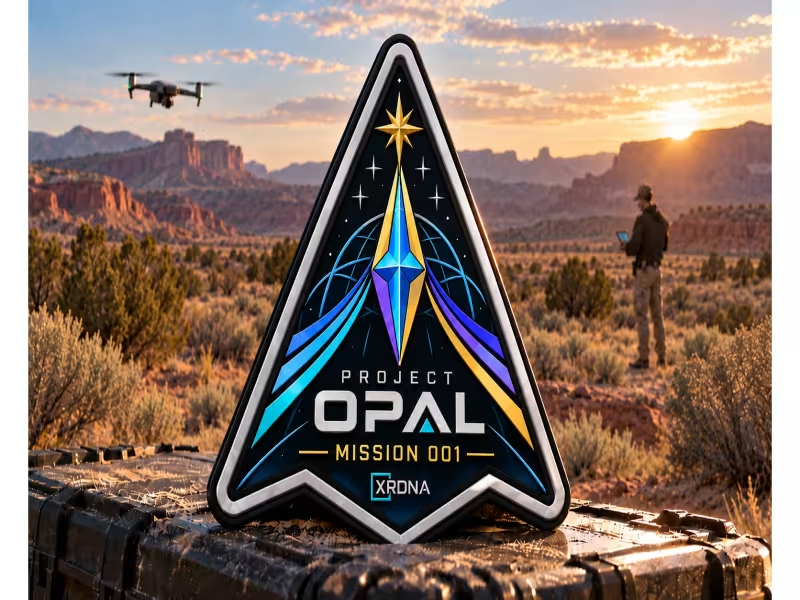
Salt Lake City – October 06, 2026 -- XRDNA Inc. has completed Phase I of Project OPAL, moving its Mission Fabric persistent identity platform out of lab demonstrations and into a live field environment with participating mission partners.
XRDNA tests persistent identity across people, assets and sensors in live field conditions
The internally funded initiative, Operational Prototyping for Advanced Logistics, validated XRDNA's ability to maintain a single digital representation of an active mission spanning personnel, field locations, mobile assets, sensor nodes, drones and simulated downrange payloads. The company used its eVa (Elastic Vector Addressing) identity system to connect these elements through a live mission manifest rather than treating each as an isolated data source.
MoE interaction layer links sensor data to mission context in real time
XRDNA's Map of Everything (MoE) served as the AI-assisted layer allowing operators to interact with the mission context generated by Mission Fabric, associating field sensor observations with the specific people, places and assets they represented. The system was tested under practical constraints including mobile devices, distributed sensors, shifting asset relationships and communications limitations.
"Phase I of Project OPAL was an important transition for XRDNA because we weren't demonstrating Mission Fabric against a scripted software environment -- we were using it to represent an actual mission unfolding around us," said Charles Adelman, CEO and Co-Founder of XRDNA. "People moved. Assets moved. Sensors generated observations. Communications changed. Mission relationships evolved. The underlying identity of those elements had to remain persistent throughout all of it."
Future OPAL phases will expand scenario complexity and sensor integrations
XRDNA plans to continue Project OPAL as an iterative prototyping effort, with subsequent phases increasing the complexity of mission scenarios, participating systems, sensor integrations and communications environments tested in the field. Phase I generated field observations and warfighter feedback that will feed into continued development of Mission Fabric, MoE, eVa, Field View and XRDNA's broader sensor integration infrastructure.
The company frames the field test as a validation milestone toward its stated goal of an identity, resolution and trust infrastructure connecting heterogeneous systems across terrestrial, airborne, space and simulated environments.