Technology & Innovation

Roche's Oral SERD Giredestrant Sets New Benchmark in Early ER-Positive Breast Cancer

Image
Roche’s Oral SERD Giredestrant Sets New Benchmark in Early ER-Positive Breast Cancer

SHERIDAN, WYOMING - December 2, 2025 - Roche has reported landmark Phase III results for its oral selective estrogen receptor degrader (SERD) giredestrant, positioning the candidate as a potential new standard of care in early-stage ER-positive, HER2-negative breast cancer after a pivotal trial showed superior invasive disease-free survival versus standard endocrine therapy.

First oral SERD to show superior invasive disease-free survival

The Phase III lidERA Breast Cancer study evaluated adjuvant giredestrant against standard-of-care endocrine monotherapy in more than 4,100 patients with medium- or high-risk stage I-III ER-positive, HER2-negative early breast cancer. At a pre-planned interim analysis, the trial met its primary endpoint: giredestrant delivered a statistically significant and clinically meaningful improvement in invasive disease-free survival compared with standard endocrine therapy.

Roche's Trontinemab Data Put the Swiss Pharma Back in the Alzheimer's Race

Image
Roche’s Trontinemab Data Put the Swiss Pharma Back in the Alzheimer’s Race

SHERIDAN, WYOMING - December 2, 2025 - Roche is re-entering the frontline of Alzheimer's disease drug development, after new Phase I/II data showed its next-generation antibody trontinemab cleared amyloid plaques below the threshold of positivity in the vast majority of treated patients while keeping key safety signals under tight control.

Early Brainshuttle data show deep amyloid clearance

In the ongoing Brainshuttle AD Phase I/II study, 92% of patients treated with trontinemab achieved amyloid levels below 24 centiloids, the PET scan threshold commonly used to define amyloid positivity. The data, presented at the 2025 Clinical Trials on Alzheimer's Disease (CTAD) meeting, mark one of the strongest plaque-clearing signals yet seen in a mid-stage program.


Imvax Seeks FDA Path for IGV-001 After 6-Month Survival Gain in Glioblastoma

Image
Imvax Seeks FDA Path for IGV-001 After 6-Month Survival Gain in Glioblastoma

SHERIDAN, WYOMING - December 2, 2025 - Imvax is moving its autologous glioblastoma immunotherapy IGV-001 toward the FDA, despite a missed primary endpoint in Phase IIb, betting that a six-month overall survival benefit and a novel "synergistic" treatment concept will resonate in a setting where outcomes have barely budged in two decades.

Phase IIb data highlight survival benefit despite PFS miss

In a mid-stage trial of 99 patients with newly diagnosed glioblastoma, Imvax evaluated IGV-001, a biologic-device combination, against placebo. While the study did not achieve its primary endpoint of improving progression-free survival, the company reported a median overall survival of 20.3 months in the treatment arm-around six months longer than in the control group.

Roche's Alzheimer's Comeback Signals a New Competitive Phase for Disease-Modifying Therapies

Image
Roche’s Alzheimer’s Comeback Signals a New Competitive Phase for Disease-Modifying Therapies

SHERIDAN, WYOMING - December 2, 2025 - After years of volatility in Alzheimer's R&D, Roche's re-emergence with positive early data for trontinemab is reshaping expectations for the next competitive cycle in disease-modifying therapies, signaling that big pharma is not done pushing for better outcomes in this high-risk, high-need market.

From Aduhelm's fallout to a more mature Alzheimer's market

The modern Alzheimer's era was defined-some would say scarred-by the 2021 approval of Biogen and Eisai's Aduhelm, a controversial and costly monoclonal antibody that ultimately failed to deliver convincing clinical benefit and was later withdrawn. The backlash damaged Biogen's reputation and, for a time, cast doubt on the entire amyloid-directed approach, raising questions about regulatory standards and payer willingness to back expensive, marginally effective therapies.

Building the Next Generation of Biologics: How Protein Engineering Platforms Are Catching Up with Complexity

Image
Building the Next Generation of Biologics: How Protein Engineering Platforms Are Catching Up with Complexity

SHERIDAN, WYOMING - December 2, 2025 - As bispecifics, antibody-drug conjugates (ADCs), protein degraders and AI-designed mini-proteins move rapidly into clinical development, discovery teams are confronting a new bottleneck: not target ideas, but the practical engineering and scalable production of molecules that strain conventional biologics workflows.

From monoclonals to a radically more complex biologics toolbox

Monoclonal antibodies still anchor the biologics market, with more than 160 FDA approvals and a dominant share of global drug revenues. But the modality mix is shifting fast. More than 200 ADCs are now in clinical stages, bispecific approvals have climbed to 19 with sales above $12 billion in 2024, and regulators are increasingly supportive of novel protein formats.

AGC Biologics Tackles Speed, Scale and Yield in Next-Generation Microbial Manufacturing

Image
AGC Biologics Tackles Speed, Scale and Yield in Next-Generation Microbial Manufacturing

SHERIDAN, WYOMING - December 2, 2025 - Microbial fermentation is moving back to the center of biologics manufacturing strategy, and contract development and manufacturing organizations (CDMOs) like AGC Biologics are under pressure to turn the platform's greatest strength-speed-into a reproducible, industrial-scale advantage.

Microbial fermentation's resurgence - and its speed problem

Microbial systems have long been valued for fast, efficient production of biologics, and they are now seeing renewed interest for a new generation of therapies. Yet the same speed that makes microbial fermentation attractive also makes it unforgiving. Typical production runs last around 48 hours, leaving very little time to diagnose and correct process deviations once a run is underway.

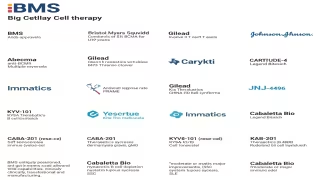
Six Cell Therapy Holdouts Double Down on CAR T and Autoimmune Plays as Big Pharma Retreats

Image
Six Cell Therapy Holdouts Double Down on CAR T and Autoimmune Plays as Big Pharma Retreats

SHERIDAN, WYOMING - December 2, 2025 - As several large pharmas pull back from cell therapy, a core group of biopharma players is doubling down on CAR T and next-generation approaches, positioning themselves to capture long-term value in oncology and autoimmune disease even as near-term sentiment cools.

Big pharma exits reshape expectations, not potential

Over the past year, the cell therapy field has seen a string of high-profile retreats. Takeda halted new investments in the modality and is offloading its pipeline and platforms after more than eight years of heavy spending. Novo Nordisk followed by terminating all cell therapy work, including a type 1 diabetes program, with nearly 250 roles cut. Belgian biotech Galapagos also shut down its cell therapy business after failing to find a buyer.

HAE Market Pivots to RNA and Gene Therapies as Patient 'Stickiness' Slows Uptake

Image
HAE Market Pivots to RNA and Gene Therapies as Patient ‘Stickiness’ Slows Uptake

SHERIDAN, WYOMING - December 2, 2025 - A wave of first-in-class hereditary angioedema (HAE) therapies is reshaping the U.S. Biotech & Research landscape, but questions remain over how quickly clinicians and patients will adopt these options in an already well-served rare disease market.

New approvals expand hereditary angioedema treatment choices

The HAE pipeline has accelerated dramatically, moving from basic C1 esterase inhibitors to sophisticated RNA-targeting and gene-editing approaches. The disease's life-threatening swelling attacks, including airway involvement, have long justified investment in both acute and prophylactic care, with the first FDA-approved preventive and on-demand therapies arriving in 2008 and 2009.

Tech-Powered CPG: How AI, Analytics and Sustainable Innovation Will Shape 2026

Image
Tech-Powered CPG: How AI, Analytics and Sustainable Innovation Will Shape 2026

SHERIDAN, WYOMING - December 2, 2025 - As consumer packaged goods companies head into 2026, Kellanova sees technology not as a back-office enabler but as a growth catalyst connecting insight to action, purpose to performance, and innovation to impact. From agentic AI to connected commerce and smart, sustainable supply chains, the company's leadership argues that digital transformation in CPG is now about reinvention, not just modernization.

Agentic AI moves from pilots to real business impact

Agentic AI is emerging as a force multiplier across the CPG value chain, capable of analyzing real-time data, making recommendations and executing actions without constant human intervention. In practice, that means automating repetitive tasks, streamlining cross-functional workflows and reacting to market shifts with new speed and precision.

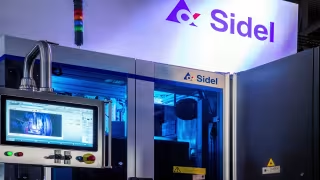
Sidel's EvoBLOW Laser pushes beverage and packaging lines toward leaner, low-energy blowing operations

Image
Sidel’s EvoBLOW Laser pushes beverage and packaging lines toward leaner, low-energy blowing operations

SHERIDAN, WYOMING - December 2, 2025 - With energy prices volatile and brand owners under pressure to cut carbon and costs, Sidel's EvoBLOW Laser technology is emerging as a strategic lever for beverage, food, home and personal care producers looking to modernize PET blowing operations. Following its breakthrough launch at drinktec and one year of industrial use in the field, President & CEO Pietro Cassani is outlining how the system's performance, simplicity and lightweighting potential are reshaping expectations for next-generation blowing equipment.

Laser-based blowing targets efficiency and TCO head-on

For producers operating high-speed PET lines, the shift from traditional halogen to laser-based blowing is more than a technical upgrade. It directly affects line efficiency, energy consumption and total cost of ownership across increasingly complex packaging portfolios.