Embedded Systems

Nuvoton Gerda HMI Controller Gets Qt for MCUs Support

KYOTO – November 05, 2026 -- Nuvoton Technology Corporation Japan (NTCJ) and Qt Group (Nasdaq Helsinki: QTCOM) have added Nuvoton's Gerda HMI controller platform as target hardware for Qt for MCUs, enabling premium graphical interfaces without external memory.

Built-in RAM removes external memory from the bill of materials

Gerda's large built-in RAM and its display, connectivity and control interfaces allow standalone HMI systems with no external memory. Qt for MCUs' graphics optimization and Gerda's texture compression shrink the GUI memory footprint. The companies say the result is a lower component count and lower total system cost, which matters most in high-volume products.

Target applications range from automotive and motorcycle instrument clusters and head-up displays to home appliance display panels. The companies demonstrated a motorcycle instrument cluster and a washing machine interface.

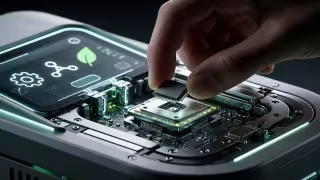
ABR Ships On-Device Speech AI SDK for Alif Ensemble on Zephyr

Image
ABR Ships On-Device Speech AI SDK for Alif Ensemble on Zephyr

WATERLOO – November 02, 2026 -- Applied Brain Research (ABR) has made its speech AI software development kit generally available on Zephyr RTOS for Alif Semiconductor's Ensemble family of edge AI processors. On the Ensemble E8, its Niagara ASR engine delivers 133 ms average latency from first audio to first token while drawing 15 mW of active power above baseline.

SDK bundles streaming recognition and synthesis that run without a cloud connection

The kit combines two engines. Niagara ASR provides full-vocabulary streaming speech recognition with low latency, transcribing speech continuously as it is spoken. Nith TTS provides low-latency streaming speech synthesis.

The SDK also offers native Zephyr RTOS support for battery-powered and air-gapped products, plus ongoing model updates and expansion.

Memory Squeeze Pushes Cellular IoT Makers Toward Embedded Processing

Image
Memory Squeeze Pushes Cellular IoT Makers Toward Embedded Processing

Global – – October 30, 2026 -- Rising memory costs and constrained memory supply are forcing cellular IoT device makers to decide whether their own engineers or the module supplier will requalify components when parts become unavailable, according to Telit Cinterion.

Hosted designs leave memory qualification with the manufacturer

In a hosted architecture, a host processor runs the application software while a separate cellular module provides connectivity. External memory and power management circuitry support the processor. The manufacturer keeps direct control over the application, and less software depends on a specific module, which simplifies switching suppliers.

If the selected memory becomes unavailable, engineers must qualify a replacement and verify its compatibility with the host processor. If it is not fully compatible, they may need to adapt the memory-communication software and revalidate the design.