Technical Guidance

TDengine Guide: Historian Data Needs Context Before AI Training

Image
TDengine Guide: Historian Data Needs Context Before AI Training

Global – October 27, 2026 -- A historian export of tags and timestamps is rarely a training-ready dataset for Industrial AI, according to TDengine guidance that tells engineers to establish what each measurement means, when it happened, which asset produced it and whether it is reliable before data reaches an external model-training workflow.

Engineers define the pump decision before selecting data

For a centrifugal pump, the guiding question is whether a reliability engineer should review the pump given its recent operating signals. That differs from asking a model to declare the cause of a failure. Records created after a maintenance decision must not become inputs, because they would not exist when the model makes its prediction.
OPC UA Connection Test Proves Only Part of Historian Data Path

Image
OPC UA Connection Test Proves Only Part of Historian Data Path

Global – October 27, 2026 -- A successful OPC UA connection check shows only that a client can reach the endpoint. It does not prove the intended nodes are readable, monitored, mapped or written to the historian, according to a five-step troubleshooting workflow for industrial data pipelines.

The method starts with one known, changing point, traced from the OPC UA server to one expected historian table. Large tag lists hide the first failure.

OPC UA vs MQTT: Match the Protocol to the Plant Data Role

Image
OPC UA vs MQTT: Match the Protocol to the Plant Data Role

Global – October 27, 2026 -- Industrial data architects should choose OPC UA when a collector must discover and read a structured source, and MQTT when producers publish through a broker to one or more consumers, according to a TDengine technical comparison. The guide adds that the two names do not describe equivalent layers, so the rule is only a starting point.

OPC UA preserves equipment context that MQTT leaves to the architect

OPC UA is a family of specifications covering Client/Server services, information modeling, Alarms and Conditions, Historical Access and PubSub. A server can organize measurements under equipment objects, attach engineering units and ranges, and expose status, timestamps and methods. A client can browse that address space instead of encoding meaning in topic strings.

Not every server delivers a rich model, however. Some expose flat tag lists, incomplete metadata or vendor-specific structures.

OPC UA Historians Need Alarm Records, Not Just Tag History

Image
OPC UA Historians Need Alarm Records, Not Just Tag History

Global – October 27, 2026 -- A pump pressure trend shows when a value left its normal range but cannot show which alarm changed state, what severity the server reported, or when an operator acknowledged it. Those answers sit in separate OPC UA records, and historian designs must decide which questions each record has to answer.

Tag history stores values, not alarm lifecycles

An OPC UA client collects a variable through a monitored item. When DataChange criteria are met, the server sends a DataValue that the historian can store with source timestamp, server timestamp, and StatusCode, depending on the collector mapping. Sampling, deadbands, queues, and timestamp selection determine how much process behavior survives.

TDengine taosX gRPC Is Unencrypted by Default in OT-IT Links

Image
TDengine taosX gRPC Is Unencrypted by Default in OT-IT Links

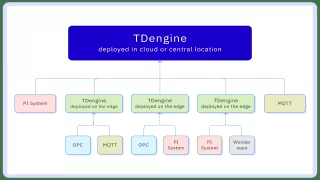
Global – October 27, 2026 -- The taosX gRPC interface in TDengine TSDB Enterprise is unencrypted by default, so teams collecting OPC UA data across network zones must explicitly enable and verify TLS, according to TDengine's security documentation. The point is part of a wider OT/IT integration checklist: a working OPC UA client beside the server proves only that the endpoint and credentials work locally, not that the same path should be opened from an enterprise historian into the control network.

Zones and flows come before collector placement

Segmentation protects more than confidentiality. OPC UA protocol security provides application authentication, message integrity and confidentiality, while network controls provide routing boundaries, firewall policy, inspection and isolation. Neither replaces the other: an encrypted session can still cross an overbroad firewall rule, end on a compromised collector, or run under an over-privileged account.