Research Report

Only 19% of Staff Feel Confident Using AI, Achievers Report Finds

Image
Only 19% of Staff Feel Confident Using AI, Achievers Report Finds

Toronto – October 17, 2026 -- Only 19% of employees worldwide feel confident using AI tools, according to the 2026 State of Recognition Report from the Achievers Workforce Institute, which argues that timely, specific recognition is missing infrastructure in AI transformation programs.

Employee readiness trails AI deployment on every measured dimension

New AI tools can arrive in weeks, while confidence, clarity and working norms take far longer to develop. The report puts numbers on that gap: 18% of employees have access to AI-enabled training, and 18% feel supported in adapting to AI and technology changes. Only 18% feel informed when changes affect their jobs, and 23% say communication is clear during uncertainty.

Only 17% of Firms Reach Optimized AI Adoption in L&D, Study Finds

Image
Only 17% of Firms Reach Optimized AI Adoption in L&D, Study Finds

Global – October 17, 2026 -- Only 17% of organizations have reached the top phase of Brandon Hall Group's Learning and Development Progression Model, where AI adoption spreads widely across L&D, while 39% still lack the foundational enablement infrastructure for it.

Brandon Hall Group data shows 44% of firms stall at deployment

The research covers four phases of L&D maturity. The 44% of organizations in Phase 3 (Defined/Strategic) have the structure to launch AI initiatives. Many of them treat AI as a technology rollout rather than a capability-building effort, which leads to stagnant adoption rates.

The 39% at the bottom have no personalized pathways, no analytics to identify capability gaps and no way to turn tool access into skills. Only Phase 4 (Optimized) organizations combine analytics expertise, data-driven decisions and forward-looking learning infrastructure.

Brandon Hall Review: Coaching Cuts Early Attrition to as Low as 16%

Image
Brandon Hall Review: Coaching Cuts Early Attrition to as Low as 16%

Chicago – October 17, 2026 -- Early-tenure attrition at key Advocate Health sites fell from more than 70% to as low as 16% after the system added coaching for new hires. The result is one of several outcomes in a Brandon Hall Group review of 27 HCM Excellence Awards Excellence in Practice blueprints from 11 patient-care organizations. The firm presented the review at the WMHH Summit in Chicago.

Ascension and Acibadem tie human skills to observable behaviors

Ascension's Elevated Service Actions initiative translated service commitments into six observable behaviors. Leaders reinforced one behavior per month through huddles, staff meetings and coaching. The case reported a 13-point improvement in care team responsiveness and nearly five points in clinician interaction scores.

MSC Decade Study: US Seafood Buyers Expect Sustainability by Default

Image
MSC Decade Study: US Seafood Buyers Expect Sustainability by Default

WASHINGTON – October 16, 2026 -- U.S. seafood consumers now treat sustainability as a default expectation rather than a niche preference, according to 10 years of Marine Stewardship Council (MSC) research covering 15,000 respondents since 2016.

The report, "A Decade of Change: Sustainability Now a Mainstream Concern of U.S. Seafood Consumers," was conducted for the MSC by the independent insights firm GlobeScan. It finds that U.S. consumer support for sustainability has climbed to match levels traditionally seen only among European consumers.

Consumers demand independent proof of sustainability claims

Shoppers increasingly want environmental claims independently verified, and claims alone no longer suffice. The MSC says this reinforces the value of credible third-party certification. Consumers also view sustainability as built into seafood products rather than added on, and economic realities continue to shape purchasing decisions.

Agentic AI Tests Insurers' Operating Models, CGI Research Finds

Image
Agentic AI Tests Insurers' Operating Models, CGI Research Finds

Global – October 15, 2026 -- Only 19% of insurance executives believe their operating model is agile enough to support digital transformation, even though 71% say digitalization is already affecting it, according to CGI's 2026 Voice of Our Clients research.

Agentic AI moves insurers from managing interactions to orchestrating outcomes

Conversational AI can explain what a policyholder should do after storm damage. An agentic system could go further: authenticate the customer, check coverage, open the claim, collect information, arrange services, initiate permitted payments and send proactive updates. A human claims professional steps in when judgment or extra support is required.

Checkr: 40% of US Hiring Managers Interviewed Fake Identities

Image
Checkr: 40% of US Hiring Managers Interviewed Fake Identities

San Francisco – October 15, 2026 -- Forty percent of U.S. hiring managers have interviewed a candidate later found to be using a fake identity, up from 31% in 2025, according to a new survey from verification platform Checkr.

The report, The Hiring Hoax 2026: Fraud Doesn't End at the Offer, is based on responses from 3,000 U.S. managers involved in hiring within the previous 12 months. The online survey ran Sept. 11-16, 2026, through a third-party platform.

Fraud training jumps to 71% of HR teams, but confidence stays at 23%

Formal fraud training among HR teams has risen from 17% to 71%. Only 23% of managers are extremely confident their hiring process would catch a fraudulent candidate.

CompTIA: 98% of Firms Rank AI Risk Management Essential

Image
CompTIA: 98% of Firms Rank AI Risk Management Essential

Downers Grove, Ill. – October 15, 2026 -- Some 98% of companies surveyed by CompTIA say risk management is important within organizational AI policies, as the focus of enterprise AI shifts from adoption to execution risk, according to the trade group's new research brief "Practical Implications of AI Safety."

About six in 10 organizations move toward enterprise-wide AI implementation

CompTIA's "Corporate AI Adoption" report found that roughly 60% of organizations are moving from experimentation and individual productivity use cases toward enterprise-wide deployment. Cybersecurity concerns rank as the second-largest challenge to AI adoption. Only finding the right balance between human employees and AI-powered tools and agents ranks higher.

Security-related policy elements draw near-universal support

Among surveyed companies, 96% cited data protection and privacy as important, and 95% cited governance. Risk management led at 98%.

EOS Survey: 29% of Europeans Prefer AI for Sensitive Banking Talks

Image
EOS Survey: 29% of Europeans Prefer AI for Sensitive Banking Talks

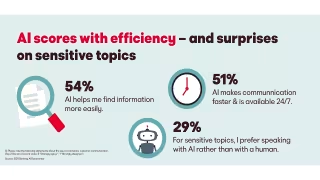
Hamburg – October 15, 2026 -- Some 29% of European bank customers would rather discuss sensitive financial matters with AI than with a human employee, according to the EOS Banking AI Barometer published by EOS Group. Among 18-34-year-olds, the share rises to 38%.

46% of consumers report better bank communication through AI

Only 11% of respondents perceive a decline in service quality. Some 54% value AI for helping them find information, and 51% praise faster communication and round-the-clock availability.

Trust in AI's problem-solving ability stays at 35-36%

Only 35% to 36% of respondents trust AI to understand their needs, act with precision and solve problems effectively. Some 60% miss the human touch in AI communication.

EOS Group CEO Marwin Ramcke said the best banks use AI as a tool for better service, not as a replacement for relationships.

Censys: Exposed AI Infrastructure Jumps 63% in Nine Months

Image
Censys: Exposed AI Infrastructure Jumps 63% in Nine Months

Ann Arbor – October 15, 2026 -- Internet-facing AI infrastructure grew 63% in nine months to nearly 268,000 systems, according to the fifth annual State of the Internet Report from Censys. The report also counts roughly 134,000 Internet-exposed hosts running industrial control systems (ICS). About 70% of those sit on consumer and mobile networks, which complicates efforts to identify their owners and close the exposure.

n8n and OpenClaw dominate exposed AI tooling

The Censys Advanced Research Collective (ARC) drew on historical and real-time data from the Censys Internet Map. The exposed AI category covers chatbots as well as the tools that connect AI to data, applications and user accounts.

CEOs Overrate Employee Trust: 90% Confident, 46% of Staff Agree

Image
CEOs Overrate Employee Trust: 90% Confident, 46% of Staff Agree

Boston – October 14, 2026 -- Nearly 90% of CEOs believe their employees trust their leadership, but only 46% of employees agree, according to the second edition of Boston Consulting Group's CEO Insomnia Index.

The gap is widest around AI transformation. Four in ten employees say their CEO has not been transparent enough about how AI will affect their roles and career opportunities. Only 15% of CEOs worry that their AI approach could erode employee trust.

The study draws on global surveys of 645 CEOs of companies with at least $100 million in revenue and 500 nonexecutive employees, plus five years of CEO turnover data from the S&P 1200. This edition adds employee perspectives to the Index for the first time.