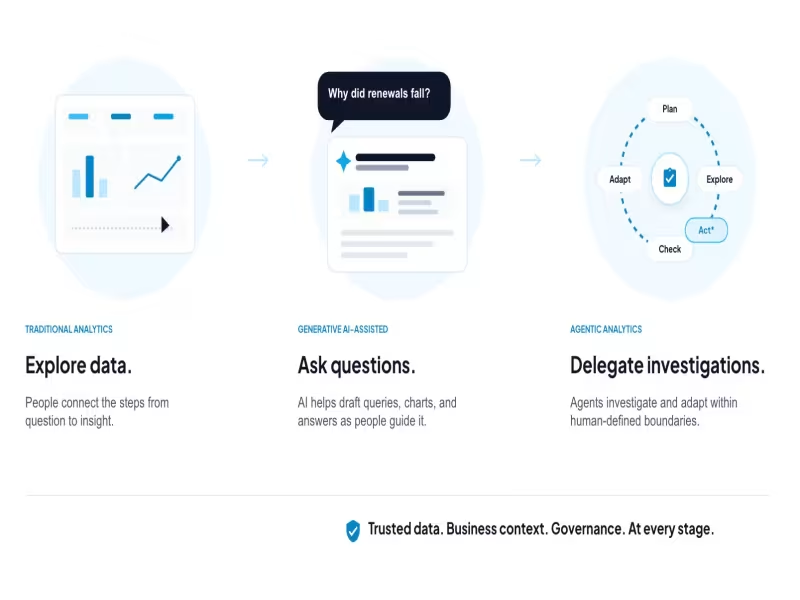
Global – October 27, 2026 -- Snowflake is built around three pillars, Ground, Analyze and Act, wrapped in a governance layer it calls Assure, to let AI agents run open-ended business investigations on enterprise data without copying that data into each agent platform.
The model targets agents that decide which data to examine, learn from each result and choose the next step. A churn probe, for example, could compare customer segments, product usage and support issues, then feed a recommended response into a retention workflow.
Semantic views, verified queries and certification tags give agents trusted business context
The Ground pillar combines Snowflake Horizon Context, semantic views and Snowflake Cortex Search. Verified queries give agents tested examples of how metrics should be answered, and certification tags point them to trusted tables. Data Metric Functions monitor quality dimensions such as completeness and uniqueness, while Dynamic Tables refresh derived data toward a configured freshness target.
Snowflake Optima and Interactive Analytics handle shifting agent query patterns
On Gen 2 and Adaptive Warehouses, Snowflake Optima uses observed workloads to improve query planning and data access automatically. Eligible repeated queries can reuse persisted results. Snowflake Interactive Analytics covers low-latency, high-concurrency selective queries, standard warehouses take compute-intensive analysis, and multi-cluster warehouses add capacity within configured limits.
Assure caps agent spend and restricts data even where user roles permit more
Configured policies can recognize agent-active sessions and limit the data an agent sees. Resource monitors and budgets track agent compute spend and can trigger actions at set thresholds, and statement timeouts stop runaway queries. Access controls stay attached to the data whether the agent is built on Snowflake or connected from another platform.
Approved outcomes reach business applications through MCP connectors or Snowflake tables
The agent recommends a next step and shows its evidence, and a person decides whether it proceeds. Consequential actions go to a person for approval, while routine ones can run under rules approved in advance. The owning application keeps control of the process. Records of agent-driven queries and data access can be combined with workflow records to review the resulting action.
Snowflake says interoperable interfaces, including the Model Context Protocol (MCP), semantic views and SQL objects, let authorized agents from different platforms use the same context. It cautioned that statements on future product offerings are not commitments to deliver.