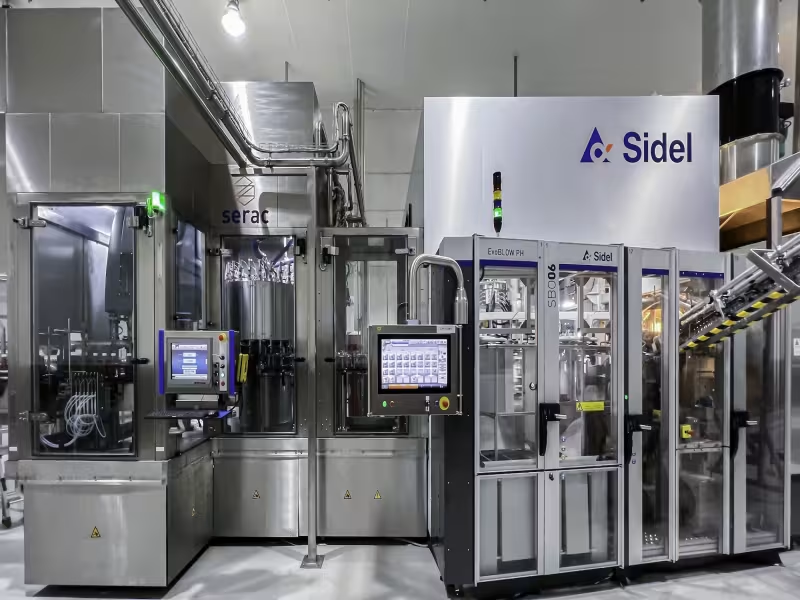
SHERIDAN, WYOMING - April 4, 2026 - Food and beverage manufacturers facing mounting pressure to reduce downtime, cut energy consumption, and raise output per line meter are increasingly looking to integrated packaging technology providers for solutions that address all three simultaneously. Sidel's participation at CFIA 2026 in Rennes, France positions the company's line optimization portfolio directly in front of the European food processing and packaging decision-makers who will be setting capital equipment budgets for the next procurement cycle.
Sidel's presence at CFIA 2026
CFIA - the Carrefour des Fournisseurs de l'Industrie Agroalimentaire - is one of France's principal trade events for the food and beverage processing and packaging industry, drawing plant managers, production engineers, and procurement leads from across the agri-food supply chain. Sidel, a global supplier of packaging and processing equipment for liquid food products including water, carbonated soft drinks, juices, dairy, and edible oils, is exhibiting at the 2026 edition to demonstrate its approach to full-line performance management.
The company's exhibit focuses on how integrated line design, combined with digital monitoring tools, can raise overall equipment effectiveness (OEE) and reduce total cost of ownership across filling, labelling, packaging, and palletizing operations. For manufacturers operating high-volume PET or carton lines, the practical implication is measurable: fewer unplanned stops, faster changeovers, and traceable energy data per SKU.
Line optimization technologies on display
Sidel's core proposition at CFIA 2026 centres on the operational efficiency gains available when individual line components - fillers, cappers, conveyors, packers, and wrappers - are engineered and monitored as a single system rather than as discrete machines. The company's line performance services include real-time production monitoring, predictive maintenance diagnostics, and operator support tools designed to surface bottlenecks before they cause throughput losses.
Digital connectivity plays a direct role in this efficiency model. Sidel's services portfolio includes remote monitoring and data analytics capabilities that allow production teams to benchmark actual performance against designed line capacity, identify recurring fault patterns, and schedule maintenance interventions during planned downtime rather than in response to breakdowns. For high-throughput beverage facilities running three-shift operations, the difference between reactive and predictive maintenance scheduling translates directly into annual output volume and labour cost.
Relevance to the European food processing sector
European food and beverage producers are navigating a combination of energy cost volatility, tightening sustainability reporting requirements under EU regulations, and ongoing pressure to reduce packaging material consumption. Line efficiency directly affects all three: a line running at 92% OEE versus 78% produces the same volume with less energy per unit, generates less material waste from rejected or reworked product, and reduces the frequency of unplanned energy surges associated with restart cycles.
France represents one of Sidel's core European markets, and CFIA provides concentrated access to French and broader European agri-food manufacturers at a single venue. The event's focus on supplier-buyer interaction makes it a commercially relevant platform for Sidel to engage plant-level and procurement-level contacts who are in active evaluation phases for capital or service contract decisions.
Business impact
Production and operations managers at food and beverage manufacturing sites evaluating line upgrade or service contract decisions in 2026 can use Sidel's CFIA presence as a direct comparison point against competing line integrators. The specific metrics on display - OEE benchmarks, energy consumption per unit output, changeover time reductions - provide the quantitative inputs that capex justification processes require. For operations directors running ageing lines with high reactive maintenance costs, the predictive maintenance and remote diagnostics offer a defined path to reducing unplanned downtime without full line replacement.
Procurement leads responsible for multi-year service agreements will find CFIA a useful venue for evaluating total cost of ownership models across line suppliers. Sidel's integrated approach, where equipment supply and digital performance services are offered within a single vendor relationship, affects how procurement teams structure service contracts and what performance guarantees they can negotiate. As EU sustainability disclosure obligations extend further into manufacturing operations through 2026 and beyond, the ability to report verified energy-per-unit data - which connected line monitoring enables - moves from a competitive differentiator to a compliance input for larger food manufacturers subject to corporate sustainability reporting.