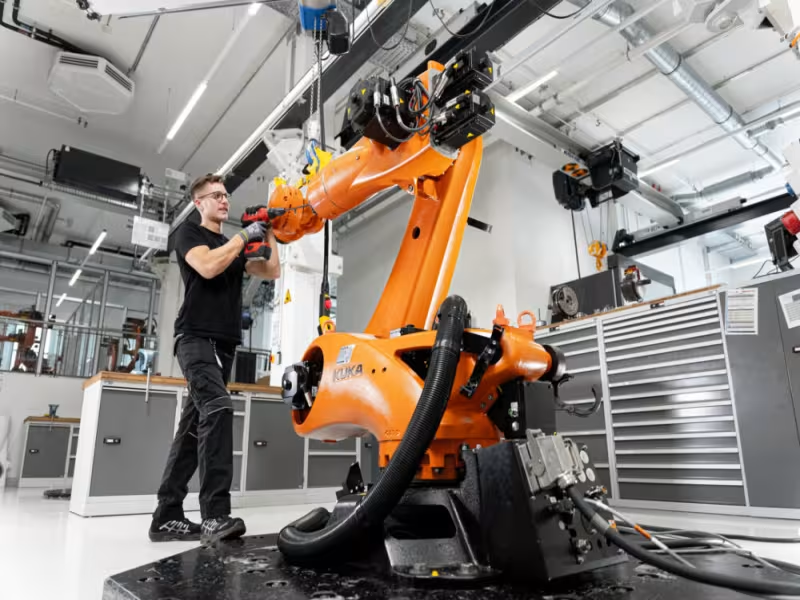
SHERIDAN, WYOMING - April 13, 2026 - Industrial robot adoption in pipe, wire, and tube manufacturing is accelerating sharply, driven by efficiency demands, sustainability targets, and a widening skilled labor shortage across the sector. KUKA, WAFIOS, and TRUMPF are among the equipment suppliers extending robot integration across welding, bending, and laser processing workflows, with solutions designed to reduce setup time, specialist training costs, and production downtime. According to the International Federation of Robotics, 542,000 industrial robots were installed globally in 2024-more than double the figure recorded a decade earlier-reflecting sustained investment as manufacturers pursue higher output and lower scrap rates. The European pipe market is projected to reach nearly 34 billion US dollars by 2030, reinforcing the commercial basis for continued automation investment across the sector.
Global Robot Installations Surpass 500,000 Units for Fourth Consecutive Year
The International Federation of Robotics reported 542,000 robot installations worldwide in 2024, marking the fourth year running in which annual deployments exceeded 500,000 units. A total of 4.664 million industrial robots were in operation globally by the end of 2024, representing a year-on-year increase of 9%. Asia accounted for 74% of new installations, with Europe at 16% and the Americas at 9%. The OECD and IMF forecast global robotics market growth of between 2.9% and 3.1% for 2026. Germany remains Europe's largest robotics market and the world's fifth-largest, with 26,982 units installed in 2024-the second-best result on record, just below the peak year of 2023.
European Pipe Market Growth Underpins Long-Term Automation Investment
The European pipe market is expected to expand at approximately 5% annually between 2023 and 2030, according to Data Bridge Market Research, reaching a potential value of nearly 34 billion US dollars. This growth is driven in particular by developments in the European energy landscape and rising pipeline infrastructure requirements. Germany has been identified as the fastest-growing pipe market in Europe, concentrating both demand for and supply of automated pipe production solutions within the region. For equipment suppliers and processors, this sustained growth trajectory represents a durable commercial incentive to invest in automation capability and expand production capacity.
KUKA Receives Follow-On Order for Twelve Additional FSW Cells in EV Manufacturing
Following a major 2024 contract for 23 Friction Stir Welding cells with integrated robots for an electric vehicle manufacturer in the United States, KUKA has now secured an additional order for twelve further FSW cells to support a production expansion at the same facility. The cells incorporate KUKA robots alongside clamping systems tailored to the FSW process and are integrated into electric vehicle production lines across multiple production stages. A central KUKA software platform supports the entire automation workflow, enabling seamless data exchange across all planning and production steps. The company notes that digital twins have made robot deployment faster and more accessible, with offline programming and virtual commissioning extending the reach of Industry 4.0 implementation into complex manufacturing environments.
WAFIOS EasyRobot Eliminates Standalone Programming Step for CNC Bending Operations
Responding to rising quality and packaging requirements in the handling of springs, wires, and bent-pipe components, WAFIOS has fully integrated robots from KUKA's Agilus and Cybertech line into its WPS 3.2 EasyWay programming system. The resulting EasyRobot capability allows the robot to be controlled directly through the WAFIOS machine interface, merging component and robot programs without requiring a separate programming phase.
"This means the robot can be controlled just like a WAFIOS machine, eliminating the need for expensive specialist robot training," the company explains.
"Thanks to this complete integration of the industrial robot into the production process, the EasyRobot significantly reduces the programming time for bending programmes involving handling tasks, and reduces costs associated with specialist operator training."
For operators of WAFIOS CNC machines producing springs, wire, and bent-pipe components, the practical outcome is the elimination of a standalone robot setup phase and the removal of specialist programming requirements-reducing both training overhead and configuration time on the production floor.
TRUMPF-Led Research Project Targets Cognitive Automation for Special-Purpose Machine Setup
TRUMPF is participating in a collaborative research initiative titled "Cognitive Automation for Production," which aims to automate the manual and complex steps involved in setting up large machine tools using robotics and artificial intelligence. The project is particularly focused on the construction of special-purpose systems and the manufacture of small batches-historically among the most difficult areas to automate at scale. Partners in the project are developing a modular software toolkit for cognitive automation functions in robotics, with AI integrated as a core architectural component rather than a supplementary layer. For manufacturers operating low-volume or custom production environments, this approach signals a practical near-term pathway to meaningful automation coverage.
Maincor, Maxsyma, and Fraunhofer IPA Deploy AI Algorithm for Real-Time Weld Fault Detection
A separate AI-driven collaboration involves Maincor Rohrsysteme, Maxsyma, and the Fraunhofer Institute for Production Technology and Automation, with a focus on process optimization, predictive maintenance, and quality assurance in pipe production. Central to the initiative is an intelligent algorithm designed to monitor ultrasonic welding processes in real time, capable of detecting faulty welds immediately and reducing both scrap rates and machine downtime. Maincor has cited precise monitoring and predictive maintenance as key drivers of efficiency and quality gains in the sector. This type of targeted algorithmic integration offers pipe manufacturers a practical route to waste reduction and improved process reliability without requiring full-scale production redesign.