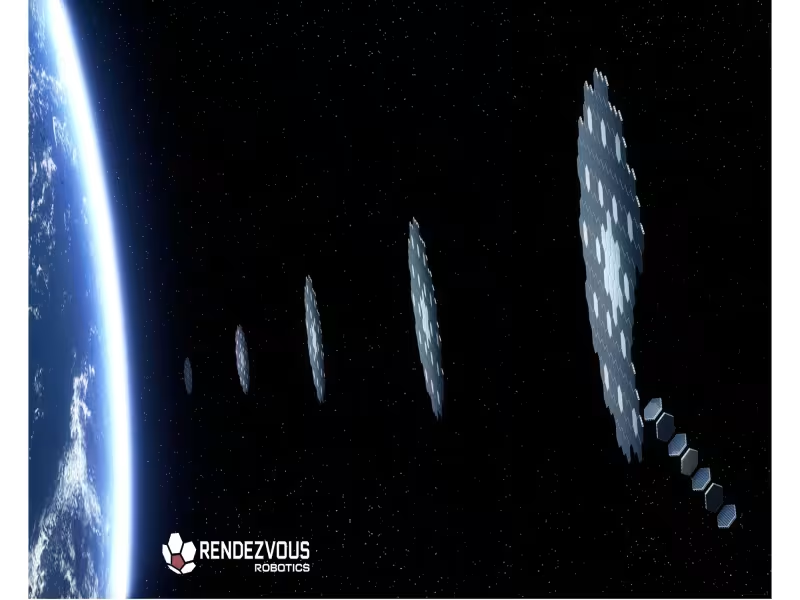
GOLDEN – October 29, 2026 -- Rendezvous Robotics has raised $20 million in an oversubscribed seed round to build spacecraft that assemble themselves in orbit. MaC Venture Capital and Toyota Ventures led the financing, the company's first priced round.
The University of Michigan Endowment participated significantly. New investors include Astera, co-founded by Jed McCaleb, and Industrious Ventures. Existing backers Aurelia Foundry, ATX Venture Partners and Mana Ventures also took part. The capital will fund next-generation spacecraft development, flight demonstrations and team expansion.
Seven-tile mission targets no earlier than April 2028
Rendezvous plans a low-earth orbit demonstration on a reserved rideshare launch, no earlier than April 2028. Seven independent spacecraft tiles will autonomously join into a single spacecraft, separate, and assemble again in a different configuration. The company says the mission will show a spacecraft changing its physical structure after launch without external robotic assistance.
Ground demonstrations are validating autonomous movement, alignment and assembly of the larger tiles. A parabolic flight campaign in November 2026 will test electromagnetic actuation and mobility in microgravity.
Design removes the rocket fairing as the limiting factor
Most spacecraft are sized to fit inside a launch fairing. That forces tradeoffs in power generation, compute, antenna size and heat dissipation before launch. Rendezvous instead launches compact, independent tiles that maneuver, align and connect in orbit, so structures can grow or be reconfigured for new missions.
"We're changing what it means to build a spacecraft," said CEO and co-founder Joe Landon. He pointed to potential megawatt-scale power generation and large communications and sensing apertures. The company is targeting commercial, civil and national security missions.
TESSERAE research from MIT supplies the technical base
Rendezvous builds on nearly a decade of work on TESSERAE, a modular self-assembly technology invented by Dr. Ariel Ekblaw at MIT. It was further developed through the Aurelia Institute, which Ekblaw founded. She is now Rendezvous co-founder and board chair. Earlier generations flew on Blue Origin's New Shepard rocket and on two International Space Station missions.
A final ISS demonstration of fifth-generation TESSERAE is scheduled for December 2026. In it, 32 tiles will autonomously assemble into a three-dimensional structure in controlled microgravity. The experiment closes the TESSERAE research program as Rendezvous shifts to the larger, free-flying architecture.
Toyota Ventures cites autonomy as core to the design
Chris Abshire, Partner at Toyota Ventures, said autonomy is fundamental to how Rendezvous designs its spacecraft rather than an added feature. He said modules that maneuver, connect and eventually reconfigure in orbit could give designers and operators new options.
Michael Palank, Managing General Partner at MaC Venture Capital, said Rendezvous is rethinking how spacecraft are built rather than how they are packaged for launch. Daniel Feder, Senior Managing Director at the University of Michigan Investment Office, said his office has followed Ekblaw's research and backs the team's move from research into practical use.