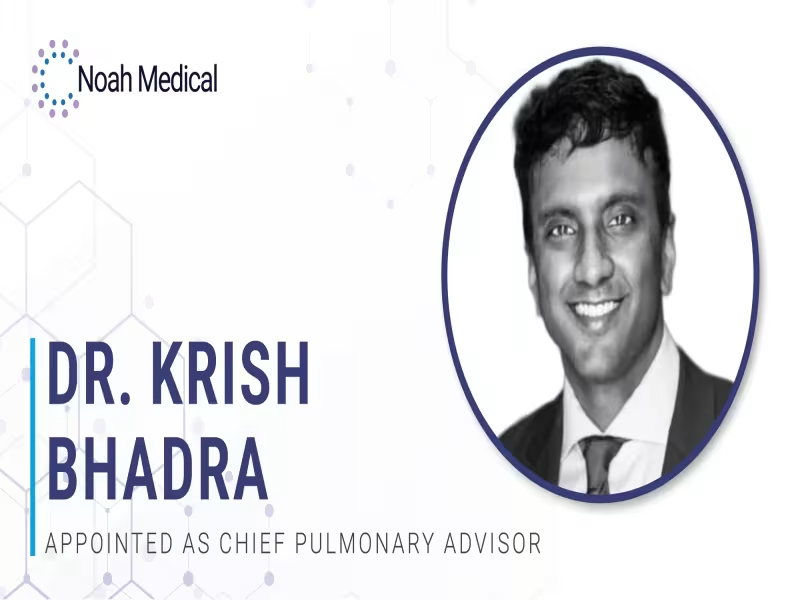
San Carlos, Calif. – October 12, 2026 -- Noah Medical has created a Chief Pulmonary Advisor role and filled it with Krish Bhadra, MD, an interventional pulmonologist at Stanford Medicine who has performed more than 2,300 robotic-assisted bronchoscopy procedures.
Bhadra to steer clinical education, evidence strategy and product development
In the newly created position, Bhadra will guide Noah Medical's clinical education, evidence strategy and product development. The medical robotics company said the aim is to expand access to advanced robotic bronchoscopy for the millions of patients at risk for lung cancer.
Noah Medical CEO Jian Zhang said the company is scaling the impact of its Galaxy System and called Bhadra "exactly the partner we need" for that effort.
Bhadra brings early adoption of tomosynthesis and cone beam CT
Bhadra was one of the first physicians in the United States to implement digital tomosynthesis in bronchoscopy. He was also an early adopter of cone beam CT technology. Noah Medical credits both with setting new standards for diagnostic precision.
His research covers procedural optimization, imaging integration and technique standardization. He has made contributions in apneic oxygenation, ventilation strategies and prone positioning, all aimed at improving diagnostic yield and patient safety. He has also authored multiple peer-reviewed publications.
Bhadra targets reproducible bronchoscopy across sites and operators
Bhadra said his focus has been making advanced bronchoscopy safer, more accurate and more reproducible, regardless of where a patient is treated or who performs the procedure. He described the Galaxy System as a platform that can move the needle on early lung cancer detection.
Advisor's track record spans multicenter research and national lung programs
Bhadra has collaborated on multicenter research and medical device development and has taught at national and international forums. He served as National Co-Chair of the CommonSpirit Health Lung Council, formerly Catholic Health Initiatives, and sits on the scientific board of the GO2 for Lung Cancer Foundation.
He completed fellowships in Pulmonary Disease and Critical Care Medicine at the University of Pennsylvania Health System and the University of Vermont Medical Center. He earned his medical degree at the University of Miami Miller School of Medicine.