United States

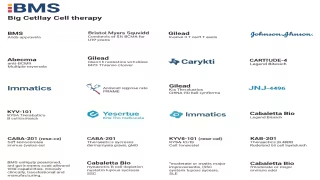
Six Cell Therapy Holdouts Double Down on CAR T and Autoimmune Plays as Big Pharma Retreats

Image
Six Cell Therapy Holdouts Double Down on CAR T and Autoimmune Plays as Big Pharma Retreats

SHERIDAN, WYOMING - December 2, 2025 - As several large pharmas pull back from cell therapy, a core group of biopharma players is doubling down on CAR T and next-generation approaches, positioning themselves to capture long-term value in oncology and autoimmune disease even as near-term sentiment cools.

Big pharma exits reshape expectations, not potential

Over the past year, the cell therapy field has seen a string of high-profile retreats. Takeda halted new investments in the modality and is offloading its pipeline and platforms after more than eight years of heavy spending. Novo Nordisk followed by terminating all cell therapy work, including a type 1 diabetes program, with nearly 250 roles cut. Belgian biotech Galapagos also shut down its cell therapy business after failing to find a buyer.

HAE Market Pivots to RNA and Gene Therapies as Patient 'Stickiness' Slows Uptake

Image
HAE Market Pivots to RNA and Gene Therapies as Patient ‘Stickiness’ Slows Uptake

SHERIDAN, WYOMING - December 2, 2025 - A wave of first-in-class hereditary angioedema (HAE) therapies is reshaping the U.S. Biotech & Research landscape, but questions remain over how quickly clinicians and patients will adopt these options in an already well-served rare disease market.

New approvals expand hereditary angioedema treatment choices

The HAE pipeline has accelerated dramatically, moving from basic C1 esterase inhibitors to sophisticated RNA-targeting and gene-editing approaches. The disease's life-threatening swelling attacks, including airway involvement, have long justified investment in both acute and prophylactic care, with the first FDA-approved preventive and on-demand therapies arriving in 2008 and 2009.

U.S. Biotech at Risk: How Federal Budget Cuts Undermine Innovation Leadership

Image
U.S. Biotech at Risk: How Federal Budget Cuts Undermine Innovation Leadership

SHERIDAN, WYOMING - December 2, 2025 - As the United States grapples with record-setting government shutdowns and budget fights, the country's biotech and research ecosystem is confronting a deeper structural problem: federal science funding is increasingly unstable, putting early-stage innovation, talent pipelines and long-term competitiveness at risk. For an industry built on long horizons and high-risk discovery, interruptions to programs such as NIH grants and Small Business Innovation Research (SBIR) contracts are more than a temporary setback-they threaten the foundations of America's leadership in biopharma innovation.

Federal science funding as the backbone of U.S. biopharma

Philips gains FDA 510(k) clearance for cloud-based Cardiovascular Workspace to accelerate AI in U.S. cardiology

Image
Philips gains FDA 510(k) clearance for cloud-based Cardiovascular Workspace to accelerate AI in U.S. cardiology

SHERIDAN, WYOMING - November 25, 2025 - Philips has received U.S. FDA 510(k) clearance for the latest release of its Cardiovascular Workspace (IntelliSpace Cardiovascular, ISCV), enabling U.S. health systems to deploy the cardiovascular imaging and information management platform as a cloud-hosted, SaaS solution on Philips HealthSuite. The move positions hospitals and cardiology networks to modernize IT, scale integrated diagnostics, and accelerate real-world adoption of AI-enabled cardiovascular workflows.

Cloud-based cardiovascular informatics for U.S. health systems

Scaling Health Innovation with Startups and Universities: Nestlé Health Science Targets Women's Health and Longevity

Image
nestle

SHERIDAN, WYOMING - November 25, 2025 - Nestlé Health Science is deepening its open innovation strategy in nutrition and health through a series of academic and startup collaborations focused on women's health, healthy longevity and weight management, positioning itself at the center of fast-growing therapeutic nutrition markets. By linking university-based science, entrepreneurial talent and its own R&D capabilities, the company aims to accelerate the translation of emerging technologies into differentiated nutritional solutions for consumers and patients.

Dentsply Sirona Expands Veteran Oral-Health Access Through Corporate-Community Partnership with DLN

Image
Dentsply Sirona Expands Veteran Oral-Health Access Through Corporate–Community Partnership with DLN

SHERIDAN, WYOMING - November 13, 2025 - Dentsply Sirona is strengthening its long-term commitment to increasing oral-health access for U.S. veterans, deepening its partnership with Dental Lifeline Network (DLN) and activating employee-driven support initiatives across the country. The renewed collaboration aligns with the company's global sustainability strategy and reflects a growing corporate focus on social-impact programs that directly address care gaps in underserved populations.

Strengthening a Decades-Long Collaboration

Dentsply Sirona and DLN have worked together since 1999, forming one of the dental industry's most enduring corporate-nonprofit collaborations. Entering its 26th year, the partnership includes direct financial support, in-kind product donations and professional-volunteer mobilization through Dentsply Sirona's VETERANS@DS employee resource group.

Pfizer's Metsera Acquisition Signals Policy-Aligned Bet on Next-Generation Obesity Therapies

Image
Correct taxonomy (Industry, Theme, Market)

SHERIDAN, WYOMING - November 13, 2025 - Pfizer has completed its $7 billion acquisition of Metsera, securing a set of differentiated obesity and cardiometabolic candidates as regulatory momentum accelerates around metabolic disease innovation in the United States. The deal positions Pfizer at the center of one of the most politically scrutinized and fastest-growing therapeutic markets, as federal leaders push for expanded access and a stronger domestic pipeline in obesity care.

Pharma's DTC Discount Wave Targets Select Drug Classes - But Real Market Impact Remains Uneven

Image
Pharma's DTC Discount Wave Targets Select Drug Classes - But Real Market Impact Remains Uneven

SHERIDAN, WYOMING - November 13, 2025 - As the TrumpRx platform approaches launch in early 2026, U.S. drugmakers are rolling out targeted direct-to-consumer pricing for a carefully chosen mix of dermatology, respiratory, cardiovascular, immunology, and metabolic products. While the discounts generate attention, analysts say their commercial impact varies sharply by drug class, revenue cycle, and therapeutic demand-revealing a strategic pattern rather than a broad affordability shift.

Discounting Patterns Reveal Manufacturers' Portfolio Priorities
Pfizer, AstraZeneca, Amgen, Bristol Myers Squibb, Novo Nordisk, and Lilly have each chosen different subsets of products for deep DTC price cuts. Across these offerings, a clear pattern emerges: brands with declining growth, approaching patent expirations, or limited payer friction are overrepresented.

Drugmakers Accelerate Direct-to-Consumer Pricing as TrumpRx Looms, But Market Impact May Be Limited

Image
Pharma Pressures Mount as TrumpRx and DTC Drug Pricing Models Face Economic and Policy Scrutiny

SHERIDAN, WYOMING - November 13, 2025 - Major pharmaceutical companies are rapidly rolling out direct-to-consumer (DTC) pricing programs ahead of the federal TrumpRx platform's debut in early 2026, signaling a shift in commercial strategy as manufacturers seek to bypass traditional intermediaries and regain control of how patients access branded therapies. Yet analysts warn that these channels-despite deep headline discounts-may offer only marginal financial relief to most patients and are unlikely to dent overall U.S. drug spending.

Pharma Pressures Mount as TrumpRx and DTC Drug Pricing Models Face Economic and Policy Scrutiny

Image
Pharma Pressures Mount as TrumpRx and DTC Drug Pricing Models Face Economic and Policy Scrutiny

SHERIDAN, WYOMING - November 13, 2025 - As the federal government prepares to launch its TrumpRx direct-to-consumer platform in early 2026, U.S. drugmakers are accelerating their own discount initiatives in anticipation of sweeping pricing reforms tied to the Most Favored Nation (MFN) framework. Yet analysts and health economists warn that these programs-ranging from discounted dermatology creams to multi-billion-dollar GLP-1 therapies-may have limited influence on overall spending, with most insured patients unlikely to shift away from existing payer pathways.