Brisbane – September 30, 2026 -- The EATP Pegasus long endurance drone completed a nearly two-hour test flight covering more than 75 kilometres on a single Li-S Energy lithium sulfur battery pack, landing safely with battery capacity to spare.
Pegasus battery delivers 80% more range than comparable lithium polymer packs
On a same cell weight basis, Li-S Energy's 382 Wh lithium sulfur battery packs delivered 80% more range and flight time than an equivalent high-performance professional lithium polymer UAV battery pack, according to the company. The twin-motor, five-metre wingspan aircraft combines V-TOL Aerospace's airframe and power systems, Li-S Energy's battery packs and battery management system, and a perovskite solar array fabricated by Halocell Energy.
Commonwealth grant of $1.35 million backed the two-year development programme
The project was supported by a grant of just over $1.35 million from the Commonwealth Government under the Emerging Aviation Technology Partnership programme, matched by the three collaboration partners. This flight marks the culmination of the EATP project's practical development and flight test work, announced initially in June 2024.
Dual battery configuration targets 5-8 hour missions covering 250 kilometres
Pegasus is designed to accommodate two Li-S Energy battery packs. With planned improvements to Halocell's solar array performance beyond the current airframe configuration, the partners expect the platform to achieve flight missions of five to eight hours and 250 kilometres, suited for long endurance mapping, surveillance, agricultural, utilities and environmental monitoring missions.
Drone market investment from US and Australian governments exceeds A$100 billion
Demand for drones is growing across commercial and defence markets, with proposed US and Australian government investment in drone and counter-drone technologies now exceeding A$100 billion. Li-S Energy filed two patent applications during the project covering the battery management system and battery pack design.
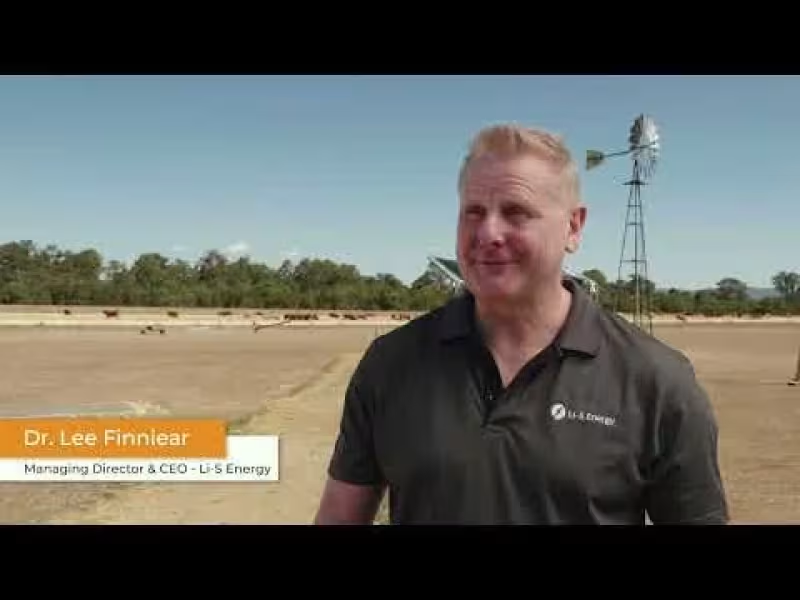
Dr Lee Finniear, Chief Executive Officer and Managing Director of Li-S Energy, said the flight demonstrates Australia's sovereign capability in the sector following two years of work across the three companies.
Following the successful flight, the collaboration partners intend to assess further commercial development and are targeting future platform sales, with flight data now being analysed to characterise platform performance and inform commercial assessment.