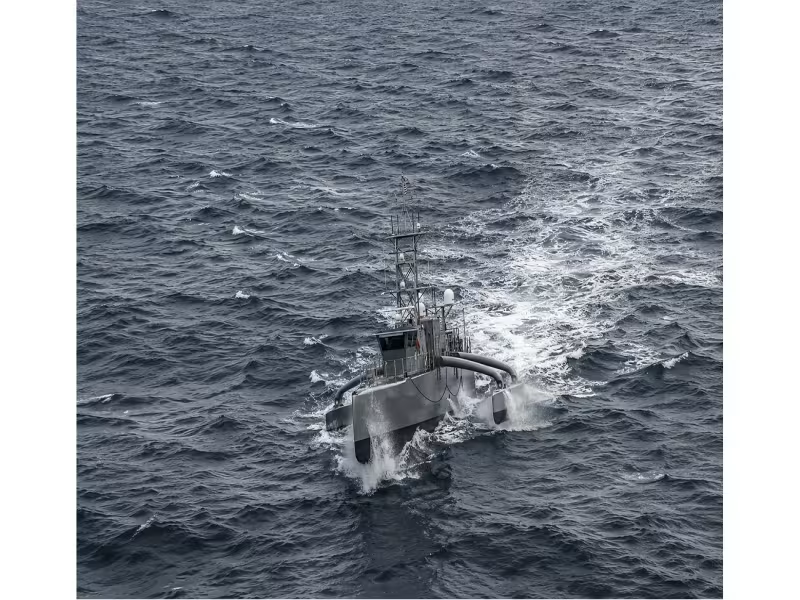
Reston, Virginia – September 12, 2026 -- Leidos-built autonomous surface vessels Sea Hunter and Seahawk have logged more than 200,000 nautical miles and 14,000 hours of autonomous operation across the company's maritime portfolio, marking over a decade of at-sea autonomy development.
Sea Hunter completes 2,000-nautical-mile autonomous transit during RIMPAC 2026
Sea Hunter served as the exercise's only Medium Unmanned Surface Vessel (MUSV), operating autonomously from Pearl Harbor, Hawaii, to San Diego, California, a distance exceeding 2,000 nautical miles. The vessel demonstrated autonomous surveillance and manned-unmanned teaming, functioning both as part of a larger naval force and as a stand-alone platform.
Seahawk becomes first MUSV to deploy operationally with a carrier strike group
Seahawk is currently operating alongside crewed naval forces within the USS Theodore Roosevelt Carrier Strike Group's communications and command-and-control framework. Its capabilities include autonomous navigation and perception, COLREGs-compliant collision avoidance, automatic avoidance of designated Keep Out Zones, and communications failover to alternate control paths. The vessel also demonstrated GPS-denied navigation, following commanded waypoints without satellite positioning and reintegrating GPS while remaining on track.
Leidos Autonomous Vessel Architecture powers both platforms
Sea Hunter and Seahawk run on the Leidos Autonomous Vessel Architecture (LAVA), modular software enabling autonomous navigation, mission execution and obstacle avoidance. The architecture provides a common autonomy foundation adaptable across different vessels and mission requirements.
Ranger test-fired an SM-6 missile under the Navy's Ghost Fleet Overlord program in 2021
The Leidos-built MUSV Ranger, also running LAVA, test-fired an SM-6 Standard Missile from a modular launch system in 2021. Combined with Sea Hunter and Seahawk, the three vessels demonstrate autonomy applications spanning surveillance, fleet integration and weapons deployment.
"Sea Hunter and Seahawk show what more than a decade of operating autonomy at sea brings to the mission," said Mike Rickels, Leidos senior vice president for Maritime. "Real-world operations validate performance while providing lessons that further refine autonomy for future missions."