SHERIDAN, WYOMING - May 13, 2025 - Beverage and liquid food producers are entering one of the sector's most operationally demanding periods in years. Regulatory deadlines are tightening. Qualified line operators are harder to find. Raw material costs remain elevated. KHS, the Dortmund-based turnkey systems supplier, is responding with an expanded portfolio that links automated packaging machinery, resource-conserving secondary formats and advanced PET barrier technology into coordinated line solutions - designed for producers who can no longer afford to treat these challenges separately.
PPWR and Plastic Restrictions Are Already Reshaping Line Investment Decisions
The European Union's Packaging and Packaging Waste Regulation is not a future problem. For beverage producers operating at scale, it is already influencing format decisions, supplier conversations and capital expenditure planning. Secondary packaging is where the pressure is most immediate. Plastic ring systems are restricted in several markets. Film-heavy multipacks face increasing scrutiny. The shift toward cardboard, paper and high-recyclate film is accelerating - not because producers want it, but because the regulatory and retail environment is forcing it.
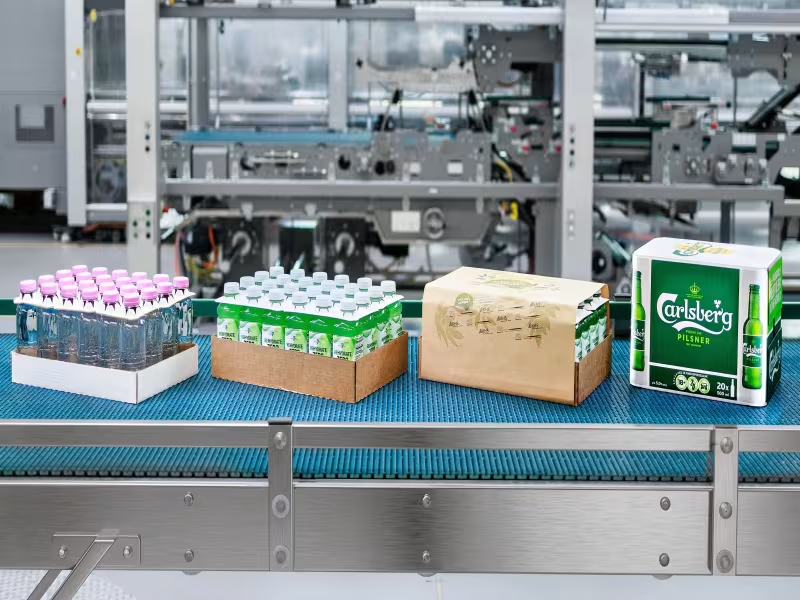
KHS positions its portfolio directly against these constraints. The company's range of secondary packaging formats covers adhesive-dot multipacks, cardboard toppers, paper-based wraps and recyclate-heavy film - giving line operators concrete format alternatives rather than roadmaps to future solutions.
What makes this strategically relevant is not any single format. It is the ability to switch between them on existing machinery without full line replacement.
Innopack Kisters TSP Advanced: Format Flexibility at High Throughput
The further-developed KHS Innopack Kisters TSP Advanced is the operational center of this flexibility argument. The fully automatic machine handles PET and glass bottles as well as cans, packing them on trays, in film, or on trays and pads combined with film. At up to 7,200 packs per hour, it operates in the high-capacity segment where format inflexibility carries real financial consequences.
The new patented BottleClip Carrier application, introduced for the first time at interpack, is the clearest example of how KHS is absorbing regulatory pressure into machine design. The cardboard carrying handle joins PET containers into stable multipacks, replacing plastic ring systems that are no longer permitted in some markets. The option is available across all standard KHS Kisters machines in the Advanced series - meaning existing customers in that series can adopt the format without changing their core machinery platform.
For procurement and production managers evaluating capital expenditure, this matters. Line replacement is expensive. Format extension on proven equipment is not.
Nature MultiPack and Carton Nature Pack Address the No-Plastic Requirement
Where the BottleClip Carrier replaces one plastic format with cardboard, two other KHS systems go further. The Carton Nature Pack uses a cardboard topper clipped onto the upper rim of cans to create stable multipacks. No plastic is used at any stage. The Nature MultiPack eliminates both cardboard and plastic film entirely, using small adhesive dots to bond cans or PET bottles into packs that maintain structural integrity while allowing individual containers to be detached cleanly.
The Nature MultiPack is already market-proven across multiple regions. In Asia, Africa and South America, film-based secondary packaging for PET bottles still dominates - but the pressure to transition is building from retail and regulatory directions simultaneously. KHS is supporting producers in these markets through format migration, not format mandate, working with customers to develop packaging strategies that are compliant, cost-effective and manufacturable on existing or planned lines.
For operations teams, the adhesive-dot approach also reduces consumable complexity. Fewer materials in the secondary packaging process means fewer supplier dependencies and fewer points of failure.
Lightweight PET and Barrier Technology Close the Performance Gap
Lightweight PET has historically created a tradeoff: reduce material, increase fragility and compromise barrier performance. Two KHS developments address this directly.
KHS Premium LITE is a 0.25-liter PET bottle weighing 6.2 grams, developed in cooperation with Husky Technologies. The container is designed for maximum filling speeds despite its minimal material weight - a combination that matters for high-throughput lines where a bottle optimized for sustainability but not for runnability creates downstream production losses.
KHS SUPREME takes a different approach. Rather than minimizing material, it addresses barrier performance. The bottle applies Plasmax technology - a wafer-thin silicon oxide layer on the inside of the PET container - to protect oxygen-sensitive products including juice, beer, carbonated soft drinks, tea, wine and liquid food from oxidation and carbon dioxide loss. Shelf life is extended. Taste and color are preserved over longer periods.
The commercial logic for barrier PET is sharpening. Glass remains the reference for oxygen-sensitive beverages, but its weight and breakage profile create logistics costs. KHS SUPREME offers glass-level barrier performance in a plastic container - one that is fully recyclable and compatible with closed-loop PET systems, because Plasmax coating dissolves completely during standard recycling. Unlike multilayer or scavenger barrier systems that complicate sorting, this approach maintains the purity of the separated PET fraction.
Automation Addresses the Labor Shortage Directly
Fewer skilled line operators. Reduced maintenance staffing. Longer mean-time-to-repair when things go wrong. The labor shortage in industrial production is not abstract - it translates directly into downtime risk and output variability for beverage manufacturers.
KHS InnoPET iflex targets this problem at the changeover stage, which is where labor dependency is highest and errors are most costly. With iflex applied on PET lines, format changeovers complete within 30 minutes and product changeovers within ten. Up to 80% of manual line conversion tasks are eliminated. For producers running multiple SKUs across shared lines, this changes the economic case for shorter production runs.
Supporting tools include:
- Innoline Basic Line Monitoring for continuous line performance visibility
- ReDiS remote diagnostics and maintenance for reduced on-site intervention requirements
- Augmented Reality Service support for operator guidance without specialist presence
- AI-assisted inspection technology for tethered caps, addressing a compliance requirement that is becoming standard across beverage categories
These are not standalone digital features. In combination, they reduce the operational dependency on scarce specialist personnel while maintaining the line performance standards that high-volume beverage production requires.
Bottles & Shapes and TCO-Focused Service as Long-Term Retention Tools
KHS' Bottles & Shapes consultancy service extends the supplier relationship beyond machinery transactions. The service supports customers from initial container design through to market launch, covering PET, recycled PET, glass and cans. The balance it strikes - between consumer-facing design, environmental considerations and reliable line behavior - reflects the reality that packaging decisions are now cross-functional, involving sustainability, operations, marketing and procurement simultaneously.
For KHS, this consultancy model serves a strategic purpose. Producers who develop container formats in partnership with their line supplier are significantly more likely to align capital investment decisions with that supplier's machinery ecosystem. It converts a transactional equipment relationship into an ongoing technical partnership.
The broader service portfolio - 3D line design, remote support, monitoring software, format changeover systems - is positioned around total cost of ownership rather than upfront price. In a market where energy costs, raw material prices and labor availability are all under pressure, the argument for low TCO over equipment lifetime is more commercially persuasive than it was five years ago.