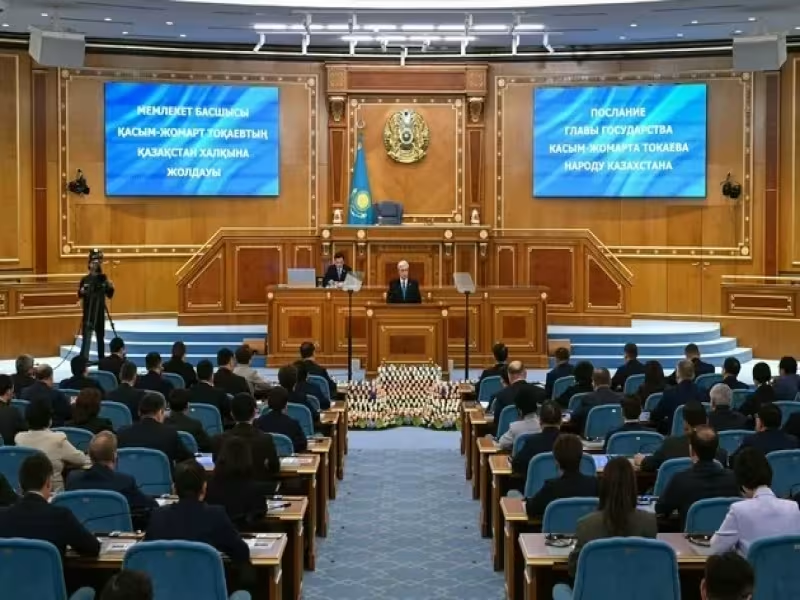
Astana – October 29, 2026 -- Kazakhstan will invest about $14.3 billion (6.5 trillion tenge) from its National Fund in infrastructure through 2029, President Kassym-Jomart Tokayev announced Wednesday in his state-of-the-nation address. The program aims to speed up growth in Central Asia's largest economy and reduce its dependence on raw materials.
The IMF projects that GDP per capita could rise above $19,000 as a result, up from $14,770 in 2025. Gold and foreign-exchange reserves plus National Fund assets now exceed $130 billion.
Social projects receive $3.3 billion by February 2027
A first tranche of $3.3 billion is earmarked for social projects by February 2027. It covers 70 healthcare facilities and about 50 education, sport and cultural venues. Tokayev said next year will be declared the year of nationwide construction.
272-kilometer rail line and 800-kilometer highway target China-Europe transit
The 272-kilometer Bakhty-Ayagoz railway in eastern Kazakhstan is scheduled to open in 2027. A roughly 800-kilometer highway between Beineu and Saksaulsk is also under construction. According to Tokayev, it will shorten the China-Europe route by about 1,000 kilometers and cut delivery times by up to three days.
The projects are meant to strengthen the Middle Corridor, which links Asia and Europe via Central Asia, the Caspian Sea and the South Caucasus. For German and European companies, the buildout offers added scope to diversify supply chains.
Government plans to eliminate 1.5 billion kWh power deficit by 2029
Kazakhstan generated 123.1 billion kilowatt-hours last year but consumed 124.6 billion. Net imports covered the gap of about 1.5 billion kilowatt-hours. By 2029, the government wants to generate more power than the country uses. It plans to modernize existing plants, add capacity and expand the grid.
Alongside renewables, Kazakhstan continues to rely on coal-fired plants and is entering nuclear power. Construction of the Balkhash nuclear plant could begin in 2027, but the first reactor is not expected on the grid until 2034. Tokayev also announced that a strategic uranium reserve is under consideration.
Alatau city to get common-law-style court for investment disputes
The government is to coordinate support for large industrial projects more closely and make public contracts easier to win for small and medium-sized businesses. A three-year moratorium on certain state inspections for smaller firms is being considered from 2027.
In the planned economic and innovation city of Alatau near Almaty, a separate court system for investment and commercial disputes is to follow English common law. Draft legislation is due by the end of January 2027.
German firms could find opportunities in mechanical and plant engineering, energy and transport technology, logistics and industrial digitalization. Kazakhstan, however, wants to retain as much value creation as possible domestically and plans greater involvement of local companies in infrastructure projects.
Minimum wage rises 29% to 110,000 tenge on January 1, 2027
The monthly minimum wage will increase from 85,000 to 110,000 tenge, benefiting about 1.8 million people, according to the government. More than 77,000 primary healthcare workers are due raises of up to 40 percent. Hospitals, children's rehabilitation centers and other public facilities are to be built, particularly outside major cities.
Delivery depends on how many private investors the government attracts, whether construction is completed on schedule and how efficiently funds are used. The government is to present a concrete infrastructure plan by the end of the year.