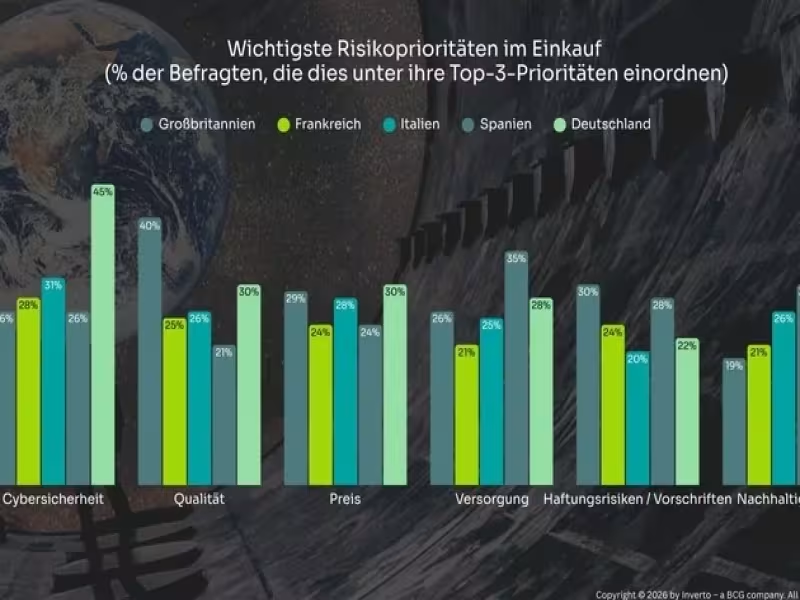
Cologne – November 09, 2026 -- No single risk dominates European procurement anymore: across 18 potential risks, each was named by only 14% to 21% of respondents in Inverto's Risk & Resilience Study 2026, the first year without a clear leader.
Inverto, the procurement and supply chain consulting subsidiary of Boston Consulting Group (BCG), surveyed more than 400 executives across Europe. The firm has polled managers from various industries regularly since 2010. A new whitepaper builds on the spring study and sets out responses to the overlapping risks.
Supplier failures, tariffs and cyber threats now rank as equals
Respondents see a broad set of comparable threats, including supplier failures, geopolitical tensions, trade tariffs, cybersecurity and price volatility. Inverto concludes that companies can no longer manage risks one by one and must steer a system of interdependencies.
Shortages hit 83% of surveyed companies
83% of respondents report ongoing supply shortages, a marked increase on prior years. They cite supplier capacity limits, logistics problems, insolvencies and persistent geopolitical conflicts as causes.
Visibility remains a weak point. Only a minority of companies know their full supply chain beyond direct suppliers. Patrick Lepperhoff, Managing Director at Inverto, argues that firms spotting vulnerabilities early can act before productivity and delivery capability suffer.
46% consolidate suppliers while a third turn to nearshoring or reshoring
Since the start of the Covid pandemic, companies have kept redesigning their supply chains. 46% of surveyed firms are consolidating their supplier base, and roughly one-third are pursuing nearshoring or reshoring strategies. Resilience is gaining weight in network design, while cost optimization is no longer the top objective.
Lepperhoff says many companies are now deciding how much extra resilience is worth to them and how much they will pay for it.
89% use digital risk tools, but mostly reactively
89% of companies deploy digital tools in risk management, and 67% use them extensively. Most, however, use the resulting data reactively. Lepperhoff calls for a shift to proactive risk management that uses data and AI to anticipate crises, so companies can keep delivering when competitors cannot.