Pharmaceuticals

Obesity Deal Surge, FDA Turbulence and CTAD Breakthroughs Reshape 2026 Biopharma Strategy

Image
Obesity Deal Surge, FDA Turbulence and CTAD Breakthroughs Reshape 2026 Biopharma Strategy

SHERIDAN, WYOMING - December 11, 2025 - A new convergence of obesity dealmaking, regulatory uncertainty at the U.S. Food and Drug Administration (FDA) and fresh neurology data out of the Clinical Trials on Alzheimer's Disease (CTAD) conference is forcing biopharma executives to recalibrate their 2026 playbooks across R&D, partnering and risk management.

Obesity Dealflow Enters a More Competitive, High-Stakes Phase

Pfizer continues to double down on cardiometabolic disease, following its $10 billion acquisition of obesity startup Metsera with an exclusive collaboration to license YaoPharma's oral GLP-1 receptor agonist YP05002. Together with other emerging oral and peptide GLP-1s, this next wave of assets is pushing obesity beyond a single-product, single-modality market and into a diversified, highly competitive landscape.

Pfizer Deepens Cardiometabolic Push with Global YaoPharma Deal for Oral GLP-1 Candidate

Image
Pfizer Deepens Cardiometabolic Push with Global YaoPharma Deal for Oral GLP-1 Candidate

SHERIDAN, WYOMING - December 10, 2025 - Pfizer Inc. is expanding its cardiometabolic ambitions through an exclusive global collaboration and license agreement with YaoPharma, a subsidiary of Shanghai Fosun Pharmaceutical, to develop, manufacture and commercialize YP05002, an oral GLP-1 receptor agonist currently in Phase 1 for chronic weight management. The deal strengthens Pfizer's position in the fast-moving obesity field and adds a differentiated small-molecule asset to its portfolio of metabolic disease candidates.

Strategic Bet on Small-Molecule GLP-1 in Obesity

Under the agreement, China-based YaoPharma will complete an ongoing Phase 1 study of YP05002 before transferring global development and commercialization rights to Pfizer. For Pfizer, the asset fits neatly into a strategy that aims to pair novel mechanisms with scalable, oral delivery formats for obesity and adjacent cardiometabolic conditions.

Pfizer Schedules Analyst Webcast to Outline Full-Year 2026 Financial Guidance

Image
Pfizer Schedules Analyst Webcast to Outline Full-Year 2026 Financial Guidance

SHERIDAN, WYOMING - December 10, 2025 - Pfizer Inc. is setting the stage for its next financial chapter with an analyst conference call and webcast on December 16, 2025, where the U.S.-based biopharmaceutical leader will present full-year 2026 financial guidance to investors and the broader market. The event underscores how large pharma companies use structured guidance cycles to frame expectations around revenue, R&D investment, pipeline execution and capital allocation.

Anchoring Investor Expectations with 2026 Guidance

Pfizer will host the live call with investment analysts at 8:00 a.m. EST on Tuesday, December 16, 2025, with a simultaneous webcast for global stakeholders. The primary objective is to provide formal full-year 2026 financial guidance, giving clarity on topline trends, margin expectations, R&D spending and the company's capital deployment priorities.

FDA Clinical Hold on Denali's Brain-Penetrant Pompe Therapy Highlights First-in-Human Safety Scrutiny

Image
FDA Clinical Hold on Denali’s Brain-Penetrant Pompe Therapy Highlights First-in-Human Safety Scrutiny

SHERIDAN, WYOMING - December 8, 2025 - Denali Therapeutics is facing another regulatory setback after the U.S. Food and Drug Administration (FDA) placed a clinical hold on DNL952, its enzyme replacement candidate for Pompe disease, citing preclinical hypersensitivity signals and demanding protocol changes before the company can start Phase I studies.

FDA Flags Hypersensitivity Risk Before First Human Dosing

The clinical hold, disclosed in an SEC filing, stems from "hypersensitivity reactions" observed in mouse models. While the agency has not required additional non-clinical studies, it is insisting on a more conservative first-in-human plan. Denali has been asked to lower the proposed starting dose for DNL952 and implement "revised inclusion criteria, adjusted stopping rules and unspecified safety monitoring commitments" before the program can proceed.

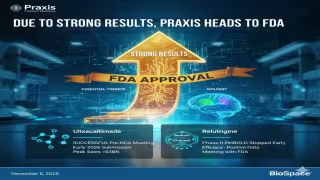
Praxis Scores Phase II Win in Rare Epilepsies as Ulixacaltamide Tracks Toward 2026 FDA Filing

Image
Praxis Scores Phase II Win in Rare Epilepsies as Ulixacaltamide Tracks Toward 2026 FDA Filing

SHERIDAN, WYOMING - December 8, 2025 - Praxis Precision Medicines has doubled down on its neurology strategy with back-to-back updates: a Phase II win for its sodium current blocker relutrigine in rare developmental and epileptic encephalopathies (DEE) and a "successful" pre-NDA meeting for its essential tremor candidate ulixacaltamide, positioning the Boston biotech as a potential new commercial player in both ultra-rare epilepsy and movement disorders.

Relutrigine Study Stopped Early for Efficacy in DEE

Praxis has halted its mid-stage EMBOLD trial of relutrigine early, after an independent data monitoring board recommended the study "stop the study early for efficacy." The Phase II EMBOLD study is evaluating relutrigine in patients with DEE linked to SCN8A and SCN2A mutations, a small but highly underserved genetic epilepsy population with limited therapeutic options and high unmet medical need.

Eisai Doubles Down on Tau as Alzheimer's R&D Broadens Beyond Amyloid

Image
Eisai Doubles Down on Tau as Alzheimer’s R&D Broadens Beyond Amyloid

SHERIDAN, WYOMING - December 8, 2025 - Days after Johnson & Johnson reported a mid-stage failure for its anti-tau antibody posdinemab, Eisai is using the Clinical Trials on Alzheimer's Disease (CTAD) 2025 conference to argue that tau is still a viable target-if drug designers hit the right part of the protein-while investors and scientists pivot their attention to inflammation and vascular pathways.

Anti-tau Setbacks Raise the Bar for New Entrants

Tau-directed drugs have been among the most high-profile disappointments in Alzheimer's disease (AD) R&D. J&J's recent miss with posdinemab follows last year's Phase II failure of UCB's bepranemab and Eli Lilly's inability to replicate its amyloid success with the anti-tau candidate LY3372689. Collectively, these readouts have fed a narrative that tau may be an intractable or poorly understood target for disease modification.

Roche's Oral SERD Giredestrant Sets New Benchmark in Early ER-Positive Breast Cancer

Image
Roche’s Oral SERD Giredestrant Sets New Benchmark in Early ER-Positive Breast Cancer

SHERIDAN, WYOMING - December 2, 2025 - Roche has reported landmark Phase III results for its oral selective estrogen receptor degrader (SERD) giredestrant, positioning the candidate as a potential new standard of care in early-stage ER-positive, HER2-negative breast cancer after a pivotal trial showed superior invasive disease-free survival versus standard endocrine therapy.

First oral SERD to show superior invasive disease-free survival

The Phase III lidERA Breast Cancer study evaluated adjuvant giredestrant against standard-of-care endocrine monotherapy in more than 4,100 patients with medium- or high-risk stage I-III ER-positive, HER2-negative early breast cancer. At a pre-planned interim analysis, the trial met its primary endpoint: giredestrant delivered a statistically significant and clinically meaningful improvement in invasive disease-free survival compared with standard endocrine therapy.

Pfizer's Metsera Acquisition Signals Policy-Aligned Bet on Next-Generation Obesity Therapies

Image
Correct taxonomy (Industry, Theme, Market)

SHERIDAN, WYOMING - November 13, 2025 - Pfizer has completed its $7 billion acquisition of Metsera, securing a set of differentiated obesity and cardiometabolic candidates as regulatory momentum accelerates around metabolic disease innovation in the United States. The deal positions Pfizer at the center of one of the most politically scrutinized and fastest-growing therapeutic markets, as federal leaders push for expanded access and a stronger domestic pipeline in obesity care.

Pharma's DTC Discount Wave Targets Select Drug Classes - But Real Market Impact Remains Uneven

Image
Pharma's DTC Discount Wave Targets Select Drug Classes - But Real Market Impact Remains Uneven

SHERIDAN, WYOMING - November 13, 2025 - As the TrumpRx platform approaches launch in early 2026, U.S. drugmakers are rolling out targeted direct-to-consumer pricing for a carefully chosen mix of dermatology, respiratory, cardiovascular, immunology, and metabolic products. While the discounts generate attention, analysts say their commercial impact varies sharply by drug class, revenue cycle, and therapeutic demand-revealing a strategic pattern rather than a broad affordability shift.

Discounting Patterns Reveal Manufacturers' Portfolio Priorities
Pfizer, AstraZeneca, Amgen, Bristol Myers Squibb, Novo Nordisk, and Lilly have each chosen different subsets of products for deep DTC price cuts. Across these offerings, a clear pattern emerges: brands with declining growth, approaching patent expirations, or limited payer friction are overrepresented.

Drugmakers Accelerate Direct-to-Consumer Pricing as TrumpRx Looms, But Market Impact May Be Limited

Image
Pharma Pressures Mount as TrumpRx and DTC Drug Pricing Models Face Economic and Policy Scrutiny

SHERIDAN, WYOMING - November 13, 2025 - Major pharmaceutical companies are rapidly rolling out direct-to-consumer (DTC) pricing programs ahead of the federal TrumpRx platform's debut in early 2026, signaling a shift in commercial strategy as manufacturers seek to bypass traditional intermediaries and regain control of how patients access branded therapies. Yet analysts warn that these channels-despite deep headline discounts-may offer only marginal financial relief to most patients and are unlikely to dent overall U.S. drug spending.