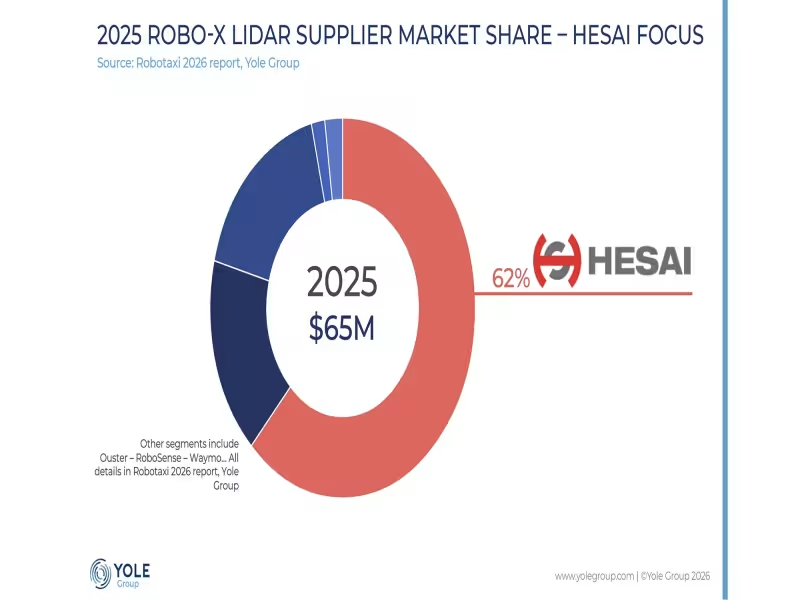
Palo Alto – October 29, 2026 -- Hesai Group held a 62% share of the global robotaxi lidar market in 2025, more than all other suppliers combined, according to Yole Group's Robotaxi 2026 report. The figure is up from the 61% Yole attributed to the Nasdaq- and HKEX-listed company in its previous report.
Yole projects robotaxi fleet growth from 10,000 to 331,000 vehicles by 2031
Yole Group expects the global robotaxi fleet to expand from approximately 10,000 vehicles in 2025 to 331,000 in 2031. Operators scaling at that pace will need lidar that delivers precise perception in complex environments, automotive-grade quality and reliable supply at volume, the report says.
Hesai lidar is selected by seven Level 4 programs including Baidu Apollo Go and Pony.ai
Per Yole, Hesai's sensors have been chosen for leading Level 4 robotaxi and autonomous vehicle programs at Baidu Apollo Go, Pony.ai, WeRide, DiDi, Motional, Aurora and KargoBot. Hesai says this spread shows adoption across multiple platforms and operating environments, rather than dependence on one customer or program.
CEO Yifan "David" Li said the shift toward scaled deployment "raises the bar for every component on the vehicle."
Upgraded ETX lidar reaches 4,320 channels and 600-meter range, now in customer validation
Hesai is developing a next-generation version of ETX, its flagship lidar platform for Level 3 and higher autonomous driving. The unit runs on the company's proprietary Picasso SPAD-SoC, which combines RGB sensing and time-of-flight ranging at the chip level. It captures both geometry and color in a precisely aligned point cloud.
Configurations reach up to 4,320 channels and a maximum detection range of up to 600 meters. The Picasso-equipped ETX is in customer validation and has advanced to RFI and RFQ discussions with leading robotaxi operators and global automakers.
Hesai passes 3.5 million cumulative lidar deliveries and builds Bangkok plant for 2027 start
As of June 2026, Hesai's cumulative lidar deliveries exceeded 3.5 million units. Its in-house production lines run 100% automation across core processes and roll out one lidar unit every 8 seconds.
The company is also building a new manufacturing facility in Bangkok, Thailand, which is expected to begin production in 2027.