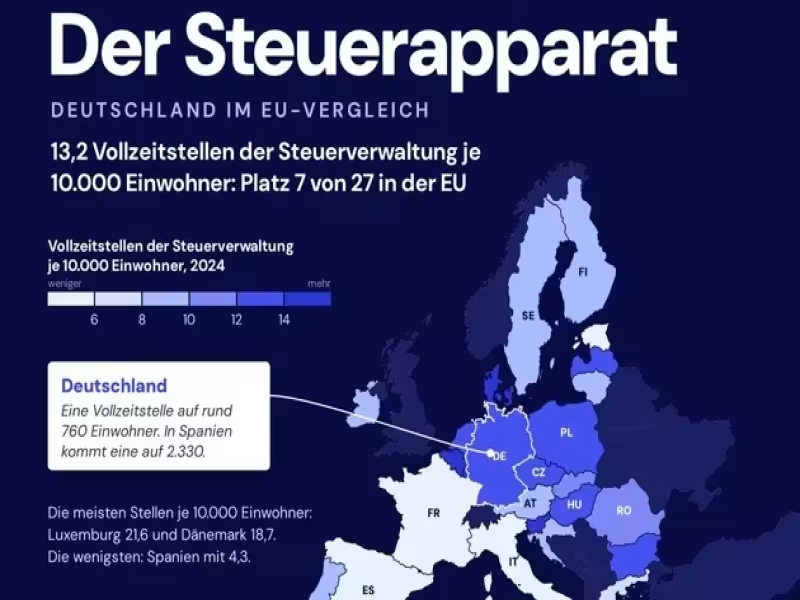
Berlin – October 28, 2026 -- Germany's tax administration employs 13.2 full-time staff per 10,000 residents, against an EU average of 9.3, yet its local tax offices left 6,869 positions unfilled in 2024. The figures come from a joint analysis of all 27 EU states by accounting software provider BuchhaltungsButler and data studio DataPulse Research.
Germany ranks seventh in the EU for tax staff per resident
EU tax administrations counted 416,274 full-time positions in 2024, of which 110,024 were in Germany. Per 10,000 inhabitants, the range runs from 4.3 in Spain to 21.6 in Luxembourg. Germany has one full-time post per roughly 760 residents; Italy has one per 1,850 and Spain one per 2,330.
Four of the six countries ahead of Germany also collect social security contributions through their tax authorities. Among the 14 administrations that do not, Germany ranks third behind Luxembourg and Belgium. In Germany, health insurers collect these contributions.
German tax offices lost 3.5% of staff while budgeted posts rose
Budgeted positions in the tax offices rose from 109,060 in 2017 to 110,752 in 2023. Actual staffing fell 3.5% between 2014 and 2025, to 96,736 full-time equivalents. Vacancies reached 6,869 in 2024, up from 6,828 a year earlier. These figures cover only the tax offices, a part of the administration included in the EU comparison.
Operating costs reach EUR 10.7 billion, or EUR 128 per resident
Germany spent EUR 10.7 billion on running its tax administration in 2024, the fourth-highest per-capita figure in the EU. France spent EUR 64 per resident and Spain EUR 28.
Relative to revenue, Germany spends EUR 1.2 per EUR 100 of tax collected, third among 27 states behind Poland and Slovakia. The EU median is EUR 0.7. Germany's ratio has stayed between EUR 1.2 and EUR 1.4 every year since 2018. The authors caution that the comparison is limited: excise taxes collected by customs are missing from the revenue reported for Germany, and including them would lower the ratio.
Private tax advisory sector grew 28% since 2014, outpacing overall employment
Germany had 464,000 people working in tax advisory, bookkeeping and auditing in 2023, more than any other EU country. Their workload equaled about 397,000 full-time positions, which places the sector 11th of 27 per resident. Employees subject to social security contributions in the sector rose 28% between 2014 and 2025, while total German employment of that type grew 16%.
Study data covers staffing and cost, not efficiency
The analysis draws on ISORA survey data for 2024, excluding pure customs offices, and on Eurostat business statistics for 2023. It also uses German federal government responses to parliamentary inquiries and data from the Federal Employment Agency. The authors state that the results show administration size and operating cost, not how efficiently the authorities work. Thirteen of the 27 administrations also collect social security contributions, which limits direct country comparisons.
For small businesses, the study identifies e-invoicing as a starting point for digital bookkeeping, since structured invoice data can be read automatically and passed on to accounting.