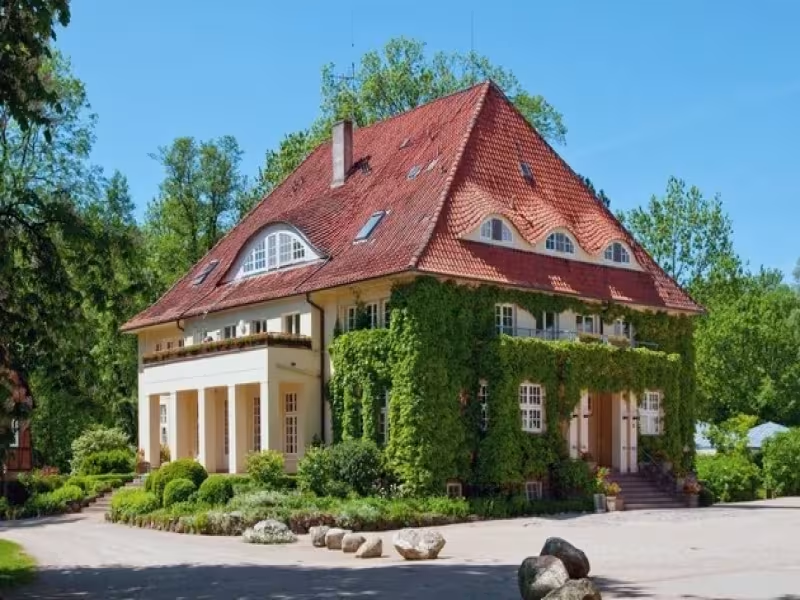
Dahlem-Marienau – September 12, 2026 -- One in four 15-year-olds in Germany now fails to meet basic science competency standards, according to the newly released PISA 2026 study, which recorded the country's worst results since the assessment began. In response, private boarding school Schule Marienau in Lower Saxony is investing roughly €800,000 in a new STEM facility designed to reverse the decline in scientific literacy among students.
PISA 2026 data show only 10% of German students rank as high performers in science
The study found science performance at an all-time low nationally, with the top-performing segment stagnant while the broader student base loses ground. Marienau's leadership frames the results as a structural problem rather than statistical noise, arguing that schools have shifted too far from applied, problem-solving education toward rote knowledge transfer.
Marienau commits €800,000 to build combined Open-Lab, AI lab and MakerSpace
The project, called "Naturwissenschaftliches Zentrum+," merges biology, physics and chemistry into a single interdisciplinary Open-Lab space. A new MakerSpace will add an AI lab, 3D printing, robotics and video production facilities. School and boarding director Lars Humrich said education must prioritize collaborative, problem-solving skills over pure knowledge acquisition, given the pace of globalization and digitalization. Several alumni are financially backing the investment.
Student Makhir Yaman, 19, placed among Lower Saxony's top ten in the Chemistry Olympiad
Yaman, a four-year Marienau student, credited the school's PhD-qualified teaching staff and individualized support for his competition result, saying the academic level remains high while no student is left behind.
1KOMMA5° co-founder Philipp Schröder, a 2,500-employee cleantech firm's CEO, attended Marienau from 1994 to 2003
Schröder, whose company operates in photovoltaics, battery storage, heat pumps and wallboxes, said the school's focus on personal development and accepting difference shaped his entrepreneurial foundation.
Former Merck chairman Prof. Dr. Frank Stangenberg-Haverkamp says Germany's PISA decline reflects poor preparation, not lower intelligence
Stangenberg-Haverkamp, who spent four decades at pharmaceutical and chemical group Merck, including ten years leading the company, said students are trained to recall knowledge but not to apply, question or independently extend it. He argued that decision-making roles increasingly require generalist scientific understanding alongside specialist expertise, calling Marienau's new center a response to that gap rather than a luxury investment.
Marienau operates as a UNESCO Project School and is scheduled to mark its 100th anniversary in the 2028/2029 academic year.