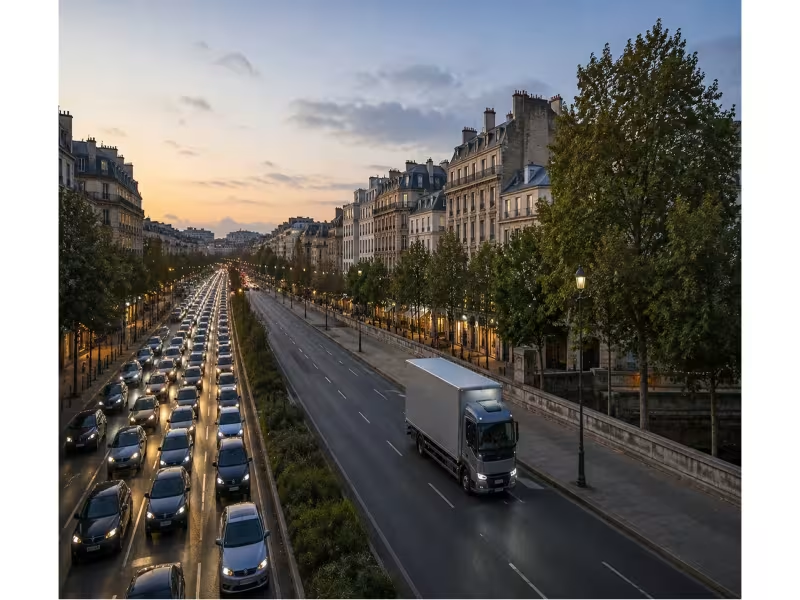
Aachen – September 12, 2026 -- Trucks navigate Berlin's roads more efficiently than passenger cars, scoring 71 points versus 55 on Geotab's new Freight Efficiency Index for European Cities, a 16-point gap that ranks among the largest recorded across the continent.
The connected-vehicle solutions provider analyzed full-year 2025 data from Geotab-connected fleets in Berlin, Amsterdam, Dublin, Rome, Paris, London and Madrid, scoring truck and car traffic flow separately on a 0-100 scale. The findings challenge the assumption that commercial trucks are the primary drag on urban traffic: in five of the seven capitals studied, trucks moved more efficiently than cars.
Rome leads truck efficiency gap at 26 points, Berlin follows at 16
Rome recorded the largest efficiency advantage for trucks over cars at 26 points, with Berlin second at 16 points. Dublin and Amsterdam also showed double-digit truck advantages. Paris trucks stayed ahead of cars, 46 points versus 31, despite posting the highest idling rate of any city in the study at 18.2%.
Berlin's polycentric road network limits peak-hour traffic spikes
Berlin's truck score of 71 is the highest among the seven cities analyzed. Geotab attributes the gap to the city's sprawling road infrastructure and polycentric layout, which spreads traffic across multiple hubs rather than concentrating it in a single center, reducing sharp peak-hour congestion. Travel-time reliability in Berlin ranged narrowly between 95 and 100 points, giving fleet operators predictable scheduling based on historical data. Truck idling accounted for 8.5% of total fuel consumption in Berlin, compared with 13.2% for cars.
London and Madrid buck the trend as cars outperform trucks
London and Madrid were the only cities where cars scored higher than trucks. In London, cars scored 29 points against 27 for trucks, with Geotab pointing to bus-lane restrictions inaccessible to trucks, narrower inner-city streets, low-emission zones and complex loading/unloading rules that push deliveries into unfavorable time windows. London trucks also recorded the highest fuel consumption of any city studied, at 36.75 liters per 100 kilometers, with an idling rate of 11.1% versus 13.6% for cars. Madrid's truck disadvantage was linked instead to particularly difficult and unpredictable traffic conditions.
Fleet routing and scheduling drive efficiency gains, Geotab says
Geotab's index weights each city's overall score 60% for cars and 40% for trucks, reflecting cars' larger share of traffic volume. Fabian Seithel, AVP EMEA at Geotab, said the data does not support the assumption that trucks are the main cause of inefficient urban traffic, crediting structured route planning, better scheduling and data-driven decisions for professional fleets outperforming general car traffic in most cities studied.
Where trucks underperform, the report notes the cause is not necessarily fleet management itself but structural factors including road infrastructure, traffic regulation and the distribution of delivery time windows.