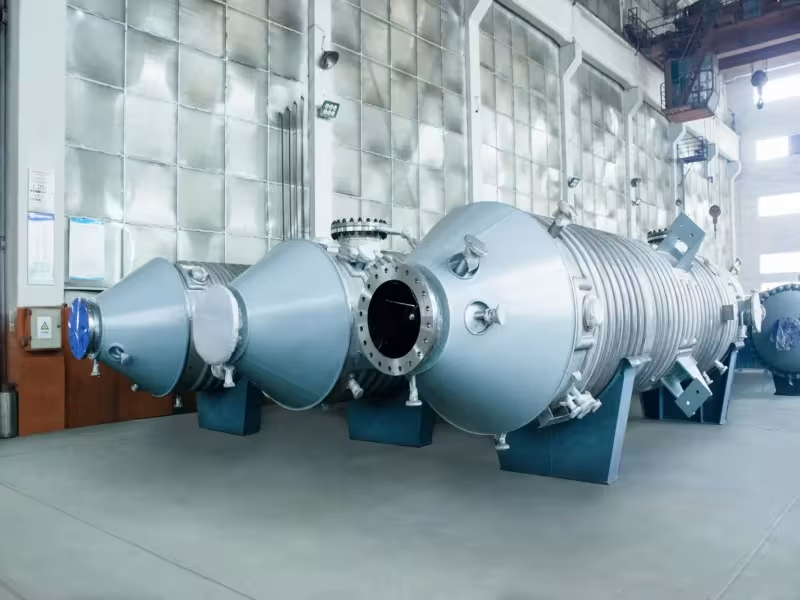
SHANGHAI – October 29, 2026 -- DODGEN supplied devolatilization technology to three Chinese polyolefin elastomer (POE) projects in 2026. Two plants, at CNPC Daqing Petrochemical and Xingchuan New Materials, have started up on the first attempt, and a third customer, Shaanxi Yuneng, has signed a supply contract.
Daqing Petrochemical produced on-specification POE three days after completing its process flow
CNPC Daqing Petrochemical's 30,000-tonne-per-year industrial demonstration plant completed its full process flow on September 23. It produced on-specification product on September 26. DODGEN engineered and supplied proprietary core equipment for the plant's devolatilization section.
Xingchuan's 10,000-tonne-scale H-POE line ran first-attempt start-up on DSXL platform
Xingchuan New Materials' hyperbranched POE (H-POE) plant produced its first on-specification products on September 12, according to the company's official announcement. DODGEN supplied the complete process solution for the polymer devolatilization unit, built on its DSXL platform.
Shaanxi Yuneng signed on May 21 for devolatilizer system at planned 100,000-tonne POE unit
Shaanxi Yuneng Energy and Chemical New Materials Co., Ltd., a wholly owned subsidiary of Yulin Energy Group, contracted DODGEN to supply the devolatilizer system. The system is designed to remove heptane solvent, ethylene and other volatile impurities. The 100,000-tonne-per-year POE unit is part of Phase I of the customer's epoxy-resin integration project in the Shenmu High-Tech Industrial Development Zone. DODGEN described this as a contract milestone only; operating progress will be reported separately.
Devolatilization determines residual levels, pelletizing stability and energy use
After solution polymerization, polymer solutions or melts still contain solvents, unreacted monomers and other volatile components. Removing them to product-specific limits requires managing high viscosity, heat-transfer limits, narrow temperature windows and continuous operation. DODGEN says devolatilization directly affects molecular-structure preservation, batch consistency and energy consumption.
The DSXL platform combines heat transfer for viscous fluids, static mixing, uniform melt distribution, and single- or multi-stage flash and vacuum devolatilization. Evaluation factors include feed rheology, residual limits and test methods, and capacity and operating flexibility. The system boundary, covering vacuum, condensation, solvent recovery, melt discharge and pelletizing, is also assessed.