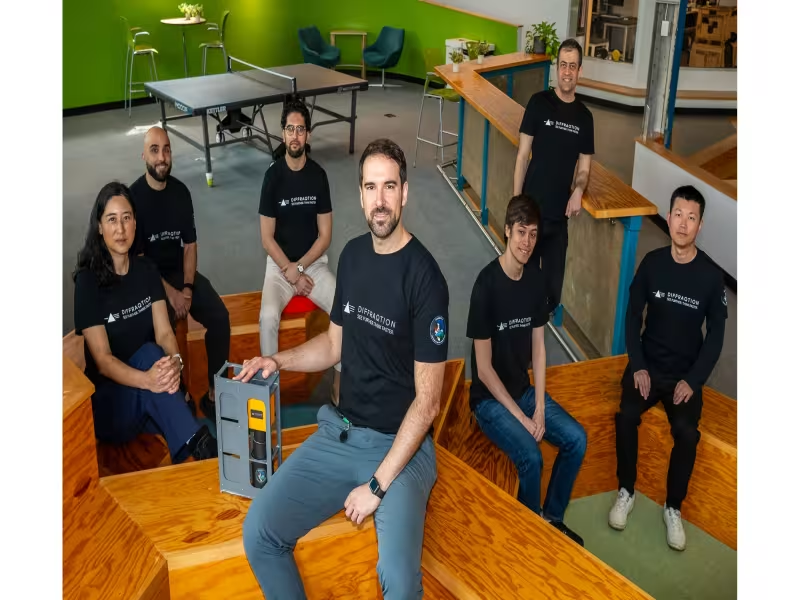
SOMERVILLE, Mass. -- September 01, 2026 -- Diffraqtion capped its pre-seed funding round at more than $10 million after Lockheed Martin Ventures and Presidio Ventures, the venture arm of Sumitomo Corporation, joined as strategic investors, the MIT and University of Maryland spinout announced Aug. 31, 2026. The Somerville, Massachusetts-based company builds quantum camera platforms for defense and space sensing. The new capital follows on-sky demonstrations, progress under a DARPA SBIR program, and two NASA awards covering orbital debris tracking and orbital edge computing.
Diffraqtion's pre-seed round drew six prior investors before the cap.
The round, first closed in January 2026 under lead investor Ground State Ventures, also includes SBI US Gateway Fund with Plug and Play, Collaborative Fund and TekVentures, plus follow-on money from existing backers Aether VC, milemark•capital and ADIN. Diffraqtion elected to close the round following what it described as strong investor interest after seven months of technical progress.
DARPA and NASA milestones preceded the strategic investment.
In the seven months since the January close, Diffraqtion completed on-sky demonstrations at a partner observatory, distinguishing closely spaced objects in orbit. Its DARPA Direct-to-Phase-II SBIR contract advanced into a second option period. NASA separately selected the company for an SBIR Phase I award in orbital debris tracking and named Diffraqtion winner of its $100,000 Space to Soil Challenge for adaptive sensing and onboard processing.
The cameras sort light by shape rather than brightness to beat the diffraction limit.
Diffraqtion's quantum cameras resolve detail below the diffraction limit, the resolution ceiling that a lens aperture imposes on conventional optical systems. By sorting incoming light according to shape rather than brightness, the cameras capture information standard sensors discard, cutting the aperture size and computing power needed to classify distant objects. Company simulations show the method resolving features up to 20 times smaller than conventional optics and classifying targets orders of magnitude faster through onboard processing. The approach is passive and relies on quantum estimation theory rather than quantum computing, requiring no qubits or cryogenic cooling.
Peter Kazlas will lead engineering for the first fielded camera.
Diffraqtion named Peter Kazlas Head of Engineering to lead development of its first fielded camera, which the company plans to fly as a hosted payload on a partner spacecraft. Kazlas has 25 years of experience moving novel optics from lab bench to volume production, including roles at E Ink and QD Vision, a company later acquired by Samsung.
Johannes Galatsanos, CEO and co-founder of Diffraqtion, said the technology delivers "better mission capability at a fraction of the aperture, size, and cost" compared with conventional camera systems built around larger optics.
Lockheed Martin Ventures and Presidio Ventures cite both military and commercial uses.
Chris Moran, vice president and general manager of Lockheed Martin Ventures, said the firm invests in technologies that can shape future mission capabilities, pointing to Diffraqtion's progress from laboratory development toward flight demonstration. Ross Leav, senior vice president at Presidio Ventures, said the same physics advantage applies whether the camera observes the sky, the earth or guides a physical system, adding that Sumitomo Corporation's venture arm sees opportunity to bring the capability to industrial and commercial markets globally.